
Mnemonic for caries activity test



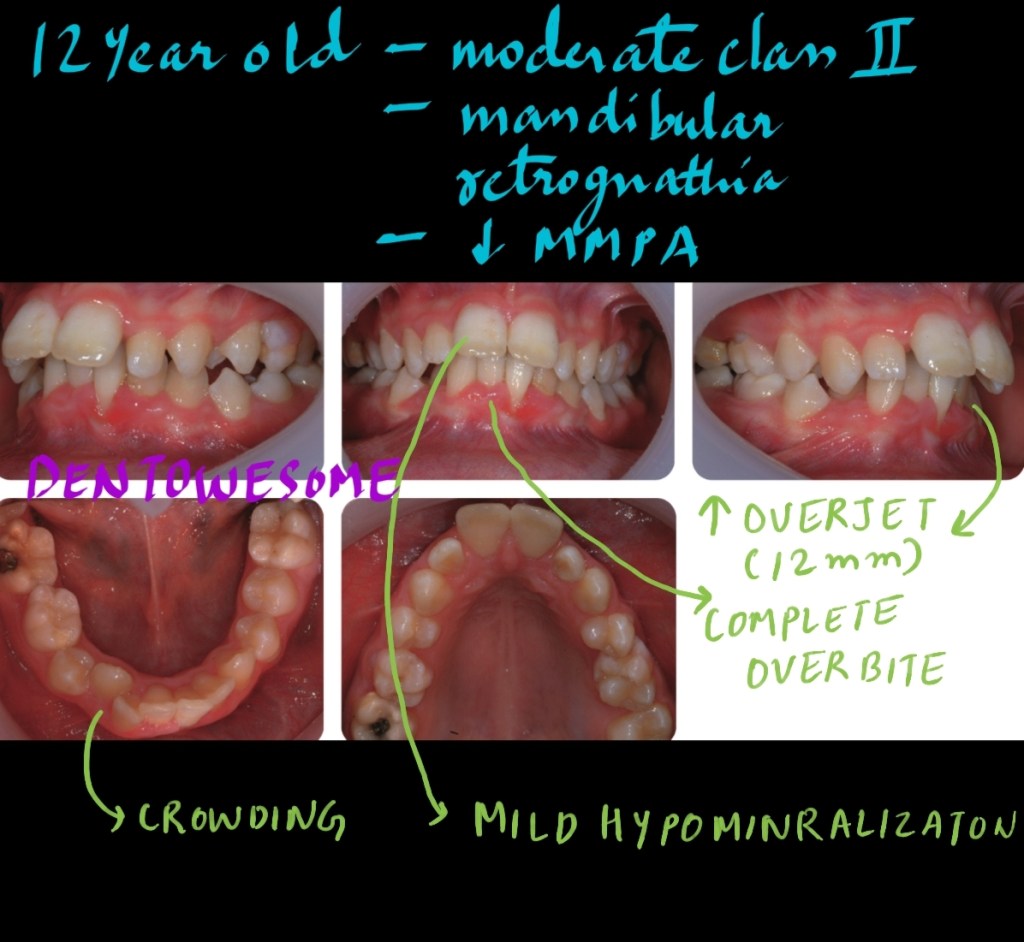
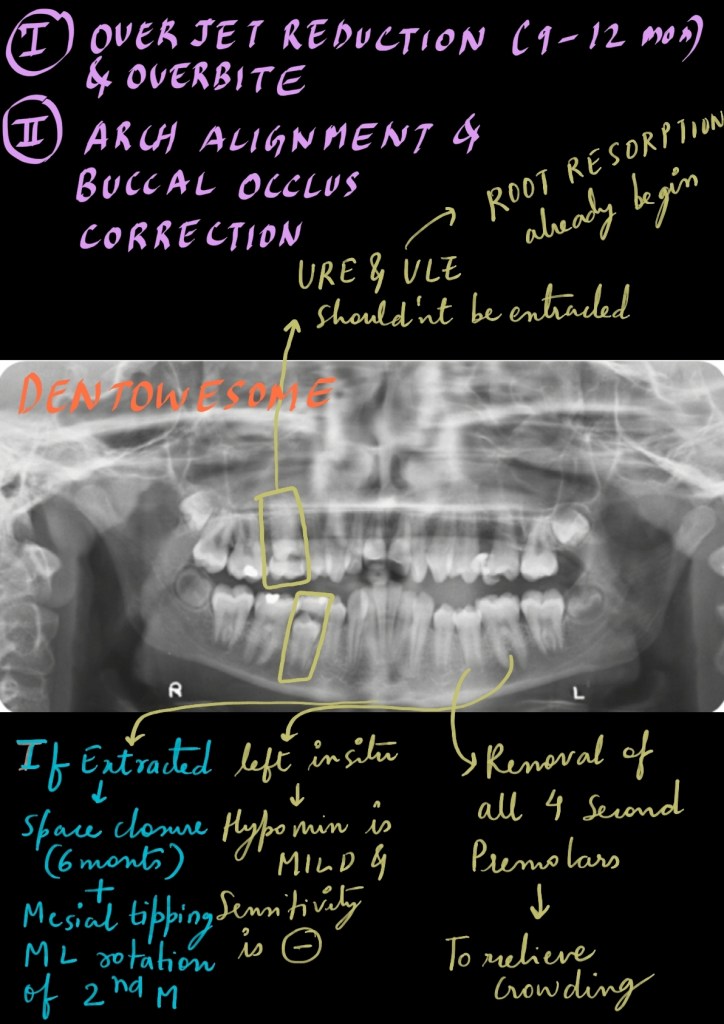
A 12-year-old female in the late mixed dentition with a class II division 1 incisor relationship on a moderate skeletal class II pattern with reduced MMPA. The malocclusion is complicated by:
• Increased overjet (12mm)
• Increased and complete overbite
• Crowding of both arches
• Mild molar–incisor hypomineralization.
Is removal of the URE, ULE and LRE indicated at this point? How would you treat this malocclusion? What are the potential orthodontic problems associated with removal of the first permanent molars? What prescription should be used during the fixed appliance phase?
I have tried my best to explain the case in the following images! Happy reading
LINK TO PDF: https://drive.google.com/file/d/1TY0almamDToyQtMMbyZ4jZxfYRMZADOk/view?usp=sharing


It can be simpliflied into 3 popularly known as JACKSON’S TRIAD
FUNCTIONAL EFFICIENCY
STRUCTURAL BALANCE
AESTHETIC HARMONY
The orthodontist should try to fulfill this Jackson’s triad by his/her treatment.
FUNCTIONAL EFFICIENCY : Firstly the orthodontist must try to improve the function of the oro-facial apparatus .
Many malocclusions affect the function of the stomatognathic system
STRUCTURAL BALANCE : The oro-facial region has 3 systems .
Stable best orthodontic treatment is achieved by maintaining balance between the 3 given below :

AESTHETIC HARMONY :

Article Reference taken from S.I.BHALAJHI , 7th Edition
Functions of tongue : deglutition, taste sensation, speech, mastication
●Tongue is mainly supplied by lingual artery branch of external carotid artery, tonsilar branch of facial artery and Ascending pharyngeal artery branch of external carotid artery
● Venous drainage : dorsal lingual veins and deep lingual veins
● Sensory supply: lingual nerve supplies anterior 2/3rd of tongue, glossopharngeal nerve supplies posterior 1/3rd of tongue, Vagus nerve supplies posterior most part of tongue
● Motor supply : All extrinsic and intrinsic muscles of the tongue are supplied by hypoglossal nerve except palatoglossus supplied by vagus nerve
● Ankyloglossia (tongue tie) : Occurs due to abnormal length of frenulum that extends to the tip of the tongue . Ankyloglossia can be corrected surgically.
● Fissured tongue: Occurs when small furrows present on dorsal surface of the tongue. They are generally painless and benign and often associated with other syndromes
● Geographic tongue: asymptomatic and benign characterized by presence of red patches with greyish white border covering dorsum of tongue
● An average adult has 2000- 4000 taste buds
● You cannot see your taste buds with naked eye. Those tiny pink and white bumps you see are actually papillae
● Tongue muscles are only muscles in the body working independent of the skeleton
● An oversized tongue is indicative of sleep apnea disorder
● Children sense flavours more intensely compared to adults. Umami is new variant of taste , monosodium glutamate is chemical responsible for this taste
● Women have shorter tongue than men.
● Your tongue is germ free only of its pink. If it is white there is a thin film of bacteria on it
● Blue whale has largest tongue in animal kingdom and weighs 5400lbs
Reference: B.D chaurasia and interesting facts from google

