Class II malocclusion—our beloved troublemaker—comes from either a mandibular deficiency (most common culprit 😬), maxillary excess, or both. And let’s be honest, more often than not, it’s that shy little mandible sitting too far back (McNamara, 1981; McNamara & Ellis, 1988).
So, what do we do? We call in our orthopedic reinforcements! 🎺
Functional jaw orthopedic appliances promise to encourage adaptive skeletal growth by keeping the mandible in a more forward position (a little push in the right direction, you know? 😉). One of the OGs in this game is the Activator(thanks, Andresen!), a widely used functional appliance.
But what if the patient is all ‘vertical overkill’ with excessive lower face height? 🤯
Enter the Activator + High-Pull Headgear Combo!
This tag-team effort helps to:
✔️ Control vertical growth (because we don’t need any more of that! 🚫📏)
✔️ Provide more cumulative skeletal changes than just the activator alone (Teuscher, 1978; Pfeiffer & Grobéty, 1982)
But Does It Actually Work? Or Are We Just Fooling Ourselves? 🤔
That’s where the real debate kicks in. While we know the dentoalveolar effects are solid (Jakobsson, 1967; Pancherz, 1984; Basciftci et al., 2003), the true orthopedic impact remains controversial (Calvert, 1982; Tulloch et al., 1990).
Many studies have compared:
📌 Activator vs. Activator + Headgear (Gögen & Parlar, 1989; Cura et al., 1996)
📌 Both vs. Untreated Class II Kids (very few studies actually do this! 😵)
So, What’s the Plan?
This study sets out to answer the million-dollar questions:
1️⃣ Does the activator (with or without headgear) actually promote mandibular growth?
2️⃣ Is one appliance better than the other?
3️⃣ Are the observed changes due to treatment… or just good ol’ natural growth?
📌 Materials & Methods (A.K.A. How We Did the Magic!)
| Category | Details |
|---|---|
| Subjects 🧑⚕️ | 49 Skeletal Class II Division 1 patients |
| Time Period ⏳ | Treated between 2001-2003 at Süleyman Demirel University |
| Inclusion Criteria ✅ | No prior ortho treatment, cooperative, treated with either activator or activator-headgear combo, no fixed appliances |
| Exclusion Criteria ❌ | One patient was excluded due to “uncooperative behavior” (aka, rebel without a retainer! 😅) |
| Study Groups 👥 | – Activator Group: 33 patients (13 females, 20 males) treated with Andresen Activator – Activator + Headgear Group: 16 patients (7 females, 9 males) treated with both appliances – Control Group: 20 patients (9 females, 11 males) who rejected treatment (yes, we tracked them down! 🕵️♂️) |
| Cephalometric Analysis 📏 | Standardized lateral cephalograms taken before (T0) & after (T1) treatment |
| Ceph Analysis Software 💻 | Vistadent™ AT (GAC International, New York, USA) |
| Measurement Reliability 🔬 | All measurements repeated 2 weeks later; error rate ≤ 0.994 for all parameters (that’s some solid consistency! 💯) |
| Statistics 📊 | – Paired t-test: Checked treatment effects within groups – ANOVA & Tukey Test: Compared changes between groups – SPSS 11.0.0 was our stats weapon of choice! 🔢 |
🛠️ Appliance Breakdown: What Were These Kids Wearing?
| Appliance | Features | Treatment Protocol |
|---|---|---|
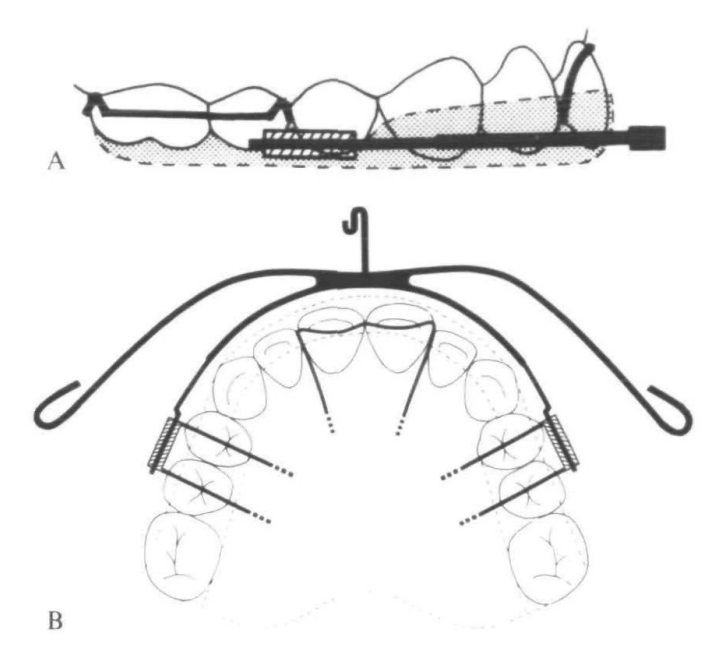
| Activator (Andresen) 🤓 | – Bimaxillary acrylic block – Upper labial bow (0.7 mm) – Adams’ clasps on maxillary molars – Lower incisors capped to avoid labial tipping 🚫 | – Mandible positioned edge-to-edge in bite registration – 5-7 mm interocclusal space increase – Used in two-step activation for large overjets |
| Activator + High-Pull Headgear 🦸♂️ | – Same activator as above but with headgear tubes in premolar area – High-pull force (~300-400 g per side) 🎯 | – Controlled vertical growth (because we don’t want them growing UP instead of FORWARD! 😆) – Worn 16+ hours per day for best results |
🤨 But What About the Control Group?
These were 20 patients who refused treatment (seriously, why? 😵). They were observed over the same period as the treated groups to see how much of Class II correction was due to natural growth vs. actual treatment effects.
The Class II Showdown: Activator vs. Activator + Headgear – Who Wins? 🦷🥊
Alright, ortho warriors! We’ve set the stage, picked our players, and now it’s time to see the results. Which appliance reigned supreme in the battle of mandibular advancement, incisor control, and overjet reduction? 🤔
Let’s break it down—but with zero headache and maximum clarity (plus a few laughs)! 😆
📌 Results in a Nutshell: Who Changed the Most?
Key takeaways before we dive into numbers:
🔹 Both appliances worked well in correcting Class II malocclusion.
🔹 The control group? Well… they mostly just grew naturally. 🥱
🔹 Mandibular growth happened in both treatment groups, but HOW it happened differed!
👀 Intragroup Changes (Within Each Group!)
| Parameter | Activator Group 🏆 | Activator + Headgear 💪🎯 | Control Group 🤷♂️ |
|---|---|---|---|
| SNA (Maxilla position) 📐 | No significant change | Decreased significantly 😏 | No significant change |
| SNB (Mandible position)📏 | Increased 🎉 | Increased 🎉 | Slight increase (not significant) |
| ANB (Class II severity)❌ | Reduced → meaning less Class II! | Reduced → same result! | Minimal reduction (not significant) |
| Mandibular Length (Co-Gn) 📏 | Increased significantly | Increased significantly | Increased (but less than the treated groups) |
| Ramus Height (Co-Go)📈 | Increased significantly | Increased even more! 🚀 | Slight increase |
| Upper Incisor Retraction🦷⬅️ | Yes | More than activator group! | Minimal |
| Lower Incisor Advancement 🦷➡️ | Greater than headgear group! | Yes (but less than activator group) | Minimal |
| Overjet Reduction 🔄 | Significant decrease ✅ | Significant decrease ✅ | Not much change… |
| Mandibular Rotation 🔄 | Some opening rotation | More opening rotation of occlusal plane | Anterior rotation of dentition |
| Occlusal Plane Angle 📐 | Increased | Increased even more! | Decreased 🤯 |
| AFH (Anterior Face Height) 📏 | Increased | Increased | Increased (but significantly less) |
| Mandibular Plane Angle📐 | Increased | Increased | Minimal change |
| Lower Lip Position 👄 | Advanced | More advanced than activator alone! | Minimal change |
🧐 Intergroup Comparisons (Between Groups!)
| What’s the Difference? | Activator 🏆 | Activator + Headgear 💪🎯 | Control Group 🤷♂️ |
|---|---|---|---|
| Mandibular Growth | ✅ Significant | ✅ Significant | ⏳ Natural growth (but less) |
| Overjet Reduction | ✅ More than controls | ✅ More than controls | 😐 Minimal |
| Incisor Changes | More lower incisor advancement | More upper incisor retraction | 😴 Minimal |
| Occlusal Plane Angle | 🔼 Increased | 🔼 Increased even more! | 🔽 Decreased! |
| Face Height (AFH) | 🔼 Increased | 🔼 Increased | 💤 Less change |
| Ramus Height Increase | 🤷♂️ Not significant | ✅ Significant increase | 💤 Minimal change |
| Lower Lip Advancement | ✅ Significant | ✅ Even more significant! | 🥱 Meh… |
EFFECTS ON MAXILLA
The activator and activator headgear are both warriors in the battle against Class II malocclusion. But do they really push the maxilla back, or are we just dreaming? Studies say… it’s complicated. Some claim that neither does much (😢), while others insist that the activator headgear combo works like a headgear-in-disguise. 🦸
What Does Science Say? 🧐
| Feature 🏷️ | Activator 🤹♂️ | Activator + Headgear 🎭 |
|---|---|---|
| Does it push the maxilla back? | Maybe, but not dramatically. 🤷♂️ Some studies (Chang, Courtney, Cura, Ruf, Basciftci) say there’s little to no orthopedic effect. | Yes, but don’t expect miracles! 🌟 The headgear-like effect is real (Jakobsson, Pancherz, Vargervik & Harvold), but not game-changing. |
| How much force does it generate? | About 100 g (softer push). 🎈 | Orthopedic-level force (stronger push). 💪 |
| Sagittal restriction of maxillary displacement? | Limited effect. 🚦 | More restriction than activator alone, but the difference is not statistically significant. 📉 |
| Effect on SNA angle? | Slight reduction. 📏 | Greater reduction than activator alone, but the difference is clinically insignificant. 🤏 |
| Long-term potential? | Needs more research! 🧐 | Could be more effective with a longer treatment duration. ⏳ |
So, Who’s the Winner? 🏆
It’s a draw. 😬 While the activator alone doesn’t do much to hold back the maxilla, adding headgear helps a little—but don’t expect a total transformation. If your goal is maxillary restriction, traditional headgear might be a better bet.Final Takeaway: If activator treatment had a slogan, it would be:“I try my best, but don’t expect magic!” 🎩✨For now, if you’re treating a growing Class II patient, use the activator headgear combo if you want a slight maxillary restriction. Just don’t forget compliance—because headgear works only when patients actually wear it! 😅
EFFECTS ON MANDIBLE
The activator has been hailed as a growth stimulator, but the science is… well, mixed. Some studies claim it increases mandibular length in the short term 🏃♂️, but long-term results are still debated. Others argue that no clinically significant growth occurs. 😬
What Does Science Say? 🔬
| Feature 🏷️ | Activator 🤹♂️ | Activator + Headgear 🎭 |
|---|---|---|
| Short-term mandibular length increase? | Yes! 📏 Studies show 2–4 mm per year growth (Harvold, Webster, Ruf, Basciftci). | Yes, same effect as activator alone. 🚀 |
| Long-term mandibular growth? | 🧐 Still not confirmed. Tulloch et al. (1998) say long-term benefits are questionable. 🤷♂️ | Same as activator alone—no extra long-term boost. 🤔 |
| Does it work better than natural growth? | Growth was statistically significant compared to control groups. ✅ | Also statistically significant, but no extra magic compared to activator alone. 📊 |
| Mandibular length increase (Co–Gn)? | About 3 mm during treatment. 🦷 | Same as activator alone. 📈 |
| Who says it works? | Luder, Righellis, Remmer, Jakobsson, Ömblus, Altenburger, Ingervall. 📚 | Same squad! |
| Who says it doesn’t? | Björk, Wieslander, Forsberg, Looi, Nelson. 🚫 | Again, same results as activator alone. 😅 |
So, Who’s the Winner? 🏆
It’s a tie once again! 🏁
- Activator does increase mandibular length in the short term. 📈
- Activator with headgear does the same thing—but not better than activator alone.
- The long-term effects remain debatable, and natural growth might be doing a lot of the work! 🤯
Final Takeaway:
“Yes, the activator helps—at least for a while. But don’t expect it to turn a retrognathic mandible into a jawline fit for Hollywood.” 🎬😂
Effects on the maxillo-mandibular relationship
| Feature 🏷️ | Activator 🤹♂️ | Activator + Headgear 🎭 |
|---|
| ANB Angle Reduction? | Yes! 📉 Multiple studies confirm reduction (Harvold, Gögen, Üner, Öztürk, Cura, Weiland, Lux, Basciftci, Haralabakis). ✅ | Yes, same reduction as activator alone. 📉 |
| Greater ANB improvement? | Cura et al. (1996) found that activator alone was less effective than activator + headgear. 😯 | Some studies suggest slightly better ANB reduction than activator alone, but… |
| Is headgear superior? | NO! 🛑 Gögen & Öztürk (1994) found no significant difference in ANB reduction between both. 🤷♂️ | No clear superiority—headgear doesn’t make a huge difference. 😅 |
| Compared to untreated Class II cases? | Definitely improves the sagittal relationship! 📏 | Also improves it, but not significantly more than activator alone. |
- Both treatments reduce ANB and improve maxillo-mandibular relationships. ✅
- Activator + headgear may offer a slight advantage in some cases (Cura et al., 1996). 🤏
- BUT! No clear evidence proves headgear is significantly better than activator alone. 🤷♂️
Effects on the dentoalveolar structures
What Happens to the Upper Incisors? 🦷🔄
| Effect 🏷️ | Activator 🤹♂️ | Activator + Headgear 🎭 |
|---|---|---|
| Upper Incisors (U1) Retroclination? | Yes! Retracted significantly 📉 | Retracted even more due to headgear force ⏪ |
| Why? | Just the activator working its magic 🎩✨ | Extra posterior force from headgear = more retraction 🚀 |
🔹 Conclusion?
👉 Headgear makes the upper incisors even more retroclined than activator alone! 😯
What Happens to the Lower Incisors? 🦷🔼
| Effect 🏷️ | Activator 🤹♂️ | Activator + Headgear 🎭 |
|---|---|---|
| Lower Incisors (L1) Proclination? | More protruded 😬📈 | Better controlled! Less protrusion ✅ |
| Why? | Activator causes forward movement of mandibular teeth. 🚀 | Headgear keeps things in check, reducing unwanted proclination. 🛑 |
🔹 Conclusion?
👉 If the patient already has protrusive lower incisors, headgear is the better bet! 🎯
What Happens to Tooth Eruption? 🌱🦷
| Teeth 🦷 | Effect |
|---|---|
| Mandibular posterior + Maxillary anterior | Encouraged to erupt! 🌱📈 |
| Maxillary posterior + Mandibular anterior | Eruption is inhibited! ❌📉 |
🔹 Why does this matter?
👉 This eruption pattern causes occlusal plane rotation, which helps correct Class II relationships! 🎯
Occlusal Plane Rotation: Activator vs. Headgear 🔄📏
| Effect 🏷️ | Activator 🤹♂️ | Activator + Headgear 🎭 |
|---|---|---|
| Occlusal Plane Rotation? | Clockwise rotation 🔄 | Even more clockwise rotation! 🔄🔄 |
| Why? | Mandibular posteriors erupt more than maxillary posteriors 📊 | Extra posterior intrusive forces from headgear ⏬ make it rotate more! |
🔹 Conclusion?
👉 Both activator and activator + headgear cause clockwise occlusal plane rotation (a good thing for Class II correction!). But headgear increases the effect slightly.
What’s the Best Choice? 🤔
- If you need more U1 retraction, go for activator + headgear.
- If the lower incisors are already too proclined, activator alone might push them even more! Consider headgear.
- Both appliances help Class II correction by altering eruption patterns & occlusal plane rotation.
👉 Moral of the story? Headgear might not be the most fashionable choice, but it gets the job done! 😂
Effects on the vertical dimension
Who Gets a Taller Face? 🤔🦷
| Effect 🏷️ | Activator 🤹♂️ | Activator + Headgear 🎭 |
|---|---|---|
| Increases Anterior Face Height (AFH)? | Yes! 📈 | Yes! But slightly less than activator alone 📉 |
| Increases Posterior Face Height (PFH)? | Yes! 📈 | Yes! Similar effect to activator alone 📊 |
| Why? | Encourages mandibular growth and posterior tooth eruption 🌱 | Headgear reduces vertical forces slightly, limiting excess AFH growth 🛑 |
🔹 Conclusion?
👉 Both appliances increase vertical height, but activator alone might cause a slightly bigger increase in AFH. 😯
What Does This Mean Clinically? 🏥
- If the patient already has an increased vertical dimension, headgear is a better choice to minimize excessive AFH growth.
- If vertical dimension needs to be increased, activator alone might be enough.
🔹 Moral of the story?
👉 Both appliances increase AFH and PFH, but headgear keeps the vertical effect in check. ⚖️
Effects on the soft tissues
Who Gets the Best Glow-Up? 💄📏
| Effect 💡 | Activator 🤹♂️ | Activator + Headgear 🎭 |
|---|---|---|
| Lower lip retrusion? | Nope! Slight protrusion instead 📢 | Yes! Noticeable retrusion 📉 |
| Soft tissue profile improvement? | Mild effect on convexity 😶 | More pronounced change 😍 |
| Why? | Moves the mandible forward but with minimal lip impact 😬 | Stronger skeletal change = bigger soft tissue impact 💪 |
🔹 Conclusion?
👉 Activator + headgear wins for soft tissue improvement! 🏆
👉 Want a stronger profile transformation? Headgear does the trick! 🎩
What Does This Mean Clinically? 🏥
- If a patient has a very convex profile, activator headgear can help flatten it out by retruding the lower lip.
- If a patient needs a milder correction, the activator alone might be enough.
🔹 Moral of the story?
👉 Activator headgear gives a more noticeable soft tissue change, while activator alone keeps things more subtle.🤓
Table of Orthodontic Glory 📊
| Category🏆 | Activator 🎭 | Activator Headgear 🎯 | Key Takeaway 🤓 |
|---|---|---|---|
| Maxillary Effects 🏛️ | Minimal orthopedic effect. Some studies say it works, others say “meh.” 🤷♂️ | Slight headgear-like restriction, but not that different from activator alone. 🤏 | Maxillary control is stronger with headgear, but the difference isn’t clinically game-changing. |
| Mandibular Growth 📈 | Can increase mandibular length by ~3mm per treatment period. 📏 | Same effect as activator. No magic wand here! 🎩✨ | Both work, but long-term extra growth is still debatable. |
| ANB Angle Reduction🔄 | Both improve maxillo-mandibular relation. 👏 | Same ANB improvement as activator. 🧐 | Both appliances improve Class II, but one isn’t superior. |
| Upper Incisor Position 😬 | Retrudes maxillary incisors more than activator headgear. 🚀 | Still retrudes, but slightly less than activator alone. ⚖️ | Activator is a better upper incisor retractor! |
| Lower Incisor Position 😁 | More proclination of lower incisors. 😲 | Better control over lower incisor position. ✅ | Headgear wins in controlling lower incisor flaring. |
| Occlusal Plane 🛤️ | Causes clockwise rotation. ⏳ | Even more clockwise rotation due to posterior intrusive forces. 🚀 | Both rotate occlusal plane, headgear does it more. |
| Vertical Growth 📏 | Increases anterior and posterior face height slightly more. 📈 | Increases AFH & PFH but no big difference from activator. 🤏 | Both equally increase face height. |
| Soft Tissue Profile 🧑🎨 | Lower lip may protrude slightly. 👄 | More lower lip protrusion than activator alone. 😘 | Headgear impacts lower lip position more! |
Memory Trick! 🧠💡
Think of Activator as your “Basic Gym Workout” 💪 and Activator Headgear as “Personal Trainer + Gym” 🏋️♀️💼. One is more controlled, but both make gains! 🎯🏆
Now, go forth and impress your profs, juniors, and clinic mentors with this knowledge! 🤓🔥 Happy studying! 🦷🎉


 Dentowesome