If you’ve ever wondered:
👉 Why small wires feel better?
👉 Why twin brackets feel “stiff”?
👉 Why bimetric systems are actually genius?
Then this is your “once-understood, never-forgotten” concept.
🔑 CORE IDEA (1-LINE TAKEAWAY)
Wire efficiency = Light force + Large range + Maximum working wire
🧠 THE MASTER TRIAD (MOST IMPORTANT FOR EXAMS)
🎯 3 Conditions for Maximum Wire Efficiency
| Factor | What to do | Why |
|---|---|---|
| Interbracket distance | ↑ Increase (narrow/single brackets) | More working wire → more flexibility |
| Wire size | ↓ Use smaller wires | Less force + more range |
| Intrabracket space | ↑ Increase play | Less stiffness + smoother tooth movement |
⚙️ CONCEPT 1: INTERBRACKET DISTANCE
💡 Logic:
Wire behaves like a beam
👉 Longer beam = more flexible
👉 Short beam = stiff
| Bracket Type | Interbracket Distance | Effect |
|---|---|---|
| Single bracket | Large | Flexible, light force |
| Twin bracket | Small | Stiff, heavy force |
⚙️ CONCEPT 2: WIRE SIZE
💡 Key Principle:
Smaller wires = more flexibility + less force
Larger wires = more stiffness + more force
| Wire Size | Force | Range |
|---|
| Large | 🔴 High | 🔽 Low |
| Medium | 🟡 Moderate | ⚖️ Moderate |
| Small | 🟢 Low | 🔼 High |
⚙️ CONCEPT 3: INTRABRACKET SPACE (THE GAME CHANGER)
💡 Definition:
Space between wire and bracket slot (aka play/slop)
🔥 Effects:
| Effect | Result |
|---|---|
| ↓ Force | Less pain |
| ↑ Range | More activation |
| ↓ Friction | Faster movement |
| ↓ Wire deformation | Better efficiency |
⚠️ THE PARADOX (VERY IMPORTANT THEORY QUESTION)
❗ Problem:
- Small wires → good (flexible)
- Large brackets → good (space)
BUT…
👉 Together = Loss of control (especially anterior torque)
🧠 One-line Answer:
“Increased intrabracket space improves flexibility but compromises control.”
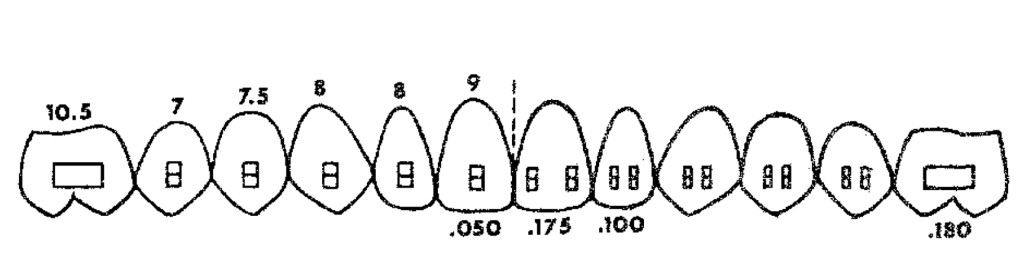
💡 THE SOLUTION: BIMETRIC PRINCIPLE
🎯 Concept:
Differential slot sizing: 0.016″ anterior (control/torque), 0.022″ posterior (flexibility/play). Resolves paradox of small wires (flexible) + large slots (range) without losing anterior control.
| Region | Slot Size | Purpose |
|---|---|---|
| Anterior | Small (0.016) | Control |
| Posterior | Large (0.022) | Flexibility |
📊 WHY BIMETRIC IS SUPERIOR
| Feature | Traditional | Bimetric |
|---|---|---|
| Force | High | ↓ Lower |
| Range | Limited | ↑ Greater |
| Comfort | Less | More |
| Efficiency | Moderate | 🔥 Maximum |
| Comparison | % ↑ Range | % ↓ Force | Overall |
|---|---|---|---|
| vs 0.018″ single | 68% | 36% | Superior posterior |
| vs 0.022″ twin | 247% | 70% | Most efficient |
📊 Final Summary Table
| Factor | Increase | Result |
|---|---|---|
| Interbracket distance | ↑ | Flexibility ↑, Force ↓ |
| Wire size | ↑ | Force ↑, Flexibility ↓ |
| Intrabracket space | ↑ | Range ↑, Force ↓ |

 Dentowesome