ProTaper Rotary File System

Developed in 2001 by- Dr. Cliff Ruddle, Dr. Pierre Machtou, Dr. John West, in cooperation with Dentsply Maillefer.

This system has 3 shaping and 5 finishing files.

Shaping files:-

  • Sx: 19/0.035
  • S1: 17/0.02
  • S2: 20/0.04

Finishing files:-

  • F1: 20/0.07
  • F2: 25/0.08
  • F3: 30/0.09
  • F4: 40/0.06
  • F5: 50/0.06

The cross section of all these files is convex triangular.

1.) Sx- Auxilliary shaping ProTaper file

  • No identification ring
  • Shorter in length: 19mm
  • Allows the shaping of coronal aspects of root canal and relocation of canal orifices in the direction of overhanging dentine area resulting in straight line access.

2.) S1, S2- Shaping ProTaper files

  • Purple and white identification rings respectively.
  • S1- to prepare the coronal one-third.
  • S2- to prepare the middle one-thirs.

3.) F1,F2,F3- Finishing ProTaper files

  • Yellow, red and blue identification rings respectively.
  • Each file has a fixed taper for the first 3mm and then a decreasing taper from D4 to D16. This:
    • Ensures continuous flexibility withing the file.
    • Avoids too large diameter at the shaft area of the instrument.
    • Reduces the potential for dangerous taper lock.
    • Enhances the strength of the file.

4.) F4,F5- Finishing ProTaper files:

  • Help in the apical preparation of larger canals.
  • F4 has 2 black rings and F5 has 2 yellow rings.
  • The body of both the files has a progressively decreasing taper and hence ensures excellent flexibility.

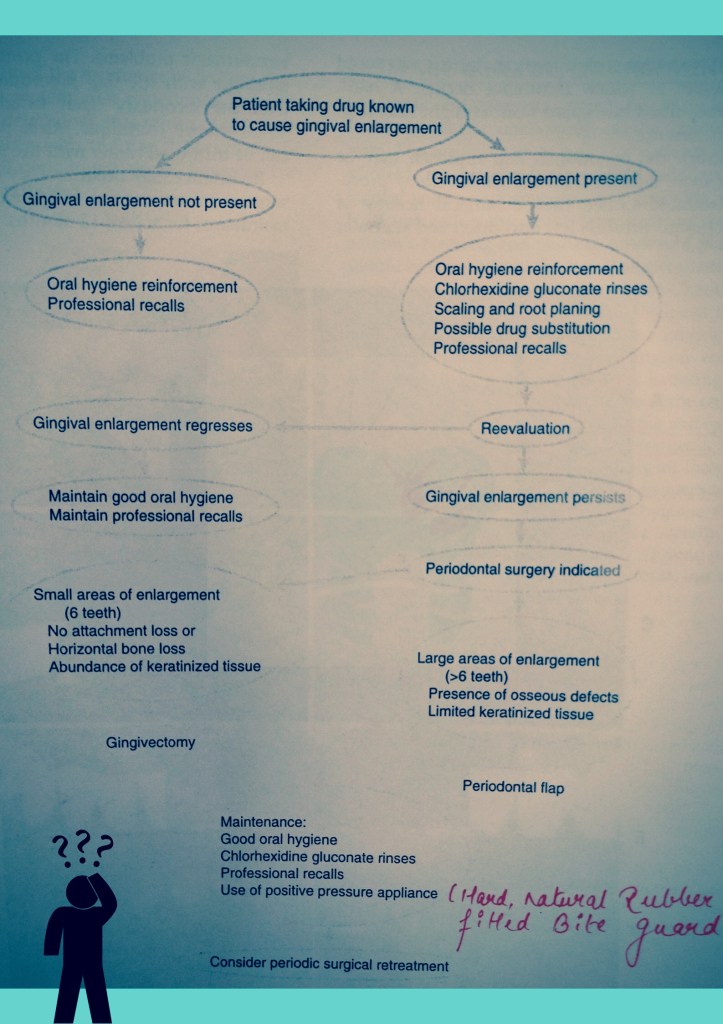
Treatment Options for Drug-Associated Gingival Enlargement

Periodic Dental Check-ups: You can say good riddance to tartar, plaque, cavities and gum disease…..

Here’s an overview of various treatment options for drugs known to cause Gum disease/Gingival Enlargement.💊

To discover more w.r.t this topic head on to ✍🏻 – https://dentowesome.wordpress.com/2020/07/03/gingival-enlargement/

Presentation Tip💡: Try to present your answers with flowcharts & diagrams rather than long paragraphs!! It will definitely have more impact & help you score well in exams..👍👇🏻

Surgical Approach (Diagrammatic View); MGJ: Muco-gingival junction; BL: Bucco-lingual; CT: Connective Tissue
Decision Tree for treatment of Drug-Associated Gingival Enlargement

Source: Carranza’s Clinical Periodontolgy, 10th Ed


Dentowesome|@drmehnaz🖊

DENTAL PLAQUE

Plaque is a sticky film of bacteria that constantly forms on teeth. Bacteria in plaque produce acids after you eat or drink.These acids can destroy tooth enamel and cause cavities and gingivitis

Untreated plaque can harden into (tough to remove ) tartar. Proper oral hygiene, including daily brushing and flossing gets rid of plaque

SYMPTOMS AND CAUSES

● plaque forms when bacteria present in mouth mixes with sugary or starchy foods such as milk, juice, bread ,pasta and soft drinks. These bacteria release acids that breakdown carbohydrates in food and drinks.

● Symptoms : A fuzzy feeling on teeth is the top sign of plaque. Other indicators include halitosis( bad breath ) and red , swollen , tender gums that bleed after brushing.

COMPLICATIONS

Plaque and tartar can lead to

• Cavities

• Gingivitis and periodontal disease

• Tooth decay and loss

• Tooth infection ( Abcessed tooth)

DIAGNOSIS

Since plaque can cause cavities, dental X rays to check cavities. Dental hygienest uses instruments during regular checkups to find and remove plaque

MANAGEMENT AND TREATMENT

Good oral hygiene includes regular brushing and flossing, removes plaque and prevents tartar buildup.

● Fluoride treatments : to slow the growth of plaque causing bacteria and stop tooth decay

● Chlorhexidine Mouthwash

● Dry mouth medication : to increase saliva production

PREVENTION

Plaque can be prevented by :

● Floss daily: Floss once a day with dental Floss or water flosser to get rid of food and plaque stuck between teeth. Studies shows that flossing before brushing teeth removes more plaque

● Brush twice a day: brush for 2 minutes with soft bristled toothbrush and fluoride toothpaste

● Use mouthwash : rinse with an over the counter or prescription antiseptic mouth wash

● Choose healthy food: Cut down sugary, starchy foods and drinks

Source: healthline.com

Ortho Case 2.18

13 year old patient presents complaining of the appearance of his teeth, in terms of UR1.

The problem list:

• Discoloured, ankylosed UR1
• Mild skeletal class III pattern
• Increased vertical proportions
• Mild crowding in the upper and lower arches
• Evidence of dento-alveolar compensation in the lower arch, with a retroclined lower labial segment

What is the long-term prognosis for the UR1? How will this affect the management of this patient’s malocclusion? What changes in the patient’s malocclusion may occur with future growth? Whilst monitoring the patient’s developing malocclusion, how would you manage the ankylosed tooth?

Link: https://drive.google.com/file/d/1oRT2nA2n3Oh3qVjy85bML6drS7Yskxv2/view?usp=drivesdk