Halitosis

Written by - Dr.Urusa I Inamdar

Also called as oral malodor.

” Halitosis may rank only behind dental caries and periodontal disease as the cause of the patients visit to the dentist.”

Origin

Oral

  • Poor oral hygiene
  1. Retention of odoriferous food particles on and between the teeth.
  2. Coated tongue.
  3. Artificial dentures.
  • Acute Necrotizing Ulcerative Gingivitis.
  • Pericoronitis.
  • Abscess.
  • Dehydration states.
  • Ulceration in the oral cavity.
  • Hyposalivation/Xerostomia.
  • Bone disease ( dry socket , Osteomyelitis , osteonecrosis and malignancy )
  • Smoker’s breath.
  • Healing oral wounds.
  • Chronic periodontitis with pocket formation.

Extraoral ( Conditions that can contribute to presence of oral malodor )

  • Sinusitis and other bacterial infections.
  • Dry nasal mucosa.
  • Blocked nose ( which can cause mouth breathing )
  • Tonsillitis/ tonsil stones.
  • Various carcinomas.
  • Infections of the respiratory tract ( bronchitis , pneumonia , bronchiectasis )
  • Alcoholic breath.
  • Uremic breath of kidney dysfunction.
  • Acetone odor of Diabetes.

It is important for the dental professional to eliminate systemic conditions that may be contributing to the presence of oral malodor.

The clinical assessment of oral malodor is either subjective or objective . Subjective assessment is based on smelling the exhaled air of the mouth and nose and comparing the two ( organoleptic assessment ).

Organoleptic scoring scale

  • Absence of odor.
  • Questionable to slight malodor. Odor is deemed to exceed the threshold of malodor detection.
  • Moderate malodor. Odor is definitely detected.
  • Strong malodor. Malodor is objectionable but examiner can tolerate.
  • Severe malodor. Overwhelming malodor. Examiner cannot tolerate.

Various scoring systems, such as 0 to 5 point scale and a 0 to 10 point scale can be used to estimate the intensity of exhaled oral odor, tongue odor and nasal odor , among others.

Methods for objective measurement of the breath include :

  • Detection of sulphides with an appropriate monitor- simple but may fail to detect oral malodor caused by nonsulphide components. Halimeter is a instrument that can be used chair side to measure volatile sulfur compounds in the exhaled air.
  • Gas chromatography- not applicable for routine clinical practice.
  • Bacterial detection ( such as benzoylarginine – naphthylamide test – BANA test ) , polymerase chain reaction, dark field microscopy ) – not applicable for routine clinical practice.

References

  • Dental notes.
  • A practical manual of Public Health Dentistry – C M Marya.

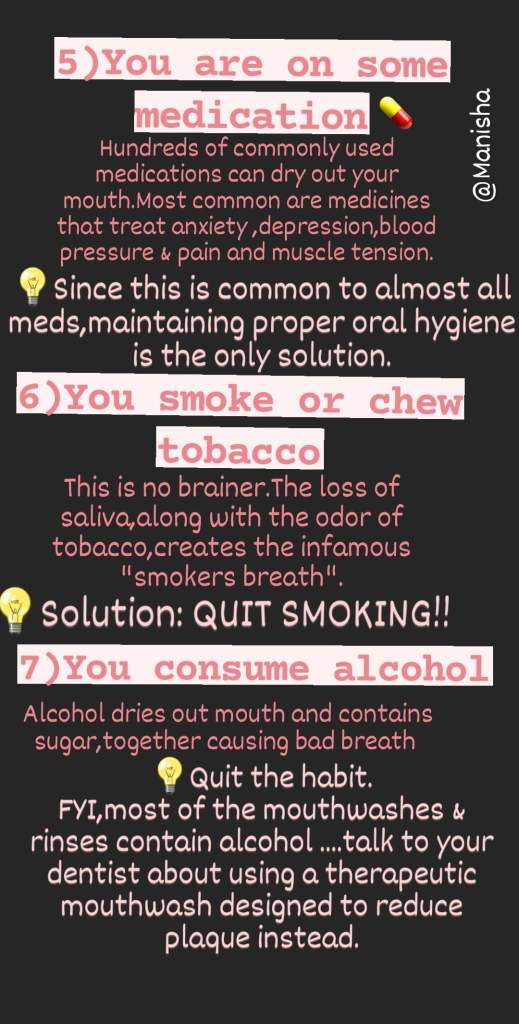
Bad breath/ Halitosis

August 1st,NATIONAL ORAL HYGIENE DAY 🦷
A reminder that oral health is the door to overall health and reinforcing the fact that “Brush and floss ,before the loss.”
Amidst the Covid era,where wearing a mask
has become a part and parcel,many of us face the problem of “BAD BREATH” or halitosis and people often end up in temporary solutions without knowing the root cause.
Here are some of the causes & remedy which might prove helpful.

Sources:instagram @team_dentistree @theunicorndentist @drsana_daruwala
Management of Odontogenic Infection

Written by : Dr.Urusa I Inamdar

Diagnosis

  • Specimen collection and processing
  • Imaging techniques

Management

  • prevention of the odontogenic infection is the golden standard.
  • complex odontogenic infection may require an incision and drainage.
  • mild odontogenic infection can be easily treated with simple antibiotic.
  • Complicated odontogenic infection require patient admission and hospitalization.
  • any odontogenic infection should be treated promptly and should not be underestimated.
  • Determine the severity of infection.
  • evaluate the host defence.

Severity of infection

  • Rate of progression.
  • Potential of airway compromise or affecting vital organs.
  • Anatomic location of infection.

Incision and drainage

  • Incise in healthy skin.
  • Incise in gravity dependent aesthetic area – if possible.
  • Explore entire abscess cavity.
  • Non – absorbable drains.

Principles in the use of drains

  • Drained wounds should be cleansed frequently.
  • Bacteria can migrate into a wound along the drain surface.
  • Latex Penrose drains are best used unmodified.

Empiric therapy of odontogenic infections

  • penicillin
  • penicillin + metronidazole
  • allergic to penicillin give clindamycin

Management

  • Determine severity- assess history of onset and progression perform physical examination of area:
  1. Determine character and size of the swelling
  2. Establish presence of trismus
  • Evaluate host defense- evaluate:
  1. Diseases that compromise the host
  2. Medications that compromise the host
  • Perform surgery- remove the cause of infection , drain pus , relieve pressure.
  • Select antibiotic- Determine
  1. Most likely causative organisms based on history
  2. Host defense status
  3. Allergy history
  4. Previous drug history
  • Follow up- confirm treatment response, evaluate for side effects and secondary infections.

Follow up

  • out patient should return for f/u in 2-3 days.
  • Patient should have decreased swelling, discharge, airway edema, malaise in 2-3 days.
  • If no improvement consider:
  1. Re- culture
  2. Re- image
  3. Repeat incision and drainage

References

  • slideshare – odontogenic infection
  • Shafer’s – Textbook of Oral Pathology (7th edition)