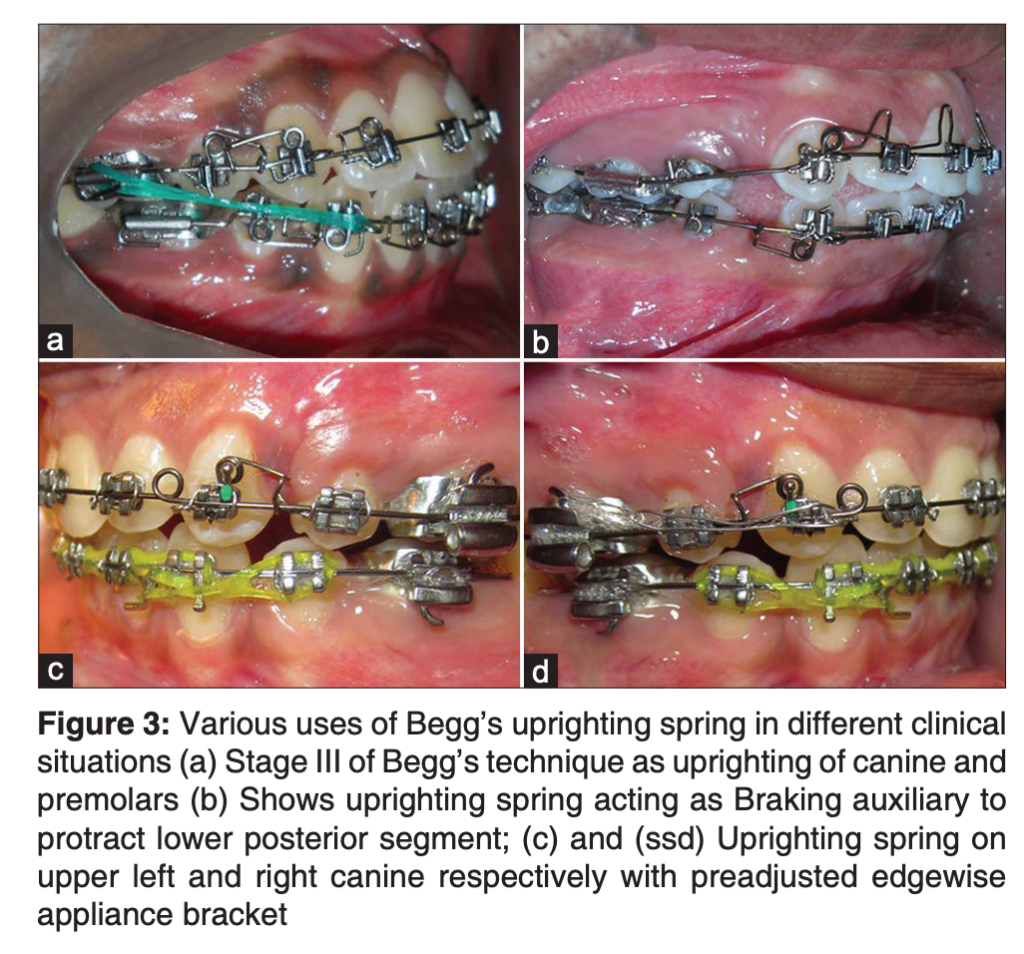
Somewhere in every orthodontic department, there’s a forgotten drawer. Inside? Old Begg pliers, Australian wire, random elastomeric chains—and one underrated genius of biomechanics: the Begg’s uprighting spring.
Modern orthodontics loves sleek prescriptions, digital setups, and aligner simulations. But when anchorage falters or teeth tip uncontrollably, this vintage auxiliary stages a silent comeback.
What Is It?
A light-wire auxiliary for mesiodistal root uprighting, anchorage reinforcement, controlled movement, and braking during space closure. Born in Percy Raymond Begg’s differential force technique, it now aids preadjusted edgewise systems with vertical slots.
Core Principle: Moments Matter
Decide root movement first—clockwise or anticlockwise. This sets coil direction for precise moments.
| Desired Movement | Spring Type |
|---|---|
| Clockwise uprighting | Clockwise coil |
| Anticlockwise uprighting | Anticlockwise coil |
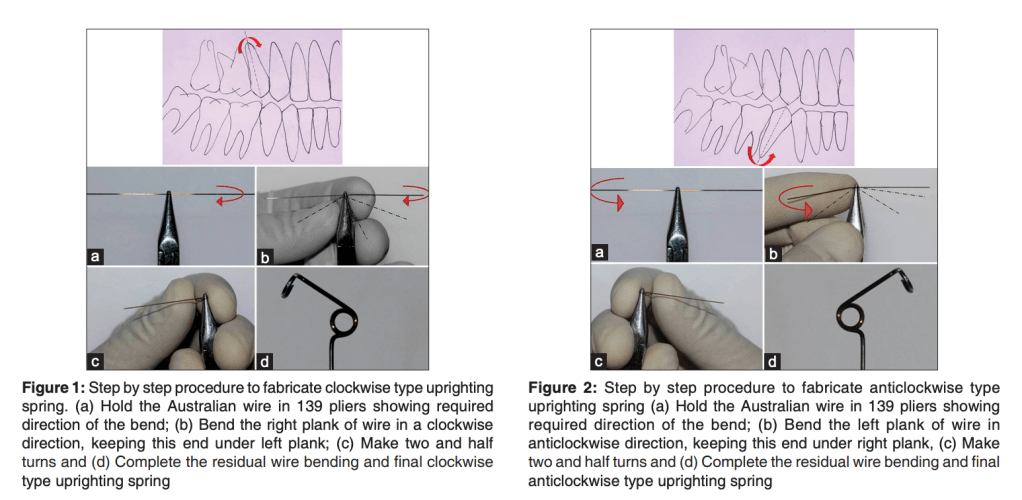
Fabrication Essentials
- Wire: 0.009″–0.018″ Australian for resilience and activation range.
- Turns: 2½ coils standard; 135° arm-stem angle minimizes extrusion, tipping, or flaring.
- Coil Index: Loop diameter ≥6× wire diameter (e.g., 0.072″ for 0.012″ wire) per Thurow, reducing fracture risk.
- Base Arch: Rigid 0.020″ premium Australian or 0.018″ premium plus to control reactions.
Clinical Power Moves
- Anchorage in demanding cases or presurgical ortho.
- Braking for space closure.
- Works with vertical-slot brackets or tip-edge.jco-online+1
It reinforces stability while protracting posteriors—like holding furniture during a room rearrange.
Why Students Need This
Master moments, predict reactions, and bend wires deliberately. In an aligner era, it restores mechanical artistry.
Quick Revision
- Uses: Uprighting, anchorage, braking.
- Specs: 2½ turns, 135° angle, 6× coil index.
- Pair with rigid base wire
Reference: Kumar V, Sundareswaran S. J Orthod Sci. 2015.


