If Class II Division 1 malocclusion is loud and obvious, Class II Division 2 is quiet—but far more deceptive. At first glance, the retroclined maxillary incisors and deep bite may seem straightforward. But for an orthodontic postgraduate, this malocclusion is a reminder that what looks simple often isn’t.
Let’s break it down—clinically, biomechanically, and philosophically.
🔍 Understanding the Core Problem
Class II Division 2 malocclusion is not merely an “incisor inclination issue.” It represents a complex interaction between vertical overlap, transverse restriction, and mandibular entrapment.
Key features include:
Retroclined maxillary central incisors
Deep overbite (often traumatic)
Reduced inter-incisal angle adaptability
Constricted lower arch due to vertical locking
Increased freeway space and altered mandibular posture
👉 Clinical pearl: The lower arch is often trapped within the upper arch due to excessive vertical overlap—not truly deficient in size.
📐 Why Cephalometric Planning Matters
One of the most overlooked steps in managing Class II Div 2 cases is planning the final incisor position before moving a single tooth.
The treatment goal is not just to reduce overbite—but to:
Normalize the inter-incisal angle
Reposition incisors within the soft tissue envelope
Improve dental esthetics without compromising stability
Rather than chasing numbers, PGs should ask:
“Where should the incisors ideally sit for facial balance and long-term stability?”
🦷 Non-Extraction: When and Why It Works
Contrary to traditional thinking, many Class II Div 2 cases can be managed non-extraction, provided:
Skeletal discrepancy is mild to moderate
Overbite is reduced early
Curve of Spee is strategically leveled
Lower incisors are advanced within lip boundaries
Overbite reduction alone can create 8–10 mm of usable space—a concept every PG should internalize before deciding on extractions.
Extraction Indicated When:
Severe skeletal Class II
Severe crowding
Proclination exceeds soft tissue envelope
🛠️ Appliance Strategy: Think Sequential, Not Simultaneous
A common mistake is trying to do everything at once.
A biologically sound sequence includes:
Initial overbite reduction (often with removable or bite-opening mechanics)
Buccal segment correction and unlocking of the mandible
Lower arch leveling and alignment
Upper incisor torque and final detailing
This staged approach improves control, anchorage, and patient compliance.
🔁 Stability: The Real Exam Question
If there’s one word Class II Div 2 teaches every orthodontist, it’s respect—for relapse.
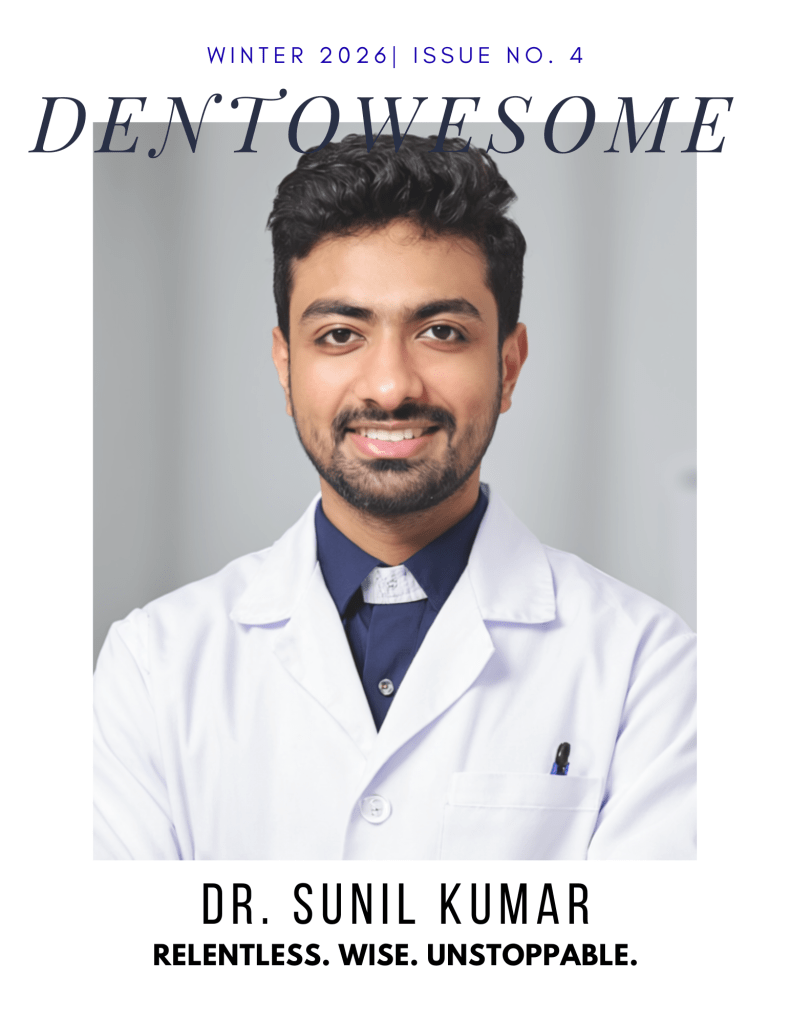
If dentistry had a superhero league, Dr. Sunil Kumar would be in it—cape optional, but books and drills mandatory. With a journey fueled by grit, self-belief, and a pinch of philosophy from the Bhagavad Gita, Dr. Sunil is not just a dentist; he’s a mentor, author, and creator shaping the next generation of dental professionals. From humble beginnings in a Hindi-medium school to running his own clinic and sharing knowledge with thousands online, his story is one of determination, creativity, and heart.
Q: Can you share how your path in the dental profession began and the key milestones that shaped it?
Like most dentists, my journey began with a lot of confusion. I decided to pursue dentistry on my own—without influence, guidance, or knowing exactly what lay ahead. But I was ready, because I firmly believe that our decisions are our responsibility. No one else is accountable for our success or failure.
Coming from a Hindi-medium school, I initially struggled to study from English textbooks. I accepted early on that if I wanted to succeed, I had to work harder than my peers. I developed a method: learn a topic, understand it deeply, and then write it out repeatedly until it became second nature. When results were announced that year, I performed far better than I had ever imagined. That moment planted a seed of self-belief in me—the understanding that wholehearted effort can exceed expectations.
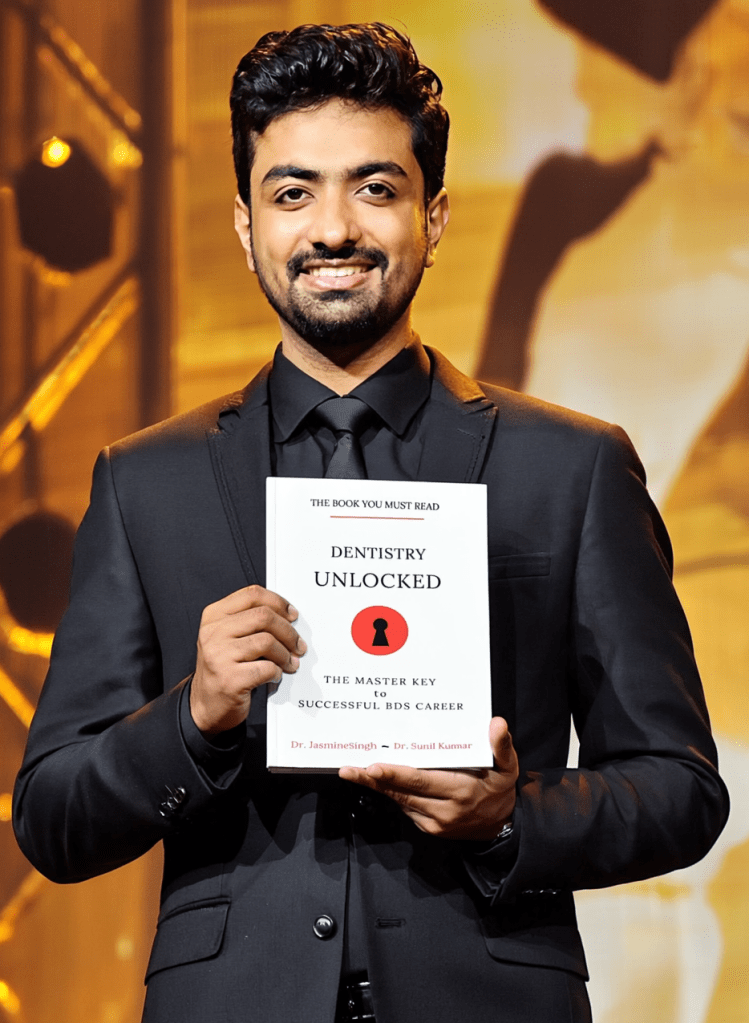
The first milestone of my journey was publishing my book Dentistry Unlocked, which gave me recognition as an author just after my internship. Later, I established my own practice, Dental Care World in Ajmer, where I experienced firsthand the challenges and rewards of running a clinic. Another defining moment came when I stepped into education and content creation—sharing knowledge with fellow dentists through YouTube [DENTAL JI] and online courses. This allowed me to reach a much wider community beyond the walls of my clinic.
Q: What inspires you to stay passionate and committed to dentistry, even during challenging times?
My biggest inspiration has always been my parents. It was very hard for them to bear the financial burden of my education, yet they somehow managed it. I was never an extraordinary student—just a mediocre one who used to pass with average marks—but my parents trusted me. Whenever I face a challenge, I remember their sacrifices, and suddenly the challenge feels small compared to their hard work.
In India, students often blame colleges or professors for not teaching adequately—especially in dentistry. But I realized early that I could not wait for the system to change. I had to find my own way of learning. Complaining doesn’t solve problems. As the saying goes, “When there is a will, there is a way.” My advice to students is simple: don’t complain about what you cannot control. Instead, focus on finding your own way forward.
Q: Who is your role model in the dental field and how has this person influenced your approach to patient care, academics, or professional growth?
If you ask me about a role model, I would say it is not a person but a philosophy—from the Bhagavad Gita. The shloka “Karmanye vadhikaraste ma phaleshu kadachana” teaches us to do our work with full sincerity and leave the results to destiny.
In short: Do your best, and leave the rest.
This philosophy has helped me grow in every aspect of my career and life. I constantly strive to improve myself—physically, mentally, emotionally, and spiritually. At the same time, I remind myself not to take things too seriously. Success is important, but so is enjoying life. Too often in the race for success, we forget to live.
Q: Could you discuss the strategies you use to manage academic responsibilities alongside your personal interests or hobbies?
Balancing academics with personal interests is less about doing everything at once and more about setting the right priorities. I make sure my academic responsibilities are clearly structured—I plan my week in advance, break down large tasks into smaller goals, and set realistic timelines. This keeps me on track and reduces last-minute stress.
I also see personal interests not as distractions, but as vital sources of balance and creativity. Whether it’s reading, fitness, or creative activities, hobbies recharge me, improve my focus, and help me return to academics with a fresh mind.
One strategy I follow is time-blocking: assigning dedicated slots for study and equally protected slots for personal interests. This way, I never feel like I’m sacrificing one for the other. Instead, I treat both as complementary parts of my growth.
Ultimately, it’s about balance and consistency: fulfilling academic duties with dedication while also nurturing personal interests to stay motivated, energetic, and well-rounded.
Q: What advice would you give to current dental students and aspiring dentists?
To my fellow young dentists and students:
You will face confusions and challenges. There may be moments when everything feels lost. At that time, put your phone aside, take a piece of paper, and write down the life you want exactly one year from now. Don’t copy anyone—just write what you truly desire.
Then ask yourself: If I give my 100%, is it really impossible to achieve this? And if it is possible, why am I so confused?
When you reflect this way, everything becomes clear.
Closing Note: Smile Like You Mean It
Dr. Sunil Kumar’s journey teaches us that dentistry is not just about drills and braces—it’s about persistence, self-belief, and the courage to carve your own path. So, to all the budding dentists out there: work hard, believe in yourself, and never forget to enjoy life along the way. After all, life’s too short to floss grudges. Keep smiling, keep learning, and maybe—just maybe—write your own book while you’re at it.
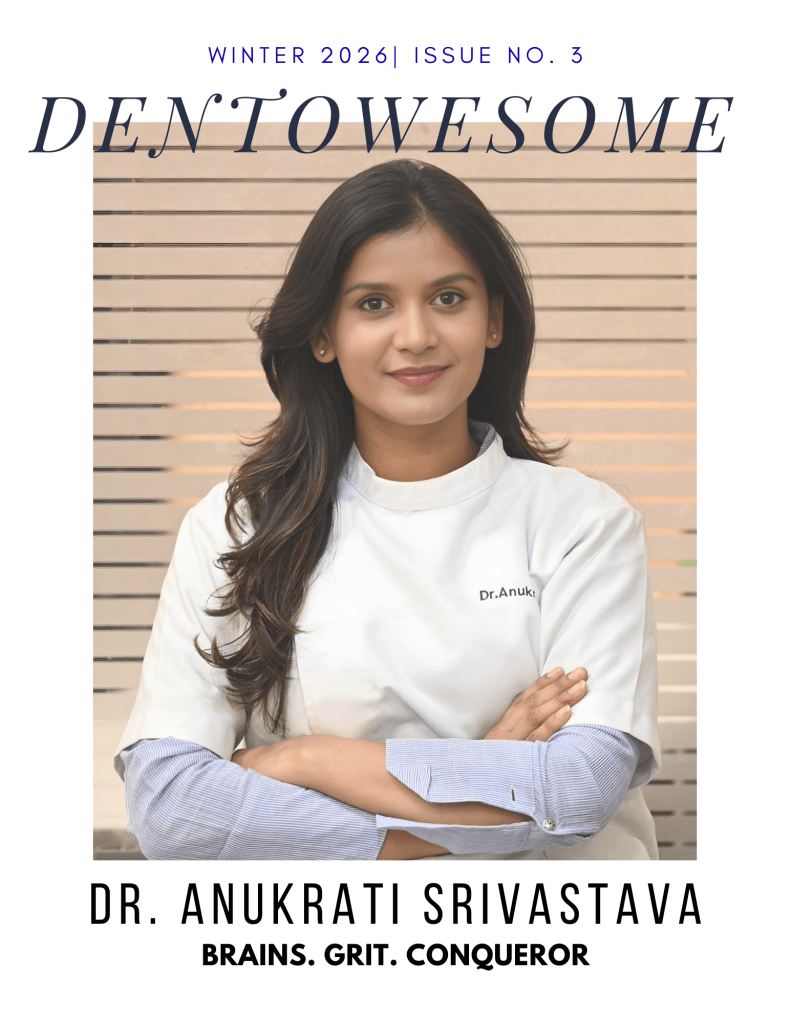
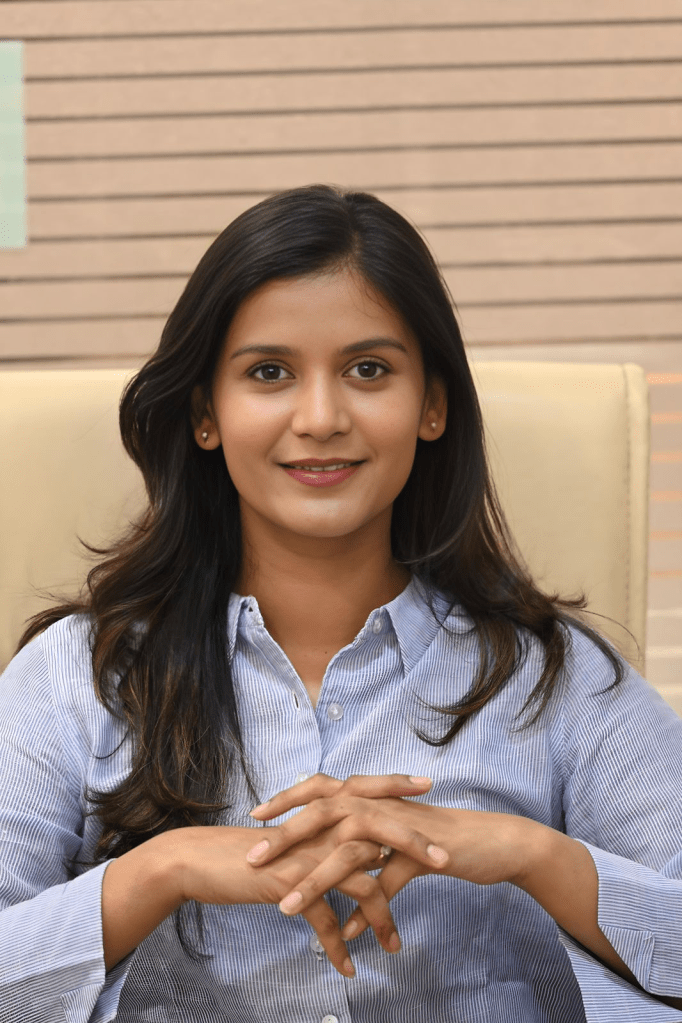
Picture this: a young dental student staring at a microscope, trying to figure out why her physiology textbook looks more like a foreign language manual than a path to making people smile. Enter Dr. Anukrati Srivastava—the woman who took that confusion, added a sprinkle of stubbornness, a dash of curiosity, and bam!—turned it into a dental career that makes patients beam and teachers proud. With an All India Rank of 97, a master’s degree, and an obsession with magnification and illumination, she’s not just treating teeth; she’s rewriting the rulebook on what it means to be a dentist who actually cares.
Think of her as the stand-up comedian of dentistry—only instead of punchlines, she delivers precision, patience, and those little “aha!” moments that make you go, “Wow, I never knew dental school could be like this.”
1) Can you share how your path in the dental profession began and the key milestones that shaped it?
My journey in dentistry began with a bit of resistance. During the first year, I wasn’t particularly interested, as the subjects like physiology and biochemistry seemed far removed from clinical dentistry. It didn’t feel relevant to what I wanted to do—treat patients and create smiles.
Everything changed in the third year when I joined a private clinic to experience dentistry beyond textbooks. That hands-on exposure taught me that dentistry is not just about treating teeth—it’s about patience, communication, and understanding the financial and emotional aspects of patient care.
A major milestone during my internship was preparing for the pre-PG exam. I began studying not just to pass, but to truly understand subjects and connect concepts. With guidance from exceptional teachers across India, patience, and consistent effort, I achieved AIR 97 and completed my master’s—a challenging journey that brought immense satisfaction.
Another pivotal moment came when I committed to performing all my cases under proper isolation, using magnification and illumination. I believe every dental student should use at least 3.5X magnification. Without it, you miss details that are crucial for becoming a better dentist.
2) What inspires you to stay passionate and committed to dentistry, even during challenging times?
I was fortunate to complete my bachelor’s and master’s at a prestigious institution—Govt. Dental College, Jaipur—with faculty who truly inspired me. Watching teachers work, understanding their thought process, and seeing their dedication to patients—not for money but for the joy of delivering excellent care—motivated me to push myself. Their example has been my anchor during challenging times, reminding me to always give my best.
3) Who is your role model in the dental field, and how has this person influenced your approach to patient care, academics, or professional growth?
While I’ve learned from many, I must mention Dr. Lalit Likhiyani and Dr. Manoj Aggarwal. They taught me to strive to be a better person every day and to deliver dentistry better than I did yesterday. During my student life, I often thought, “What would they say if they saw this?”—a question that drove me to excellence.
Academically, they never gave me straight answers. Instead, they asked more questions, encouraging me to explore literature, dig into articles, and develop reasoning. This approach instilled in me a love for learning and a habit of critical thinking.
4) Could you discuss the strategies you use to manage academic responsibilities alongside your personal interests or hobbies?
Balancing academics, clinical responsibilities, and personal life has been challenging. I realized early on the importance of prioritizing personal life. Some rules I follow include:
No work calls after 7 PM.
Weekly days off with my husband, who is also an orthodontist, with no appointments.
Allocating time for House of Endodontics in my calendar.
Maintaining an afternoon nap that I never compromise.
I also make time for painting, gardening with a cup of coffee, and long drives—simple joys that help me recharge. Sticking to a routine has been key to maintaining balance.
5) What advice would you give to current dental students and aspiring dentists?
Yes, dentistry is challenging. Yes, it requires patience and perseverance. Yes, you will be self-critical about your cases. But the satisfaction of growing, learning, and creating beautiful smiles makes it all worthwhile. Stay curious, embrace mentorship, and never stop improving.
Conclusion:
So, what’s the takeaway from Dr. Anukrati Srivastava’s story? Simple. Dentistry is tough, exams are tougher, and yes, sometimes your coffee might get cold while you’re deep in a case. But passion, perseverance, and a touch of sass can turn all that chaos into something magical.
She’s living proof that you can love what you do, learn endlessly, and still have time to sip your coffee, paint a masterpiece, or take a Sunday drive. If dental students remember one thing from her journey, let it be this: don’t just aim to fix teeth—aim to shine brighter than the overhead lamp in your operatory. And maybe, just maybe, make it look effortless while you’re at it.
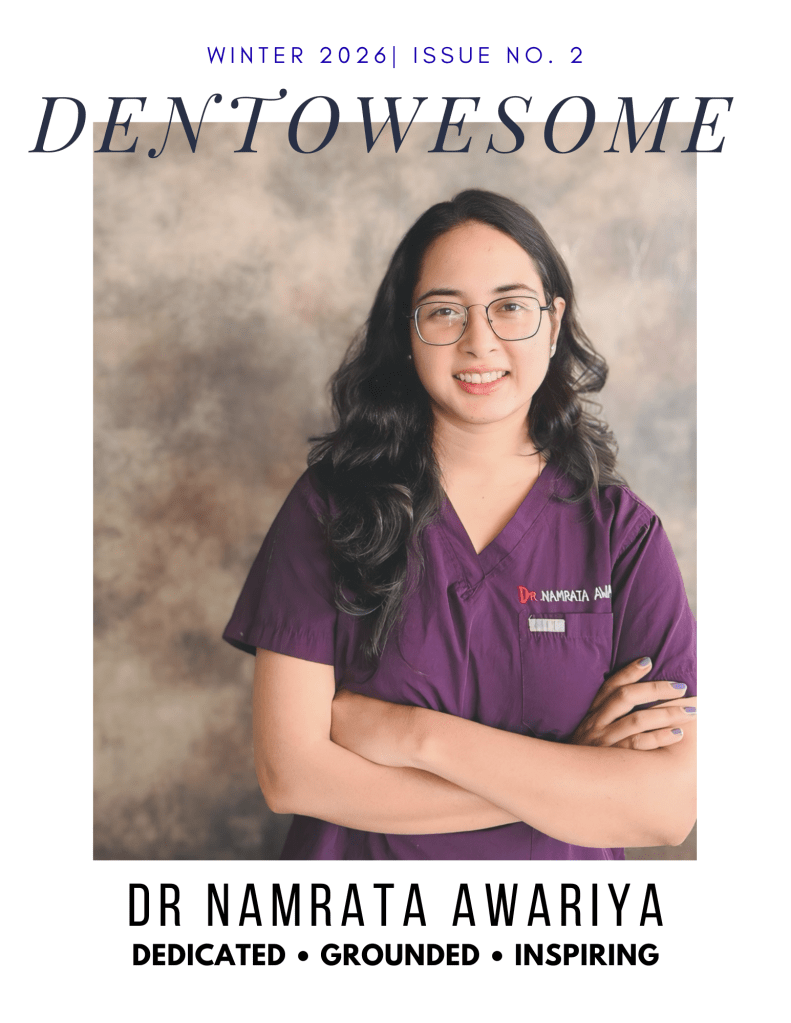
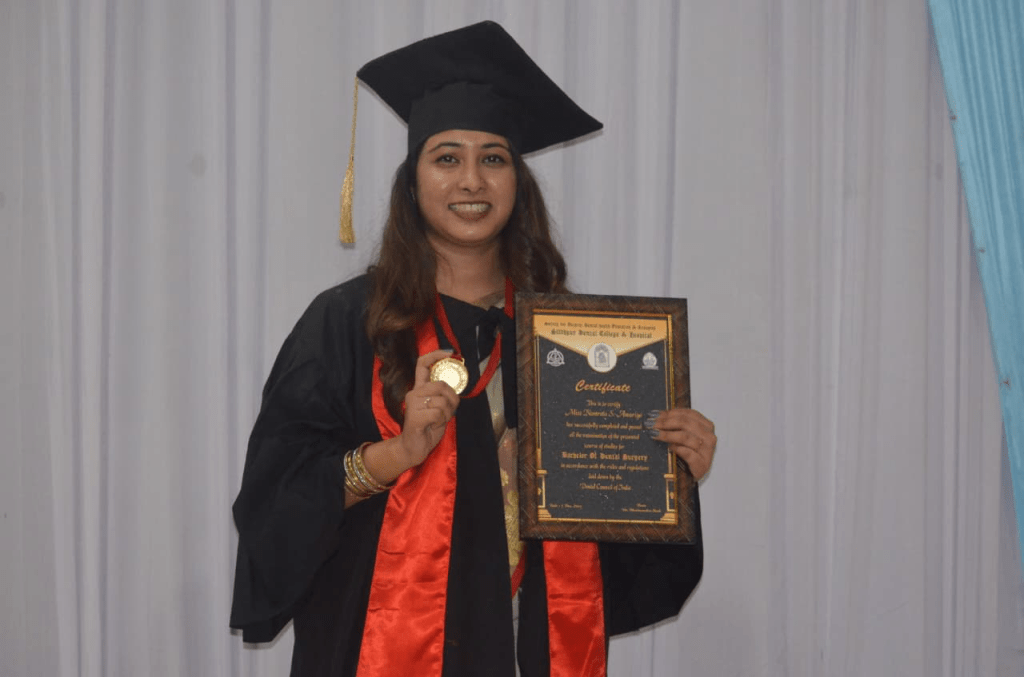
Meet Dr. Namrata Awariya—a woman who didn’t just choose dentistry, she committed to it like a long-term relationship: through deadlines, late nights, and the occasional “why did I do this to myself?” moment. She set out with one clear dream—to become the first doctor in her family—and then actually went ahead and did the work. Brave, right?
Her journey isn’t all glossy smiles and perfect impressions. It’s built on consistency, self-belief, and showing up even on days when motivation took a sick leave. She believes every tooth has a story, every patient deserves the best, and that learning never stops—especially when things don’t go exactly as planned.
In a profession that demands both precision and patience, Dr. Namrata brings compassion, discipline, and just the right amount of grit. This interview is her story—honest, inspiring, and proof that when you believe in yourself long enough, the dream eventually believes back.
1) Can you share how your path in the dental profession began and the key milestones that shaped it?
With a dream of becoming the only doctor in my entire family, I began this long journey with just one thing in mind: you have to do this—you are made for this journey. Both my mind and heart wanted dentistry as my career path.
It was not easy leaving my family and staying away from them, as my college was far from home. However, with the constant support of my family and friends, this journey became easier. From first year to final year, I learned one crucial lesson—consistency and self-belief. Even on days when you don’t feel like working, you must keep going.
Dream big, because dreams do come true. Submissions, deadlines, and late nights eventually feel worth it. The strongest pillar of your success is you. If you believe it, it will happen.
2) What inspires you to stay passionate and committed to dentistry, even during challenging times?
Every case is different, and every tooth is unique. The motivation comes from trying to give the best possible treatmentto each patient. In the end, the appreciation and blessings you receive from patients are priceless.
Relieving someone’s pain is the best part of our profession. I truly love dentistry. Either you love what you do, or you do what you love—because every profession demands consistency and hard work. Even though it isn’t easy all the time, doing this makes me happy. Discovering something new every day keeps my passion alive.
3) Who is your role model in the dental field, and how has this person influenced you?
Dr. Janu Shah and Dr. Komal Majmudar are my role models. Watching them work so effortlessly and passionately motivates me to keep pushing myself. I once attended their conference, and it deeply influenced me.
They emphasized giving patients what they truly need and providing the highest quality treatment. One thing that stayed with me was this advice: you learn every day, and even failures are part of treatment because they teach you something. That thought encourages me to keep learning every single day.
4) Could you discuss the strategies you use to manage academic responsibilities alongside personal interests or hobbies?
I am very fond of watching movies and shows, and I feel the urge to watch every new release. However, with constant submissions and deadlines, that becomes difficult. So, I made sure to study consistently on weekdays, which allowed me to enjoy my weekends guilt-free.
During final year, I was more focused on academics, and this routine became hard to maintain. Instead of spending two hours watching movies, I started going for walks around the campus for refreshment. This helped me relax while saving time—reducing a two-hour break to just thirty minutes.
5) What advice would you give to current dental students and aspiring dentists?
Dentistry may feel hard and saturated at times, but don’t quit. Escaping is not an option—keep working hard, and you will get through it. No matter how much time or effort it takes, in the end, it is worth it.
Some people believe dentistry is a saturated profession, but it is not. You deal with smiles, emotions, and lives every day. Rise each morning and treat every case as a new challenge. Because in the end, it is all worth it.
And just like that, the interview ends—but her story doesn’t. , but honestly, Dr. Namrata Awariya’s story? It’s still doing cartwheels in your brain.
Here’s the thing—dentistry isn’t all shiny tools and perfect smiles. Nope. It’s deadlines that feel like doom, teeth that refuse to cooperate, and those why-am-I-doing-this 3 a.m. moments. And yet, somehow, Dr. Namrata shows up. Every. Single. Day. With grit, grace, and a little bit of stubborn sparkle.
She doesn’t promise shortcuts or magic formulas. What she does promise is real: passion, persistence, and a heck of a lot of heart. And honestly? That’s way more valuable than any highlighter-marked textbook.
So, to all the dental students, aspiring dentists, and dreamers scrolling through this post: take a page from her book. Work hard, laugh at the chaos, keep learning, and never—ever—forget to believe in yourself.
Because if Dr. Namrata’s journey teaches us anything, it’s this: show up, keep shining, and the world will notice—even if it takes a few late nights and countless coffee cups.
Meet Dr. Sanigdha—the kind of dentist who didn’t just choose dentistry; dentistry slowly, stubbornly, and very convincingly chose her. She walks into the profession with curiosity in one hand, creativity in the other, and an unshakable belief that teeth deserve both science and style. Currently pursuing MDS in Prosthodontics, she treats dentistry less like a job and more like a lifelong love affair—complete with hard work, reflection, and the occasional existential crisis (handled gracefully, of course).
Passionate, resilient, and endlessly creative, Dr. Sanigdha believes smiles are built not just with precision, but with compassion, artistry, and a little bit of heart. She’s proof that when you mix discipline with dreams, and science with soul, you don’t just restore teeth—you make dentistry sparkle. 💫
1) Can you share how your path in the dental profession began and the key milestones that shaped it?
My journey in the dental profession began rather unexpectedly. I always wanted to make people happy and bring smiles to their faces, but pursuing dentistry was not initially part of my plan. However, once I began my Bachelor of Dental Surgery (BDS), I was truly fascinated by the vast diversity, depth, and creativity that the field encompassed.
From the very beginning, I have been an all-rounder with strong leadership qualities and a creative mindset, and dentistry provided the perfect blend of science, precision, and artistry. I was particularly drawn to how dental practice intertwines clinical expertise with artistic skills, which not only restores function but also provides aesthetics and precision.
Over the years, this field has continued to inspire me—the more I learned, the stronger dentistry pulled me toward itself. Each stage of my journey has reinforced my belief that dentistry is not just a profession, but a dynamic, multifaceted art that evolves with compassion, innovation, and creativity. I am now currently pursuing MDS Prosthodontics, the field which is and will be my first and last love!
2) What inspires you to stay passionate and committed to dentistry, even during challenging times?
What continually inspires me to remain passionate and committed to dentistry, even during the most challenging times, is the profound sense of fulfillment I derive from my patients’ satisfaction. The genuine smile and gratitude reflected on their faces after treatment serve as a constant reminder of the purpose and impact of this profession. Their trust and appreciation motivate me to continually refine my skills and strive for excellence.
My love for dentistry is unwavering—it only deepens with time. This field’s remarkable diversity and boundless creativity set it apart; I truly believe no other profession harmonizes art, science, and innovation in such a beautiful way. Since childhood, I have been deeply inclined toward both artistic expression and scientific exploration, and dentistry embodies the perfect confluence of these two fields altogether.
I often feel that dentistry was destined for me—it aligns seamlessly with who I am and what I value. The profession has not only shaped my identity but continues to inspire me every single day to pursue mastery, compassion, and creativity in all that I do.
3) Who is your role model in the dental field and how has this person influenced your approach to patient care, academics, or professional growth?
It is truly difficult for me to name just one role model in the dental field, as I have been fortunate to learn under the guidance of several remarkable mentors who have collectively shaped my professional journey. Each of them has contributed immensely to my growth in knowledge, skill, and confidence, and I owe a great part of my development to their mentorship and support.
I would especially like to acknowledge Dr. Moez Kakhiani, Dr. Manmeet Gulati, Dr. Manmohit Singh, Dr. Pratik Gupta, and Dr. Harsimran Singh Sethi—individuals whose depth of knowledge, clinical excellence, and unwavering passion for dentistry continue to inspire me every day. Their dedication to patient care, academic brilliance, and constant pursuit of innovation have not only refined my understanding of dentistry but have also instilled in me a profound sense of purpose and curiosity.
I deeply admire their humility, their commitment to continuous learning, and their ability to blend science with compassion in patient care. Observing their approach has taught me that dentistry extends far beyond technical skill—it is about empathy, precision, and a lifelong quest for excellence. These mentors have truly been the pillars of inspiration in my journey, shaping my vision of what it means to be a dedicated and compassionate dental professional.
4) Could you discuss the strategies you use to manage academic responsibilities alongside your personal interests or hobbies?
From the very beginning of my dental journey, I have been deeply inclined toward learning and understanding every aspect of the field. My curiosity about how each dental procedure is performed has always fueled my academic enthusiasm. I realized early on, right from my first year, that dentistry is not just a profession for me—it is something I wish to dedicate my entire life to.
I have always been passionate about academics and continuously strive to push myself toward excellence. However, I also believe that true growth comes from balance. I always take time to breathe and pursue my personal interests such as dancing, painting, and, most importantly, content creation—activities that allow me to express my creativity and refresh my mind.
Time management plays a crucial role in maintaining this balance. I follow a flexible yet structured approach by creating a daily to-do list—not rigid schedules, but realistic goals that help me stay productive without burnout. One of my most effective approaches, which always helps me, is that I keep a “mistake diary.” Each day, I jot down key lessons, areas for improvement, and all my mistakes. This simple practice has significantly contributed to my personal and academic growth, shaping me into a more organized, reflective, and confident individual.
5) What advice would you give to current dental students and aspiring dentists?
My heartfelt advice to all current dental students and aspiring dentists is—don’t let the challenges of this journey overpower you. I understand that dentistry can often feel demanding, exhausting, and at times even make you question your own choices.
But in those moments, remember to pause, breathe, and remind yourself that you are capable of achieving incredible things. No matter how intense this phase of your life is, never forget that this is only a part of your journey—not your entire life. Take short breaks when needed, allow yourself to reset, and return with a clearer mind and stronger determination. Stay positive, stay consistent, and most importantly, never ever give up.
If you give your hundred percent to dentistry, this field will reward you a thousandfold in return. The growth, satisfaction, and pride it brings along are truly limitless.
And as this conversation comes to a close, one thing is clear—Dr. Sanigdha’s journey is still very much in motion. Her words remind us that dentistry isn’t about having everything figured out from day one; it’s about showing up, learning relentlessly, embracing mistakes, and choosing passion even on the hardest days. With her blend of artistry, discipline, and heart, she represents a generation of dentists who don’t just treat patients but truly connect with them.
If there’s one takeaway from her story, it’s this: trust the process, stay curious, and never underestimate the power of loving what you do. Because when dentistry is driven by purpose and creativity, it doesn’t just shape careers—it shapes lives, one smile at a time.
Every orthodontic student reaches a moment in clinic where a 9-year-old with Class II malocclusion is sitting in the chair—and the faculty asks:
“So… headgear or functional appliance?”
The confusion is understandable. One appliance pulls the maxilla back, the other pushes the mandible forward. But do they actually produce different outcomes?
Evidence says something interesting: 👉 They reach the same destination—using different roads.
Let’s break this down logically.
The Clinical Question
Are headgears and functional appliances equally effective in correcting Class II malocclusions in children before comprehensive treatment?
Short answer
✅ Yes. Both appliances produce similar overall Class II correction, especially in terms of ANB reduction and overjet correction.
Evidence at a Glance
5 prospective randomized clinical trials
Children aged 7–10 years
Phase I treatment only (no fixed appliances)
Compared headgear vs functional appliances vs controls
📚 Databases used: PubMed & Cochrane Library
Study
N
Age
Duration
Appliances
Key Design
Jakobsson (1990)
57
8.5 yr
18 mo
Cervical headgear vs Andresen activator vs control
Random, all Class II
Tulloch (1998)
166
9.4 yr
15 mo
Straight-pull headgear vs mod. Bionator vs control
Headgears and functional appliances are equally effective in early Class II correction in children. The difference lies not in how much correction occurs, but in how that correction is achieved—headgear acts mainly on the maxilla, while functional appliances rely largely on dentoalveolar changes and mandibular positioning.
What Do Radiographs Really Decide in Treatment Planning?
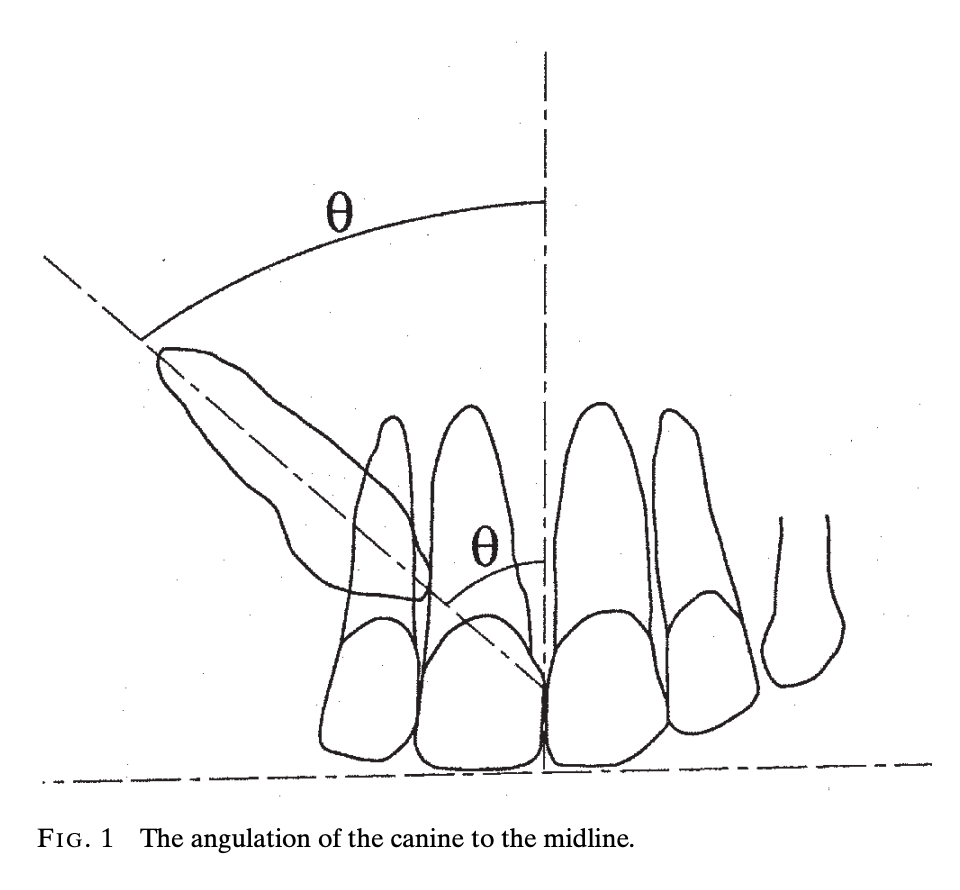
“If you see an impacted canine on an OPG, what makes you say— expose it… or extract it?”
This is a question every orthodontic student struggles with.
We are taught to look at angulation, height, overlap, resorption, and yet—when real consultants make decisions, only two radiographic factors consistently matter.
This blog breaks down which radiographic features truly influence treatment decisions and why, based on the classic study by Stivaros & Mandall (2000).
🔍 Why This Topic Matters Clinically
Impacted maxillary canines occur in 1.7–2.2% of the population. Once a patient presents late, the orthodontist must choose between:
Surgical exposure + orthodontic alignment
Surgical removal
The wrong decision can mean:
Prolonged treatment
Periodontal compromise
Failed alignment
Unnecessary extraction
📌 Radiographs guide this decision—but not in the way students often assume.
🧠 Study in One Line
Orthodontists do NOT base their decision on most OPG measurements. Instead, they rely mainly on:
(Based on Linder-Aronson et al., Am J Orthod, 1986)
As orthodontists, we often label a child as a “vertical grower” or “long-face case” very early—and then plan mechanics accordingly. But what if that growth direction is not fixed? What if airway obstruction and breathing mode are quietly influencing mandibular posture and growth direction—and correcting the airway changes the skeletal trajectory?
Understanding Mandibular Growth Direction (MGD)
What do we mean by “mandibular growth direction”?
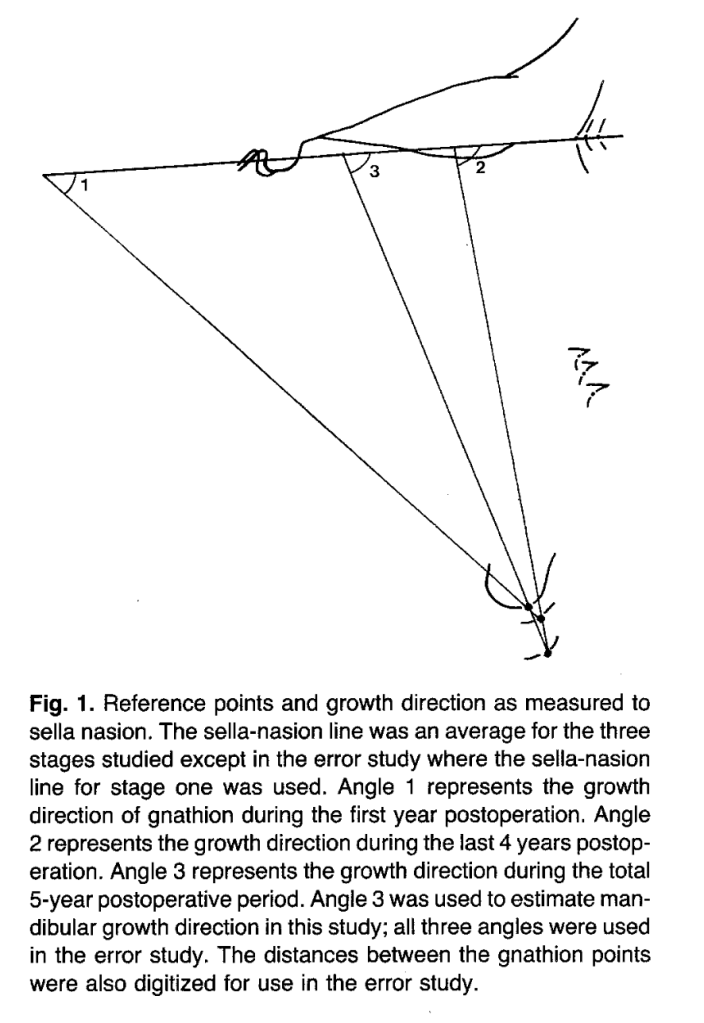
Mandibular growth direction refers to the direction in which the chin (gnathion) moves during growth
It is assessed by:
Superimposing serial cephalograms on stable cranial base structures
Tracking the movement of gnathion
Measuring its angle relative to the Sella–Nasion (SN) plane
Simplified interpretation:
More horizontal MGD → forward chin growth → better profile, less vertical facial height
More vertical MGD → downward/backward chin growth → long face tendency
📌 MGD represents the sum total of multiple growth influences, not just mandibular length.
Question to Ponder
If two children have the same mandibular length, can they still have very different facial profiles? Why?
2. Why Airway Obstruction Matters in Facial Growth
What happens in children with enlarged adenoids?
Children with severe nasopharyngeal obstruction often show:
Mouth breathing
Lowered mandibular posture
Increased lower anterior face height
Steeper mandibular plane
Retrognathic mandible
These features are classically associated with vertical growth patterns.
Cause → Mechanism → Effect
Step
Explanation
Cause
Enlarged adenoids → nasal obstruction
Mechanism
Mouth breathing → mandible held in a lowered position
Effect
Increased lower face height + vertical mandibular growth
⚠️ The key point is mandibular posture, not just airflow.
Question to Ponder
Is it the path of air or the position of the mandible during breathing that matters more for growth?
3. What Is Adenoidectomy Expected to Do (The Hypothesis)
The authors asked a simple but powerful question:
If nasal breathing is restored after adenoidectomy, does mandibular growth direction change?
Null Hypothesis: Restoring nasal breathing does not affect mandibular growth direction.
If the mandible becomes:
More horizontal → hypothesis rejected
Same as controls → hypothesis rejected
4. How the Study Was Designed
Study Groups
Group
Description
Adenoidectomy group
38 children (7–12 yrs) with severe nasal obstruction who changed from mouth to nasal breathing
Control group
37 age- and sex-matched children with clear airways
Important Controls:
No orthodontic treatment in either group
5-year follow-up using serial cephalograms
Separate analysis for boys and girls
Why not short-term?
Small growth increments exaggerate measurement errors
Reliable conclusions require ≥10 mm of chin growth
📌 Important learning point: MGD measurements are highly sensitive to superimposition errors—long-term data matters.
5. What Did the Study Find? (Core Results)
A. Girls After Adenoidectomy
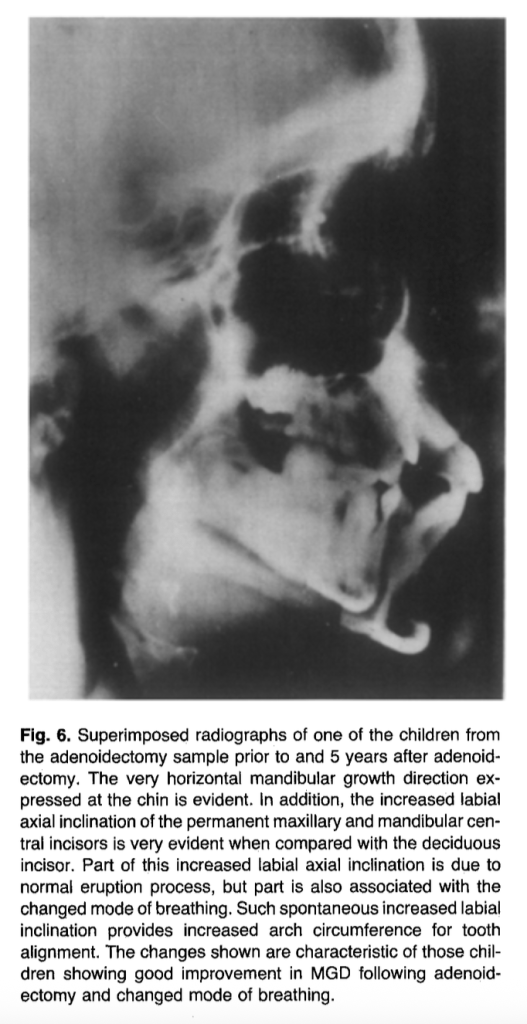
Showed significantly more horizontal mandibular growth
More horizontal than even female controls
Suggests partial recovery from earlier vertical growth
B. Boys After Adenoidectomy
Trend toward more horizontal growth
But not statistically significant
Still showed large individual variation
Group
Change in MGD After Adenoidectomy
Girls
Significant horizontal shift
Boys
Horizontal trend, not significant
Both
Greater variability than controls
Group
Boys MGD Mean (SD)
Girls MGD Mean (SD)
Variability vs Controls
Adenoidectomy
58° (18°)
61° (16°)
Higher (P<0.05)
Controls
62° (11°)
72° (9°)
Lower
Question to Ponder Why might girls show a clearer skeletal response than boys after airway correction?
6. Why Was Growth More Variable After Adenoidectomy?
Animal studies help explain this.
Key Insight from Primate Studies:
Some subjects respond to obstruction by:
Holding mandible down → vertical growth
Others:
Open mouth briefly for each breath → normal growth
👉 Different neuromuscular adaptations → different growth outcomes
CLINICAL IMPLICATIONS
1️⃣ Growth Direction Is Not Always Fixed
Traditionally, vertical growers were treated by adapting mechanics
This study suggests growth direction can partially recover naturally
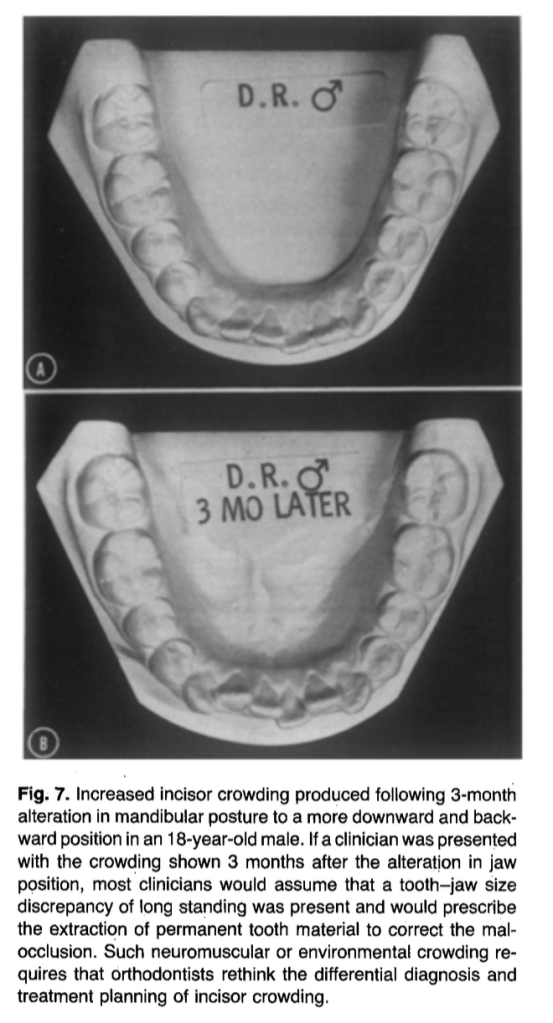
2️⃣ Incisor Crowding May Be Environmental
After adenoidectomy:
Incisors often change from retroclined → proclined
Arch circumference may increase
Some crowding may resolve without extractions
📌 Not all crowding = tooth–jaw size discrepancy
3️⃣ Timing Matters
Adenoids are largest around 5 years
Often regress naturally later by age 10 years
Surgery should be reserved for symptomatic young children
How might early airway evaluation change your extraction vs non-extraction decisions?
Final Take-Home Message
The mandible does not grow in isolation. It grows within a functional environment—especially the airway. As orthodontists, ignoring that environment means missing half the diagnosis.
Class III malocclusion is diagnostically easy to spot and frustratingly hard to treat. Parents see a negative overjet and come in early, but what you actually inherit is a complex mix of maxillary retrusion, mandibular excess, dentoalveolar compensation, and growth uncertainty. Functional Regulator‑3 (FR‑3) is one of the classic early‑treatment tools aimed at modifying growth in Class III children, introduced by Rolf Frankel in 1970 and designed to work not directly on teeth, but on the perioral and buccal soft tissues.
Levin, McNamara and co‑workers published a landmark retrospective controlled study in 2008 that, for the first time, followed an FR‑3 group and matched untreated Class III controls from pre‑puberty all the way past the pubertal spurt (about 9 years total). All FR‑3 patients were treated personally by Rolf Frankel, had good compliance, and wore the same appliance first full‑time (about 2.5 years), then part‑time (about 3 years) using his original protocol. For you as a student, that makes this study a practical “gold standard” for what FR‑3 can really do when the technique and compliance are not the problem
First, a Mental Reset: What FR-3 Is NOT
Before we discuss effects, let’s clear misconceptions:
❌ FR-3 does not stop mandibular growth ❌ FR-3 does not pull the maxilla forward like a facemask ❌ FR-3 does not “fix” all Class III cases
👉 FR-3 is not a force-delivery appliance 👉 It is a functional environment modifier
That distinction changes everything.
🔹 Components and Their Purpose
Component
Primary Function
Clinical Logic
Buccal shields
Remove cheek pressure
Allows transverse & sagittal maxillary development
Lip pads
Reduce upper lip pressure
Facilitates forward maxillary displacement
Lower labial wire
Controls mandibular incisors
Prevents excessive lingual tipping
Lingual support
Influences tongue posture
Improves oral seal & functional balance
One of the biggest mistakes students make with functional appliances is assuming that all changes seen during treatment are permanent. FR-3 is a perfect example of why time-segmented thinking (T1–T2 vs T2–T3) matters.
TIME POINTS (Keep these fixed in your head)
Time Point
Meaning
T1
Start of FR-3 treatment
T2
End of full-time wear (~2.5 years)
T3
Long-term follow-up after puberty (≈9 years from T1)
PART 1: Short-Term Effects (T1 → T2)
What changes while the child wears FR-3 full-time
Between T1 and T2, FR-3 patients were compared with untreated Class III controls. This comparison is crucial—because growth alone can fool you.
1. Maxilla: Real Growth + Modest Forward Positioning
📌 Key Finding
The maxilla does not just “look better”—it actually grows more.


 Dentowesome