Appliance components for correcting occlusal problems – Case 1

An 8-year-old boy with both permanent upper central incisors in crossbite; there is an anterior mandibular displacement on closure on 1̲/1̲ and a 5mm overbite on these incisors. 6edc21 are present in each quadrant.

  1. Adams’ clasps 6̲/6̲.
  2. Adams’ clasps d̲/d̲.
  3. Posterior capping.
  4. Z-spring(s).

An upper removable appliance incorporating these components is required to correct the anterior crossbite.

Image Based Questions – Orthodontics – Part 3

  1. IDENTIFY = DISTAL END CUTTER
  2. IDENTIFY = ADAMS PLIER
  3. IDENTIFY THE MALOCCLUSION =
    1. ANTERIOR CROSSBITE
    2. SCISSOR BITE
  4. IDENTIFY THE FIGURE = CBCT SCAN FIGURE
  5. IDENTIFY THE ANGLE MARKED BY THE ARROW IN THE
    1. MAXILLARY STUDY MODEL = 70 DEGREES
    2. MANDIBULAR STUDY MODEL = 65 DEGREES
  6. WHAT DO THE POINTS ON THE FIGURE DEPICT?
    1. GINGIVAL ZENITH
    2. GOLDEN PROPORTIONS
    3. CONNECTORS
  7. IDENTIFY THE GREEN LINE = HARMONY LINE
  8. IDENTIFY THE MALOCCLUSION AND HABIT = CLASS 3 MALOCCLUSION AND TONGUE THRUSTING HABIT
  9. IDENTIFY THE APPLIANCE = FOX PLANE
  10. WHAT IS RATIO BETWEEN MIDDLE AND LOWER FACE = 45:55
  11. IDENTIFY THE TYPE OF MOYERS MALOCCLUSION =
    1. TYPE C = MANDIBULAR ANTERIORS ARE PROCLINED + MAXILLARY IS RETROGNATHIC
    2. TYPE D = MANDIBULAR ANTERIORS ARE UPRIGHT + MAXILLARY IS RETROGNATHIC
    3. TYPE B = MAXILLA IS PROGNATHIC

Image Based Questions – Orthodontics – Part 2

  1. IDENTIFY THE SPACE MAINTAINER = BAND AND LOOP
  1. IDENTIFY THE APPLIANCE = DISTAL SHOE SPACE APPLIANCE
  2. IDENTIFY = ACTIVE TIE BACKS ***
  3. IDENTIFY = E- CHAIN
  4. IDENTIFY = GOLD CHAIN
  5. IDENTIFY = MONOCRYSTALLINE AND POLYCRYSTALLINE CERAMIC BRACKETS
  6. IDENTIFY THE TYPE OF ELASTICS = SETTLING ELASTIC
  7. IDENTIFY THE BRACKET = DAMON BRACKET
  8. IN WHICH SECTOR IS THIS CANINE IMPACTED = SECTOR 4
  9. IDENTIFY THE INSTRUMENT = SEPARATOR PLACING PLIER
  10. IDENTIFY = SPOT WELDER
  11. IDENTIFY = SAND BLASTER AND MICROETCHER
  12. IDENTIFY = WEINGART
  13. IDENTIFY = DELA ROSA

IDENTIFY = TWEED RIBBON ARCH PLIER**

Image-based questions – Orthodontics – Part 1

  1. IDENTIFY THE APPLIANCE = K LOOP DISTALIZING APPLIANCE

  1. IDENTIFY THE APPLIANCE = MANDIBULAR ANTERIOR REPOSITIONING APPLIANCE

  2. IDENTIFY THE APPLIANCE = KLAPPER SUPER SPRING


  1. IDENTIFY THE APPLIANCE = RIBBON ARCH APPLIANCE


  2. IDENTIFY THE APPLIANCE = PIN AND TUBE APPLIANCE

    7: Orthodontic Appliances | Pocket Dentistry
  1. IDENTIFY THE FIGURE = NOLA DRY FIELD SYSTEM


  2. WHO GAVE THE FOLLOWING STAGES = MCNAMARA AND BACETI


  3. IDENTIFY THE BONE = TRAPEZIUM, TRAPEZOID, CAPITATE AND HAMATE


  4. IDENTIFY THE APPLIANCE = LINGUAL CLEAT
  5. IDENTIFY THE AUXILIARY = UPRIGHTING SPRING


  6. IDENTIFY = MECKEL’S CARTILAGE


  7. IDENTIFY THE STRESS LINE = RED, BLUE, ORANGE  AND PURPLE


  8. IDENTIFY THE FUNCTIONAL APPLIANCE = BIONATOR

  9. IDENTIFY THE FUNCTIONAL APPLIANCE = FUNCTIONAL REGULATOR


  10. IDENTIFY THE FUNCTIONAL APPLIANCE = TOOTH POSITIONER

Ortho Case 4.2

An 11-year-old female presented with a class II division 1 malocclusion on a moderate skeletal class II pattern with reduced vertical dimensions complicated by an increased overjet (11mm), increased overbite, generalized spacing and bi-maxillary proclination.
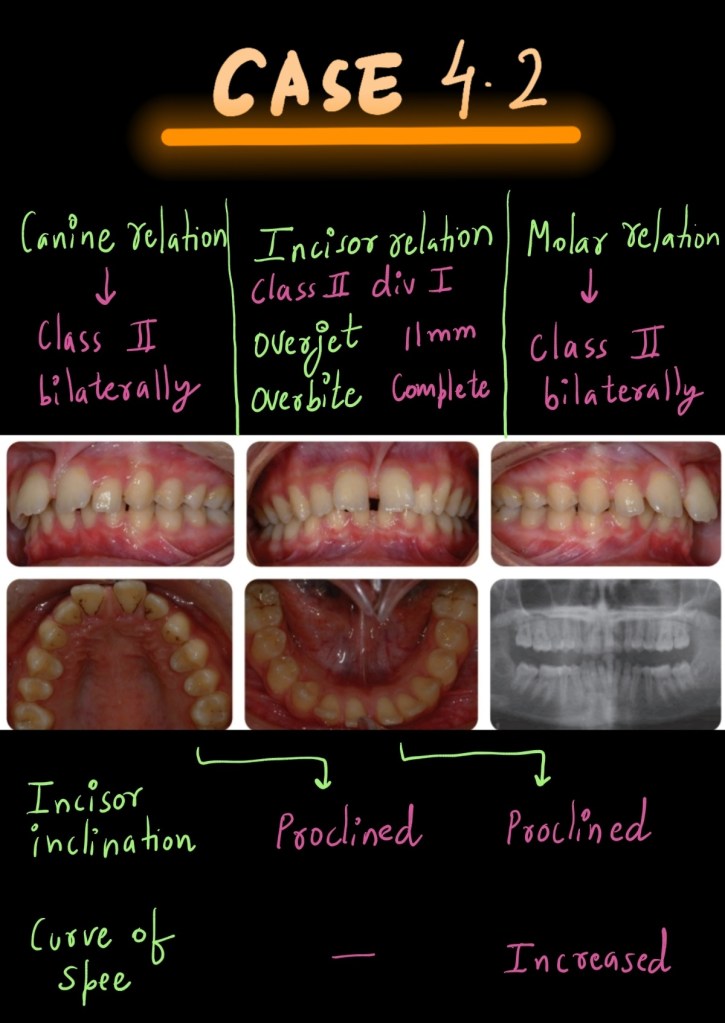
The aetiology of this malocclusion is multi-factorial.

The moderate skeletal class II discrepancy resulted in an increased overjet and class II molar relationship. The overjet was exacerbated by the presence of a lower lip trap. The generalized spacing was a result of an underlying dento-alveolar disproportion. This was compounded by bi-maxillary proclination, which arose due to resting soft tissue pressures and dento-alveolar compensation.

TREATMENT PLAN

• Integration of twin block functional and sectional lower fixed Herbst appliancee
• Continuation of functional appliance wear at night
only
• Use of headgear
• Inter-arch class II elastic traction following fixed
appliance placement

The prognosis for long-term stability of class II correction is good in this case, as the new maxillary incisor position will be controlled by the lower lip following the achievement of lip competence.
Adenoid Faces

  1. Head is tilted backwards
  2. Anterior open bite
  3. Increased overjet/ Proclined anterior teeth
  4. Crowding seen in anterior segment 
  5. Supra erupted posterior 
  6. Posterior crossbite
  7. Narrow maxilla and deep palatal vault
  8. Xerostomia = prone to caries
  9. Gingival recession
  10. Bleeding from gums
  11. Narrow nasal passages

Cantilever spring/ Finger spring 2m** = 

  1. used for mesiodistal tooth movement. 
  2. Active arm is 12 mm and retentive tag is 3-5mm. 
  3. Placed along long axis of the tooth which has to be moved. 
  4. If tooth is to be moved mesially, direction of helix will be distal
  5. The finger spring is activated by moving the active arm towards the teeth intended to be moved. This is done as close to the coil as possible.
  6. Activation of upto 3 mm is considered