PRIMARY HERPETIC GINGIVOSTOMATITIS

Oral disease transmitted by droplet spread/contact with the lesion.

🔹 Clinical Features:

• Incidence – Children & young adults. <6 months of age: Rare (Due to presence of circulating Ab. in the infant derived from the mother)

• Clinical Manifestations:

  1. Fever
  2. Irritability
  3. Headache
  4. Pain upon swallowing
  5. Regional lymphadenopathy

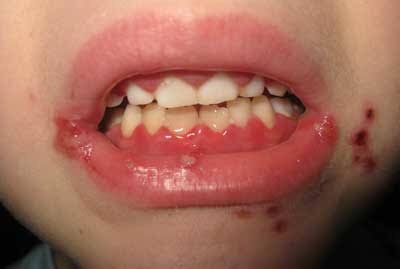
➡️ Within a few days mouth becomes painful with gingiva being inflamed, edematous & erythmatous.

➡️ Involvement of lips, tongue, buccal mucosa, palate, pharynx & tonsils.

Yellowish fluid-filled vesicles develop

⬇️

Rupture

⬇️

Shallow, ragged, extremely painful ulcers (grey membrane, erythmatous halo)

➡️ Ulcers heal within 7-14 days with No scar formation

➡️ Isolation of HSV-1 from these lesions after onset: (2 – 6 days)

➡️ Trigeminal for HSV-1 (Virus remain latent until reactivated in the ganglia)

➡️ Viral DNA to Host DNA – lifelong infection

➡️ Incubation Period: 2-20 days

🔹 Histological Features:

  • Herpetic vesicle is an intraepithelial blister filled with fluid.
  • The infected cells are swollen with pale cytoplasm & large vesicular Nuclei (Ballooning degeneration)
  • Lipschutz bodies: Intranuclear inclusion bodies. Eosinophilic, Ovoid, homogenous structure within the nucleus. They displace the nucleolus & nuclear cytoplasm peripherally ➡️ Peri-inclusion halo.
  • Giant cells seen
  • Connective tissue shows inflammatory cells
  • Vesicles rupture – exudates of fibrin, PMN, degenerative cells
  • Healing – peripheral epithelial proliferation

🔹 Treatment:

➡️ While most children will be asymptomatic, diagnosis of children with symptoms is made based on clinical presentation of erythematous gingiva, mucosal hemorrhages, and clusters of small erupted vesicles throughout the mouth.

➡️ The condition is highly contagious and complications range from indolent cold sores to dehydration and even life-threatening encephalitis.

➡️ Symptomatic relief primarily involves pain management and oral fluids to prevent dehydration until the viral infection subsides.

➡️ Acyclovir is a well established antiviral drug used effectively for the treatment of herpes simplex infections, chickenpox (shortened fever time), and shingles. It is also used frequently for children with immunodeficiency.

➡️ The current recommended dose of oral acyclovir is 40 to 80 mg/kg a day, divided in 3 or 4 doses, for 7 days. Caregivers should be aware of potential adverse effects of acyclovir such as headache, malaise, and vomiting.

Dr. Mehnaz Memon🖊

References: Shafers Textbook Of Oral Pathology 7Ed, Internet
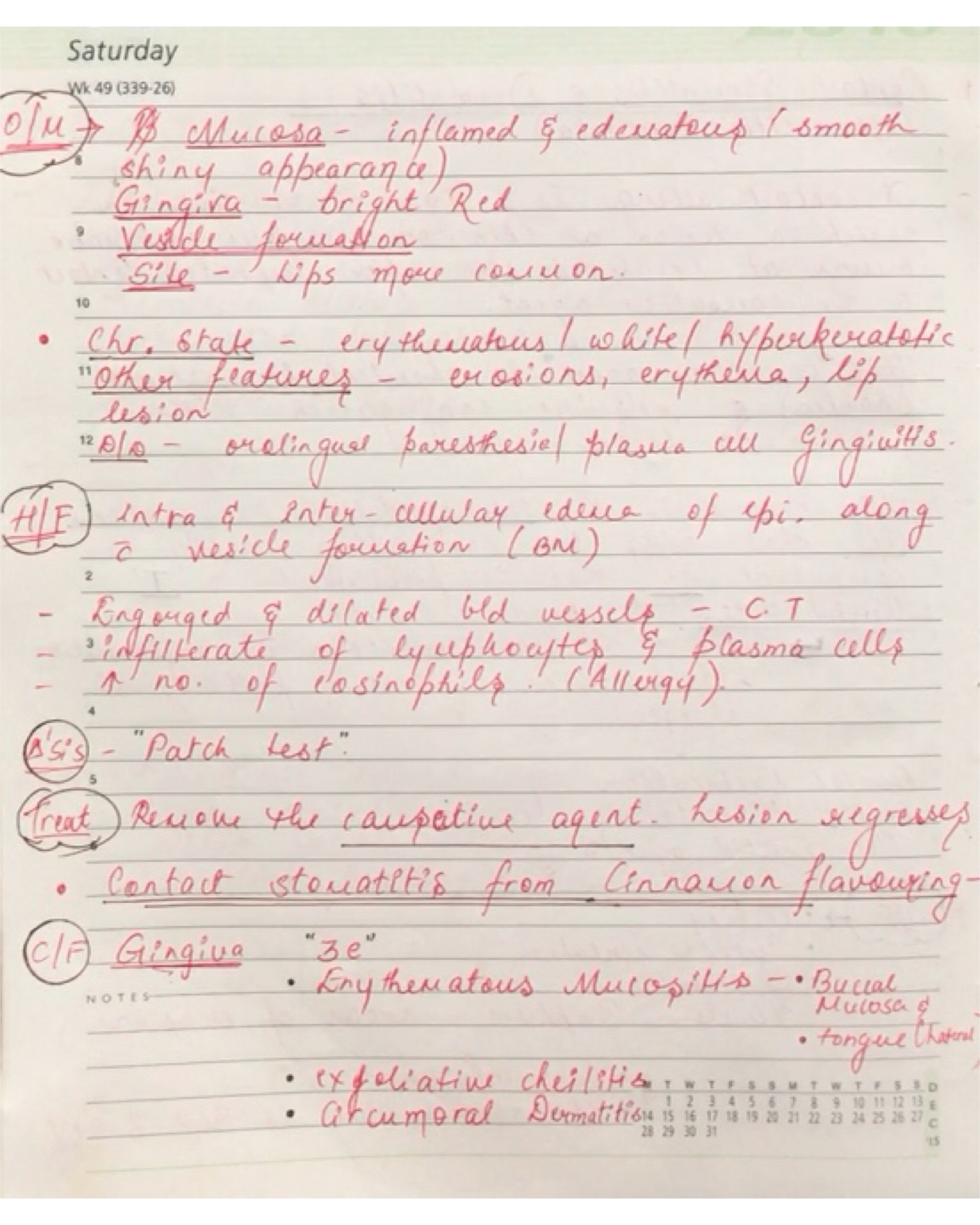
LICHENOID REACTION

🔹 Etiology:

  • Diabetes Mellitus (cell mediated contact hypersensitivity – Type IV)
  • Graft-versus-host disease
  • Drugs
  • Flavouring agents
  • Tobacco chewing

🔹 Drugs:

  • Antimalarials
  • NSAID’s
  • Anti-hypertensives
  • Hypoglycaemics
  • Beta-blockers

🔹 Clinical Features:

➡️ Reticular, erythematous, erosive lesions or ulcerations with whitish streak. Atypical location & absence of bilateral occurrence.

🔹 Histological Features:

  • Inflammatory infiltrate – diffuse & extends deep into lamina propria
  • ⬆️ no. of civatte bodies
  • Perivascular infiltrate seen
  • Lichenoid dysplasia

🔹 Prognosis:

  • Malignant transformation rate – high
  • Months to resolve.

Dr. Mehnaz Memon🖊

References: Shafers Textbook Of Oral Pathology 7Ed

ORAL LESIONS IN HIV INFECTION

🔹 Introduction:

➡️ They are clearly visible & can be easily diagnosed as per the clinical features alone – high viral load. They are useful markers of disease progression & immuno-suppression.

➡️ The EC (1995) gave two diagnostic criterias:

  1. Presumptive (initial clinical appearance)
  2. Definitive (special investigation for diagnosis)

🔹 Classification:

1) Group 1 lesions: (Lesions strongly associated with HIV infection)

🔸 Candidiasis – 4 clinical patterns observed

  1. Pseudomembranous
  2. Erythematous
  3. Hyperplastic
  4. Angular cheilitis

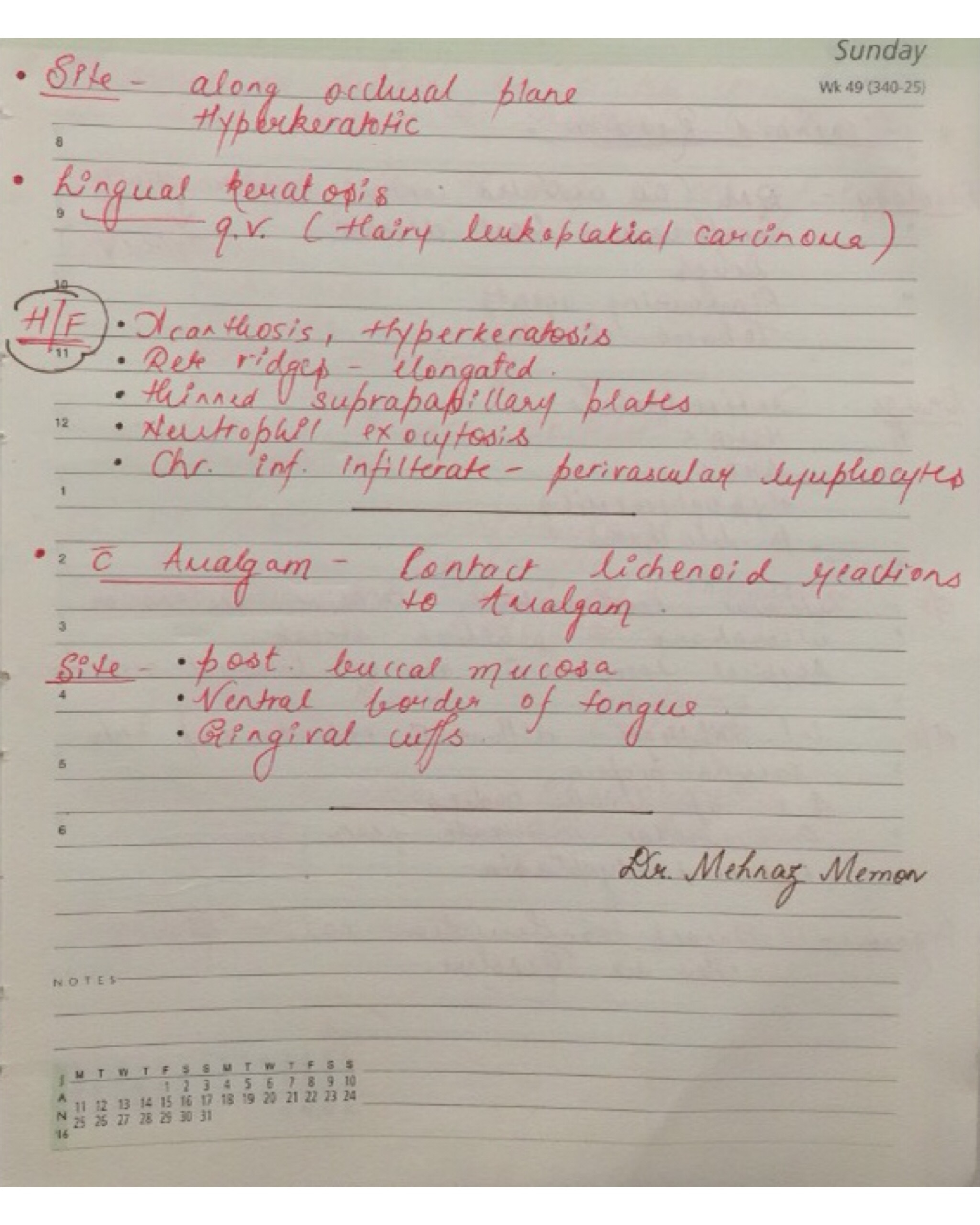
🔸 Hairy Leukoplakia – Associated with EBV

  • Lateral borders of tongue as painless, faint white vertical streaks or thickened & furrowed areas with shaggy keratotic surface – imparting corrugated appearance.
  • Homosexual males
  • Basal epithelial cells – harbour EBV (Latent)

⬇️

Langerhan cells by HIV

⬇️

cause reactivation of EBV

⬇️

epithelial hyperplasia

  • Histological Features:
  1. Acanthosis, hyperkeratosis
  2. Balloon cells – upper prickle layer
  3. Epithelial cells show Nuclear beading

🔸 Kaposis’s Sarcoma (HHV-8)

🔸 Non-hodgkin’s lymphoma

🔸 Periodontal Disease

  • Linear Gingival Erythema
  • NUG
  • NUP

2) Group 2 Lesions: (Less Common)

🔸 Bacterial infection

  • Mycobacterium TB
  • Mycobacterium avium

🔸 HSV, Herpes Zoster

🔸 Melanotic hyperpigmentation (Brown-black intra-oral focal/diffuse Macules)

🔸 Necrotizing Ulcerative Stomatitis
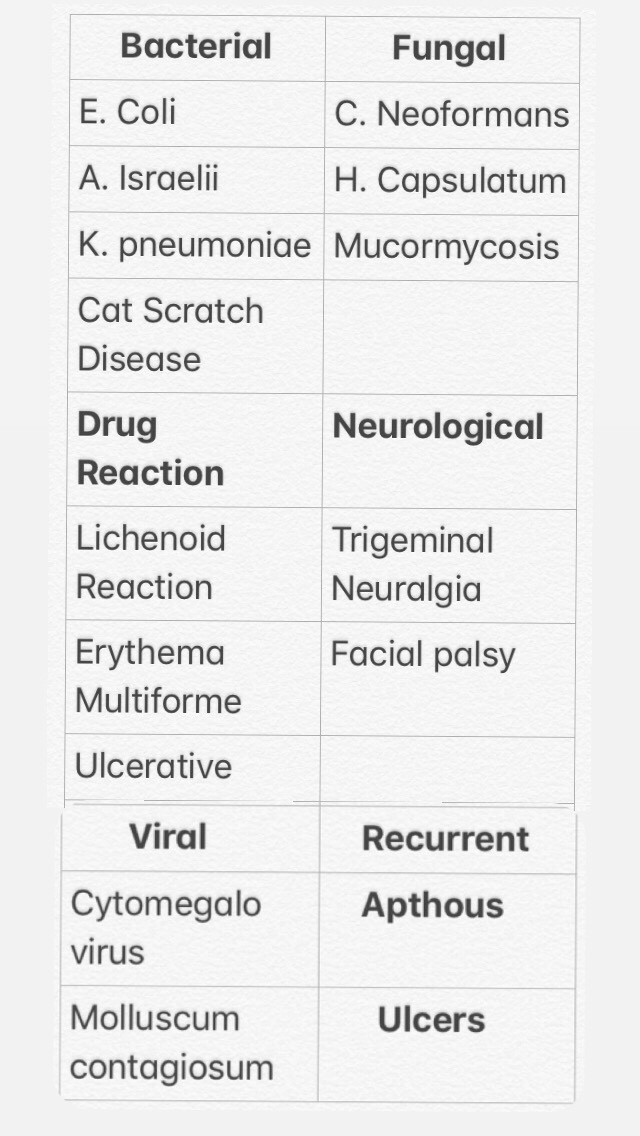
3) Group 3: (Lesions associated with HIV infection)

Dr. Mehnaz Memon🖊


References: Ghom’s Oral medicine & Internet
Amelogenesis Imperfecta

➡️ Represents a group of hereditary defects of enamel unassociated with any other generalized defects. It is entirely an ectodermal disturbance, since the mesodermal components of the teeth are basically normal.

➡️ Otherwise known as…

  • AI
  • Hereditary enamel dysplasia
  • Hereditary brown enamel
  • Hereditary brown opalescent teeth
AI can be inherited as an X-linked Autosomal Recessive or Autosomal Dominant condition

Prevalence: 1 in 700 to 1 in 15,000

Etiology:

  • Dental enamel is a highly mineralized tissue with over 95% of the volume occupied by unusually large, organized structures called the hydroxyapatite crystals.
  • The formation of these is controlled in Ameloblasts through the interaction of a no. of organic matrix molecules that include –
MMP20 (Matrix Metallopeptidase 20)
DSPP (Dentin sialophosphoprotein)

Develoment of Enamel:

➡️ 3 stages:

  1. Formative – deposition of organic matrix
  2. Calcification – Matrix mineralization
  3. Maturation – Crystallites enlarge & mature

Types of AI classification (Witkop and Sauk)

Based on clinical, histological & genetic criteria:

🔹 TYPE I HYPOPLASTIC

  • Pitted Autosomal dominant
  • Local Autosomal dominant
  • Local Autosomal Recessive
  • Smooth Autosomal dominant
  • Smooth, X-linked dominant
  • Rough Autosomal dominant
  • Enamel agenesis, Autosomal Recessive

🔹 TYPE II HYPOMATURATION

  • Diffuse Pigmented, Autosomal Recessive
  • Hypomaturation
  • Snow-capped teeth, X-linked
  • Autosomal Dominant

🔹 TYPE III HYPOCALCIFICATION

  • Diffuse Autosomal dominant
  • Diffuse Autosomal Recessive

🔹 TYPE IV COMBINATION TYPE

  • Hypomaturation – Hypoplastic with taurodontism
  • Hypomaturation – Hypoplastic with taurodontism, Autosomal Dominant
  • Hypoplastic – Hypomaturation with taurodontism, Autosomal Dominant

Clinical Features:

1) Hypoplastic – Enamel not formed to full normal thickness.

2) Hypomaturation –

  • The enamel can be pierced by an explorer point under firm pressure.
  • Can be lost by chipping away from the underlying normal appearing dentin.
  • Teeth normal in shape but exhibit a mottled, opaque white, brown-yellow discoloration.
  • Snow capped pattern – Zone of white opaque enamel on the incisal or occlusal third of crown.

3) Hypocalcified

  • The enamel is so soft that it can be removed by a prophylaxis instrument.
  • Yellow, brown or orange on eruption. Stained brown to black with time.
  • Rapid calculus apposition.
  • Coronal enamel lost with function except for the cervical portion which is mineralized better.
  • Autosomal Recessive – More severe.

Other Features:

  • Both dentition affected
  • Crown – Yellow to dark brown
  • Enamel might have numerous parallel vertical wrinkles or grooves.
  • Open Contact points.
  • Occlusal & incisal edges frequently abraded.

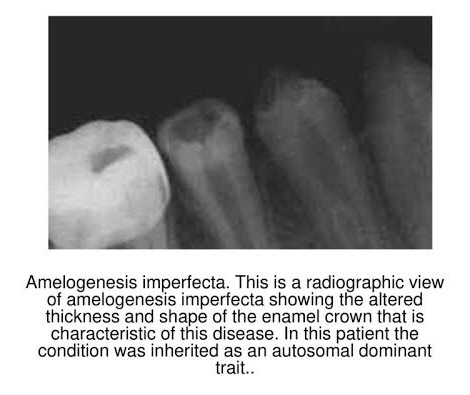
Radiographic Features:

Source: SlidePlayer
  • The enamel may appear totally absent.
  • When present may appear as a thin layer, chiefly over tip of cusps & on inter-proximal surfaces.
  • In some cases, calcification is so much affected that enamel and dentin seem to have the same radio density, making differentiation b/w the two difficult.

Histological Features:

  1. Hypoplastic: Disturbance in the differentiation/viability of Ameloblasts. Defect in matrix formation.
  2. Hypomaturation: Alteration in enamel rod & rod sheath structures.
  3. Hypocalcified: Defects of matrix structure & of mineral deposition.

Management:

  • Sealants/bonding
  • Prosthetic reconstruction

References: Shafer’sTextbook Of Oral Pathology; Internet