Rabie et al., Angle Orthodontist, 2003;73:457–465
Rabie et al., Angle Orthodontist, 2003;73:457–465
🔑 CORE CONCEPT
Stepwise mandibular advancement → Mechanical strain → ↑ Replicating mesenchymal cells → ↑ Osteoprogenitor population → ↑ Bone formation → ↑ Condylar growth potential
⚙️ STUDY DESIGN
| Parameter | Details |
|---|---|
| Animal | 250 female Sprague-Dawley rats |
| Age | 35 days |
| Control | Natural growth |
| One-step (OS) | 3.5 mm advancement + 3 mm inferior displacement |
| Stepwise (SW) | 2 mm initial advancement → +1.5 mm on Day 30 |
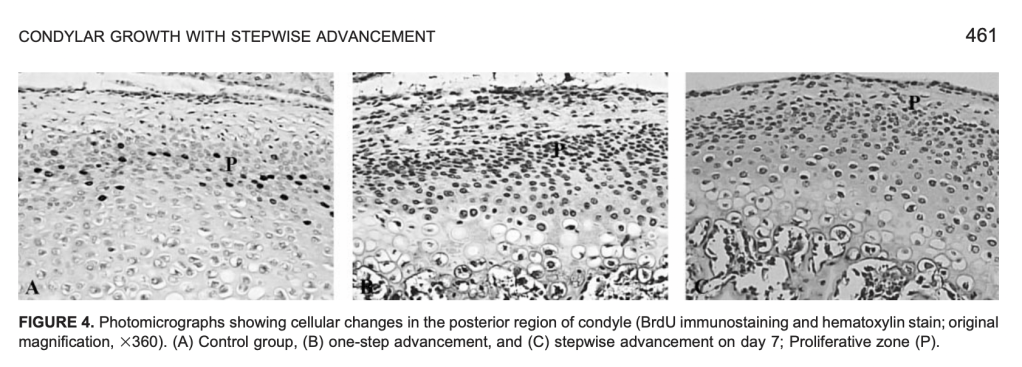
| Cell marker | BrdU immunostaining |
| Assessment | Replicating mesenchymal cells + new bone formation |
| Regions studied | Anterior, middle & posterior condyle |
| Main site of response | Posterior condyle |
🧬 MECHANISM
Forward mandibular positioning
↓
Stretching of posterior condylar tissues
↓
Mechanical strain
↓
↑ Mesenchymal cell replication
↓
Mesenchymal cells → chondroblasts / osteoblasts
↓
Cartilage formation + vascular invasion
↓
Endochondral ossification
↓
↑ New bone formation
📈 STEPWISE ADVANCEMENT — KEY TIMELINE
First advancement: 2 mm
- Day 7: ↑ replicating cells 31.61%
- Day 14: ↑ replicating cells 17.91%
- Cell replication increase occurs first
- Peak bone formation: approximately Days 30–37
Second advancement: +1.5 mm on Day 30
- Day 44: ↑ replicating cells 31.45%
- Followed by increased bone formation
- Day 60: bone formation 49% greater than natural growth and one-step advancement
⭐ KEY PRINCIPLE
Cell proliferation precedes bone formation.
⚖️ ONE-STEP vs STEPWISE
| Feature | One-Step | Stepwise |
|---|---|---|
| Advancement | 3.5 mm at once | 2 mm → +1.5 mm |
| Initial cellular response | Greater | Lower |
| Cell replication | Early increase → declines | Repeated increase after each advancement |
| Bone formation | Early peak → declines | Sustained/repeated increase |
| Long-term effect | Returns toward natural growth | Greater bone formation |
| Day 60 bone formation | Similar to natural growth | 49% higher |
🧠 WHY IS STEPWISE BETTER?
First advancement
→ recruits mesenchymal cells
→ cells proliferate
→ differentiate
→ bone formation
Second advancement
→ provides new mechanical stimulus
→ recruits another population of replicating cells
→ increases osteoprogenitor pool
→ additional bone formation
💡 Think:
“Advance → Recruit → Differentiate → Form bone → Advance again → Recruit again.”
📌 EXAM PEARLS
- Most active region: Posterior condyle
- Cell marker: BrdU
- BrdU indicates: Actively replicating cells
- Key cells: Mesenchymal / osteoprogenitor cells
- Cell proliferation precedes: Bone formation
- First SW peak in cell replication: Day 7
- Second SW peak: Day 44
- First SW bone formation peak: Days 30–37
- Day 60 SW bone formation: 49% greater than natural growth and one-step advancement
- Biological basis: Mechanical strain caused by mandibular advancement
- Clinical implication: Stepwise advancement may enhance condylar growth and mandibular length in Class II growth modification
⭐ ONE-LINE VIVA ANSWER
Rabie et al. demonstrated that stepwise mandibular advancement produces repeated mechanical strain, increasing mesenchymal cell replication in the posterior condyle; this expands the osteoprogenitor cell population and subsequently enhances endochondral bone formation and condylar growth potential.

 Dentowesome