Psychology :-

It is science dealing with human nature and behaviour.

It also includes understanding of pattern of mental process, characteristics of an individual.

(Sigmund Freud 1905)

Theory is modified by instinctive need and sexual factors

1) Oral stage :- (0-1 years)

Primary zone of pleasure is oral region and infants obtain gratification by stimulation of oral areas.

2) Anal stage :- (1-3 years)

Gratification is obtained by control of anal musculature for elimination and retension, provides him with sense of independence and autonomy.

3) Phallic stage :- (3-6 years)

Understands difference between sexes. Oedipus and electra complex develops.

4) Latency stage :- (7-12 years)

Libido submerges and child becomes unisexual. Personal identification begins and tries to socialize.

Reference :-

Writing :- notes made from mastering bds and Soben Peter books

Dental payments :-

It is defined as an arrangement under which a carrier and beneficiary are liable for a share of cost of dental service provided.

Mode of payments :-

A) Private fee for service :-  It is two party arrangement. In this patient takes appointment and dentist suggest appropriate treatment and inform patient about fee.

B) Post payment plans   :-  1st step to offer service through organized dental society plan. Under this patient borrows money from bank or finance company to pay to dentist fee.

C) Prepayment plans :-  It is 3rd party plan.  1) Insuarance companies.  2) Non profitable health service corporates e.g delta dental plans, blue sheild or blue cross.  3). Prepaid group practice.  4).  Capitation plans

D) Salary

E) Public programs

Reference :-

Writing :- notes made from mastering bds and Soben Peter books

Risk factor of dental Caries :-

Dental caries :- It is multifactorial microbial infectious disease characterized by demineralization of the inorganic destruction of the organic substance of the tooth.

Risk factor of dental caries are as follows :-

  1. Deep pits and fissures
  2. Lower socioeconomic status
  3. Recreational drug use
  4. Inadequate saliva flow
  5. Frequent snaking between meals
  6. Exposed roots
  7. Orthodontic appliances
  8. Any physical or mental illness or any oral application or restoration
  9. Inadequate exposure to flouride
  10. Visible heavy plaque on teeth
  11. Medium or high S. mutans and lactobacillus counts

Reference :-

Writing :- notes made from mastering bds and Soben Peter books

Pit and fissure sealants :-

They are defined as cements or a resin which is introduced into unprepared occlusal pit and fissures of caries susceptible teeth forming a mechanical and physical protective layer against action of acid producing bacteria and substrates

Types:-

  • 1 st generation sealants were achieved with an ultraviolet source
  • 2nd generation sealants are auto polymerizing
  • 3rd generation sealants are photoinitiated with visible light
  • Another recent innovation is flouride containing sealants

Indications :-

  • For deep occlusal fissure
  • Lingual pit
  • Occlusal fossa

Contraindications :-

  • Open occlusal caries lesions
  • Caries exist on other surfaces of same tooth
  • A large occlusal restoration is already present

Procedure :-

  1. Polish tooth surface
  2. Isolate and dry tooth surface
  3. Etch tooth surface
  4. Rinse tooth
  5. Isolate and dry tooth
  6. Apply bonding agent and cure it
  7. Material application- sealant material is applied to the tooth
  8. Evaluate the tooth
  9. Check oçcusal

Reference :-

Writing :- Notes made from mastering bds and Soben Peter books

CARISOLV

Carisolv

Carisolv is a chemomechanical method of removing dental caries that is minimally invasive. First of all a fluid is mixed consisting of a cocktail of amino acids and 0.5% sodium hypochlorite, and is applied to the dentin. The amino acids and hypochlorite form high-pH chloramines (pH 12), which react with the denatured collagen in the carious dentin, allowing it to be removed more easily. The softened dentin is removed
by scraping the surface with special hand instruments.


This technique requires longer clinic time than similar cavity preparation employing conventional bur removal. However, because
only soft carious dentin is affected and not normal dentin, the need for anesthesia is reduced, which is a major advantage in
dental-phobic patients, children, and special needs patients.

The technique is useful for the removal of root or coronal caries where access is easily
obtained, but requires repeated application of the solution over the caries.

Use of Carisolv Gel may be an inefficient method of removing caries at the enamel-dentin junction. Carious dentin may go unnoticed beneath the overhanging enamel because ideal access may require extensive preparation with a rotary bur. However, in this region, conventional removal of caries with a bur can be demanding, even when using magnifying loops.

Kidd et al. (1989) showed that demineralized dentin remained at the enamel-dentin junction in 57% of cavities that had originally been assessed as caries-free using conventional visual and tactile means. Some bacteria will remain at the enamel-dentin junction whatever approach is adopted therefore stained, hard dentin should be left alone in this area and no attempt should be made to remove it.

Carisolv Gel removes the smear layer and has no adverse effect on the bond strength of adhesive materials to dentin. Should Carisolv come into contact with exposed pulp tissue, no toxic effect should be expected.

Clinical Studies

Young et al. (2001) found no adverse effects with Carisolv when it was left in contact with rat pulp tissue.

Bulut et al. (2004) exposed the pulp chambers of 40 human first premolars with class V cavities and applied either Carisolv or sterile saline solution for 10min. The cavities were restored with a compomer filling material and the teeth extracted after either 1 week or 1 month. No adverse histologic effects due to Carisolv were observed.

Dr. Iswarya V

Reference : Operative Dentistry – Hugh Devlin

Dietary Analysis and Advice


Diet can affect teeth:
• Pre-eruptively—fluoride is the most important. The effect of calcium,phosphate, vitamins, and sugar is unclear, but is unlikely to be great.
• Post-eruptively—again, fluoride is important, as is sugar. Acidic foods or drinks can cause erosion.


Dietary Analysis


Aim: To determine the time for which the teeth are at risk of demineralization and
increase the potential remineralization period.
Indications:

(i) high caries activity,

(ii) unusual caries pattern,

(iii) suspected dietary erosion.


Dietary advice should be tailored to the individual. This is most easily done after analysing the patient’s present eating pattern.

Method:

A consecutive 3- or 4-day analysis (including at least one weekend day) is the most widely used, with the patient recording the time, content, and quantity of food/drink consumed. In addition, toothbrushing and bed-time should be indicated. When the form is returned the entries should be checked with the patient.


Analysis:
• Ring the main meals. If in any doubt,identify those snacks that contain complex carbohydrate. Assess nutritional value of meals.
• Underline all sugar intakes in red.
• Identify between-meal snacks and note any associations, e.g. following insubstantial meals or at school.
• Decide on a maximum of three recommendations.


Dietary advice should include an explanation of the effect of between-meals eating and sugary drinks. It must also be personal, practical,and positive! The suggestion that a child should select crisps when friends
are buying sweets is more likely to be followed than total abstinence.


Some helpful hints:
• Save sweets to be eaten on a day, e.g. Saturday dinnertime, or to be eaten at the end of a meal.
• All-in-one chocolate bars are preferable to packets of individual sweets.
• Foods which increase salivary flow (e.g. cheese, sugar-free chewing gum) can help to reverse the pH drop due to sugar if eaten afterwards.

• Treacle, honey, and fruit (especially fruit juice) are cariogenic.
• Artificial sweeteners should be avoided in pre-school children.
• Fibrous foods, e.g. apples, are preferable to a sucrose snack, but they can still cause decay and there is no evidence that they can clean teeth. Where the nutritional content of meals is inadequate, considerable tact is necessary. It may be possible to suggest that larger meals would reduce the temptation to eat snacks. For children who are ‘picky’ eaters snacks and sweets saved until the end of a meal can act as an encouragement to consume more food at mealtimes.

Remember that while cheese, peanuts, and crisps may constitute a safe snack in dental terms, they are all high in fat, and peanuts can be inhaled by small children. Also, ‘diet’ cola drinks are sugar-free, but can still cause
erosion if large quantities are drunk.
Therefore, dental dietary advice should be given in the wider context of the general health of the individual, i.e. decrease consumption of sugars and fats, and increase consumption of fibre-rich starchy foods, fresh fruit, and vegetables.
Meals provide a better nutritional balance than snacks. Hence good eating/drinking at mealtimes and avoiding between meals snacking is healthy.

Dr Iswarya V

General Practitioner,

Trivandrum.

Reference : Oxford Clinical Dentistry

Powerful ways to remember what you study.

Muhad Noorman P – Final year -Team Dentowesome

Most often we get frustrated by studying for days before exams, often we fail to recollect or forget while writing exams. It’s a quite natural process for a human body to forget.
However there are tricks to master our hippocampus and remember for long. Excelling in exams are only possible based on how much you remember topics.

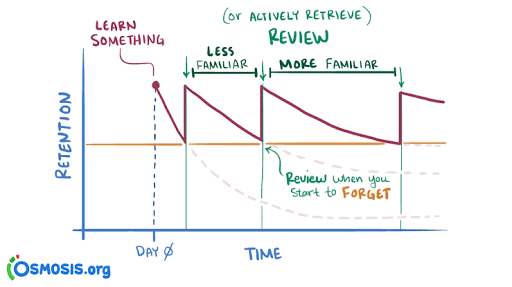
According to Ebbinghaus curve of forgetting information is lost from brain and we’re inable to recollect it.A typical graph of the forgetting curve purports to show that humans tend to halve their memory of newly learned knowledge in a matter of days or weeks unless they consciously review the learned material.

In oder to master long term memorization, we need to practice following methods

Revision : You still remember, A for apple and mitochondria is power house of cell. Constant and frequent revison makes your hippocampus to convert short term memory to long term memory.

Spaced repetition learning technique
Review Your Notes. Within 20-24 hours   of the initial intake of information, make sure the information is written down in notes and that you have reviewed them.
Recall the Information for the First Time. Recall the Materials Again.
Study It All Over Again
Difficult topics are checked regularly while easy topics could be reviewed occasionally

Take a break method
  Study for 20 minutes take a 5 minute break repeat pattern for 3 to 4 hours. It helps to gain more focus, At the end you’ll be happy for the productive hours. Without break in intervals your brains rejects input eventually your output becomes non productive. Mastering this techinque daily, your graph of productivity hits up.

Use body movements while learning,helps to Tigger muscle memory.


Make a story to memorize long topics. Pieces of information are always connected each other when a story link is given.

Organise your study table. Neat study table and fresh environment boost your intake . Bright light, fresh air, erect spine enhance brain functioning. Feel comfortable stay away from cluttered environment

Try to understand what you learn,  things you understand and studied are memorised 9 times.


Learn opposite things .

Switch your topics frequently. Similiar memory get’s intermixed (interference theory).

Things learned at the beginning and end are most memorized. Plan your topics accordingly.


Dicatate your topics and record in dictaphone you can download in your phone. Hear audios before you sleep, going to a beach or restaurant… Brain makes short term memory to long term memory while relaxed.

Visualise your topics. You still remembers the colour of precipitate and titration from your 12th chemistry lab practicals. Visualized memory is far beyond your imaginations.

Read first from books, 2 or 3 days later watch related topics videos from Youtube or any informative apps. Audio+ video learning brushes your previous stored information

Always make use of Sticky notes of alternating colours (prefer light colours- eye rejects dark colour for long time. Use sticky notes apps In your phone screen ( numericals, years etc.could be written in it).

  Last days before your exams should be used for rough reading or revison not for studying. Brain rejects things learned in stressed or a state of anxiety .( Your neurotransmitters makes it mess. Respect them 🤣)

Credits : 1) Forgetting curve definition:Wikipedia. Image : Internet. 2) Spaced repetition technique images from Internet and Osmosis.org website . Spaced repetition method content from Google.

How to study efficiently and score more marks in exams.

Muhad Noorman P, Final year Student – Team Dentowesome

Scoring good and better marks are always priority of any student irrespective of their level and class .  Hard work and smart work helps to score good marks.

Some tips to study smart and score more marks

1) Always organise yourself, Never procrastinate. Don’t think about wasted days ,look forward days ahead and make efficient planning.

2) Give importance to every subject equally, start with easy and end in hard nuts.


3) Identify your best time, and place to study. Ignore and never seek how you’re peer group works. Always your peer lies about studies, focus on yourself 🙂

4) Cut your social distraction, even though it sounds like a rocket science, regular practice helps to cut your Distraction. Utilise focus mode in android phones, Install Forest app. It Helps to prioritise your study hours.


5) Teach yourself as if you’re a teacher, trust me you’ll crack a million topics.


6) Teach you’re peer group , it’ll help to recollect and brush up your brain.


7) Regularly shift your studyplace , between a period of 1 hour or 2 hour later,  brain and mind always rejects learning from a same environment.


8) Get familiarise with the exam layout, use previous year question, understand nature of questions , prepare accordingly.


9) Always finish with previous questions first and if time allows study other topic left, mentioned in  University syllabus.


10) Reading a book not studying :  Revise topic after 1 or 2 hour, Prepare notes, put away books . Attempt topic as an exam question. Self realization is best methodology to improve yourself.


11) Never cut too many corners: Often we get devastated listening rumors , predictable questions . And the  truth is anything can come.


12) Practice mock exams during free times. Practice always make a man perfect.


13) Organize your answer while writing in exam papers. Never forget, Presentation matters. Include as much as figures, flowcharts, pie diagrams..etc.. Proove examiner you have an edge over topics. Underline important points with seperate ink.


14) Last but not least get an adequate sleep.(Ideally 6 to 7 hours)  Give some time for your brain and hippocampus to process your memory.

References: Image : Google