Category: Public Health Dentistry



DENTAL PUBLIC HEALTH



Are Dental Caries Reversible?
Manjusha Madkaiker
ARE DENTAL CARIES REVERSIBLE?
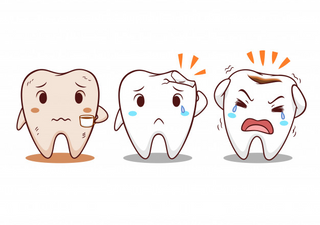
Dental caries is a multifactorial irreversible microbial disease of the calcified tissues of the teeth, which is characterized by demineralization of the inorganic portion and destruction of the organic substance of the tooth, which often leads to cavitation. Dental caries is one of mankind’s ancient and longest disease associated with the oral profession. Everyday around 2.3 billion people are affected by dental caries.
But since the late 20th century with new advancement in technologies there is slow but gradual progress in the development of the vaccine .1972, a caries vaccine was said to be in animal testing in England.
DISEASE ETIOLOGY- A CHANGING TREND

1. Acidogenic theory – this theory was proposed by WD Miller in the year 1881 which states the combined effect of acid and oral microbes leads to the decalcification of tooth structure .This theory was incidentally evolved, and according to this theory the microbes in the oral cavity metabolize the dietary starch and lead to production of organic acids that hence dissolves the tooth structure .
2.Proteolytic Theory – Proposed by Pincus in the year 1949 which states that the proteolytic breakdown of dental cuticle is the first step in the various process. He proposed that Nasmyth’s membrane and enamel proteins are mucoprotein which are acted upon by the sulphates enzyme of the bacilli and yield sulphuric acid, this acid combines with the calcium of hydroxyapatite crystals and thus destroy the inorganic components of the enamel.
3.Protelysis-Chelation theory – Proposed by Schatz in the year 1955. Chelation is the process which leads to the formation of covalent bonds which leads to poorly dissociated and/or weakly ionised compound .Therefore dental caries are considered as the bacterial destruction of organic components of enamel and the breakdown products of these organic components to have chelating properties and thus dissolving the minerals in the enamel even at the neutral/alkaline pH.
HYPOTHESIS ON THE DEVELOPMENT OF DENTAL CARIES
1. Nonspecific plaque hypothesis
In the end of 19th century the cause of dental infection was said to be due to non-specific overgrowth of all bacteria in dental plaque this was called as the nonspecific plaque hypothesis given by Black in 1884 and Miller 1890. This hypothesis was proposed irrespective of the virulence of the bacteria.
So, the best way of disease prevention in the 19th century was non-specific mechanical removal of as much plaque as possible by e.g., tooth brushing or tooth picking.
The new advancements in the 20th century lead to to isolate and identify bacteria led which resulted in the abandoning of the NSPH. But mechanical plaque removal remained the most efficient way of preventing disease.
2.Specific plaque hypothesis
This hypothesis proposed by that the use of antibiotics against specific bacterial species could cure and prevent caries. However, results even today, are not very promising, the antibiotics reduced the abundance of cariogenic bacteria but failed to eliminate them thus as soon as the treatment was stopped, abundance increased while a long period of treatment leads to antibiotic resistance.
3.Ecological plaque hypothesis
4.Keystone pathogen hypothesis.
CARIES ICEBERG
1. On top i.e. the floating iceberg represents the clinical cases.
2. The submerged portion represents the carriers.
3. The part in the waterline represents the apparent and unapparent cases.
4. And at the tip are the ones with multiple health problems.
THE VACCINE
Vaccines are an immunobiological substance designed to produce specific protection against a given disease. It stimulates the production of a protective antibody and other immune mechanisms. Vaccines are prepared from live, inactivated or killed organisms, and toxoids.
Immune response is divided Into
1. Primary response
2. Secondary response (booster response)
Although development of a vaccine for started around 30 years back, but no success was achieved due various reasons.
But the formation of dental caries can be prevented or the progression can be slowed by the use of fluoride, use of sugarless products and sealants, and increased access to dental care have had a significant impact on the amount of disease in people. Many of these approaches can be broadly effective. Hence the dental caries can be reversible to a certain extend. However, economic, behavioural, or cultural barriers have continued the epidemic of dental disease.
Integrating the caries vaccine after its development into public health programs could be beneficial in bring dental caries to a minimal level.
Diagnosis of Dental Caries
Introduction:
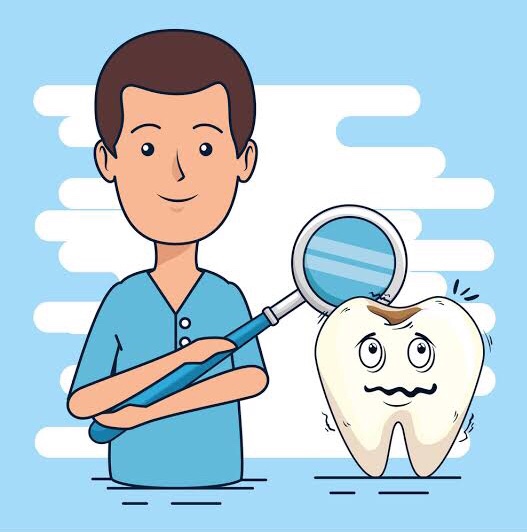
Early detection and diagnosis of dental caries reduces irreversible loss of tooth structure, the treatment costs and the time needed for restoration of the teeth. Dental caries often initiates at the fissures in the occlusal surface of the tooth. Conventional examination for caries detection is primarily done using visual inspection, tactile sensation and radiographs. While these methods give satisfactory results in detection of cavitated lesions, they are usually inadequate for the detection of initial lesions. Because of these deficiencies, new detection methods have been developed to aid better diagnosis.
Conventional Methods Used in Diagnosis of Dental Caries
It is one of the most common diagnosis methods implemented by dentists. In order to make an accurate assessment, the teeth should be clean, dry and examined under a light source. In visual examination, changes in tooth structure such as; enamel dissolution, white spot lesions, discoloration, surface roughness and presence of cavitation are assessed. When illuminated, the carious tissues scatter the light and make enamel look whiter and opaque. This is due to increased porosity caused by demineralization. Similarly, when dentin undergoes demineralization, a shadow is observed under the intact enamel. When caries progress, the surface breaks down and a cavitation is formed.
The explorer and the dental floss are used for tactile examination but the use of an explorer is not preferred because:
- Sharp tip of the explorer can produce traumatic defects on the enamel surface,
- The cariogenic bacteria may be transferred from one tooth surface to another,
- Probing may cause cavitation and fracture in the incipient lesions,
- Explorers have low sensitivity resulting in undetected lesions.
If the explorer catches or resists removal when moderate pressure is applied, and when this is accompanied by one of the following;
- Softness at the base of the lesion,
- Opacity adjacent to the pit or fissure,
- The enamel is softened adjacent to the pit and fissure, we can conclude that the area is carious.
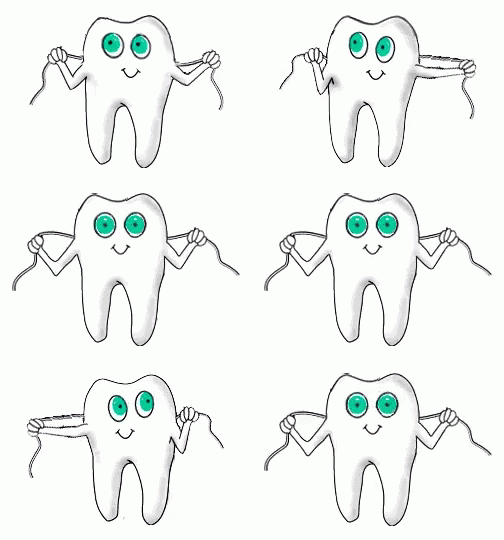
Pickard, proposed the use of dental floss for the detection of caries. When there is food packing between the teeth and the floss is frayed when passed through the contact area, this might be the indication of caries.

Radiographic examination has great value in detecting caries lesions especially when they are not clinically visible. In low caries population, as a result of fluoride use, the surface of enamel does not break down, making the caries detection harder. In recent years, the incidence of such lesions has increased dramatically. According to studies, bitewing radiography has been proven to be an effective method in the detection of proximal caries and hidden caries.
Besides its advantages, radiographs also have some limitations too. For this reason, it is advisable to use clinical evaluation along with radiographic imaging. The disadvantages of radiography are as follows:
• Proximal contacts are overlapped,
• The lesion depth may appear to be increased due to angulation and this may lead to false diagnosis,
• Occlusal lesions may not be detected because of the superposition of the buccal and lingual cusps,
• The real cause of the radiolucency can’t be determined whether it is due to caries, resorption or wear,
• The superficial demineralization of the buccal and lingual surfaces may seem like proximal caries,
• Active and arrested caries can’t be distinguished in the radiographs.
• Radiographs may give false positive results due to a phenomenon called “Mach band effect”. In this perceptual phenomenon, the contrast between the dark and lighter areas has increased, resulting in a dark demarcation band. This effect causes formation of a radiolucent area in dentin enamel junction.

• Cervical burn out is another optical phenomenon where a wedge shaped radiolucent area is seen between the bone and the cemento-enamel junction. This effect is due to tissue density and the low penetration of X-rays at the cervical region.

Despite the disadvantages, radiographs are the most commonly used diagnosis tool and with the development of new techniques many of the problems are solved.
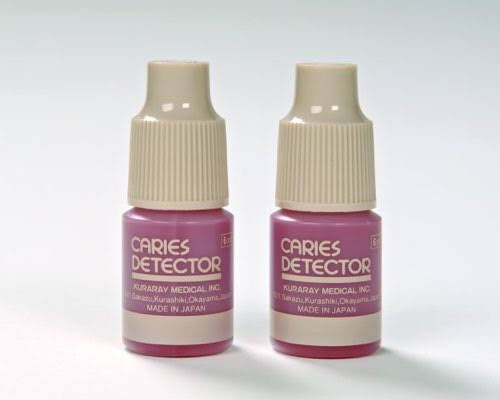
There are two layers of decalcification in carious dentin. The first one is the soft and infected layer which doesn’t have the capacity of remineralization. The second one is hard, intermediately decalcified and has the ability of remineralization. Many studies were carried out to differentiate these layers. Although there are opinions stating the benefit of caries detection dyes, there are also opinions that dyes can lead to over-reduction in the dentin.
Most clinical investigations have concluded that, caries detection dyes don’t stain bacteria but stain the less mineralized organic matrix. In a study of Demarco et al. they suggested that dye remnants that remained on the walls of the cavity may cause a decrease in the shear bond strength between the composite restorations and the enamel.
In the upcoming blog post we will learn about the Novel Methods for Caries Detection..
Happy Reading😊
References: Meandros Med Dent J 2018;19:1-8, Image source: Google
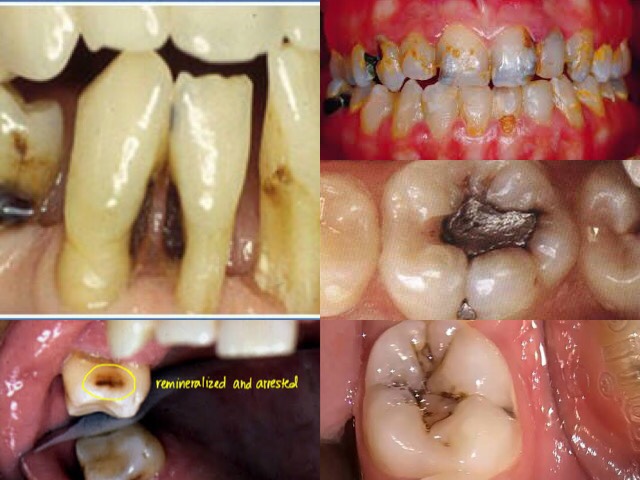
Types Of Caries
• Clinical Classification of Caries:
1️⃣ According to Anatomical Site –
- Pit & fissure caries
- Smooth Surface Caries
- Cervical
- Root caries
2️⃣ According to rate of caries progression –
- Acute dental caries
- Chronic dental caries
3️⃣ According to nature of attack-
- Primary
- Secondary
4️⃣ Based on chronology –
- Infancy caries
- Adolescent caries
A. Pit & Fissure Caries:
https://dentowesome.wordpress.com/2020/05/11/pit-fissure-caries/
B. Smooth surface caries:
- On proximal surface of teeth or gingival 3rd of buccal & lingual preceded by formation of plaque.
- Early while chalky spot – decalcification of enamel.
C. Linear Enamel Caries:
- Atypical form
- Found in primary dentition
- Gross destruction of labial surface of incisor teeth
https://dentowesome.wordpress.com/2020/05/07/dental-caries/
D. Root caries:
- Soft progressive lesion that is found everywhere on root surface that has least connective tissue attachment & is exposed to oral enviornment.
- Older age group & gingival recession
E. Acute Dentinal Caries:
- Rapid clinical course
- Early pulp involvement
- Initial lesion is small, while rapid spread of process at DEJ & diffuse involvement of dentin produce large internal excavation.
F. Rampant Caries:
Sudden, rapid & almost uncontrolled destruction of teeth affecting surface that are relatively caries free.
G. Nursing bottle caries (Baby bottle syndrome)
Affect deciduous teeth due to prolonged use of nursing bottle containing milk, sugar or honey.
💬 What is 👶 bottle decay? What causes it and how to prevent it? 👇🏻
H. Chronic dental caries: (Slower progress)
I. Recurrent caries: (Presence of leaky margins)
J. Arrested caries:
- No tendency of future progression, caries become static.
- Brown pigmentation in the hard tissue.
Dentowesome|@drmehnaz🖊
Image Source: Google.com
Planning :-
It is defined as systemic approach to defining problem, setting priorities, developing specific objectives and goal, determining alternative strategies and methods of implementation.
Planning results in formulation of plan.
A Plan is a decision of coarse of action.
Uses of planning :-
- To match limited resources with many problems
- To eliminate wasteful expenditure or duplication of expenditure
- To develop best coarse of action to accomplish a define objective.
Information needed for planning :-
A) Sociodemographic population profile :-
- Age
- Ethnicity
- Population
- Mobility
B) Existing service provision :-
- Availability of services
- Range of treatment available
- Costs of care
- Asset to service
- Effectiveness of intervention
C) Disease level :-
- Epidemiological data
- Range of condition
- Severity of disease
- Disease condition
- Trends in disease
D) Public concerns :-
- Population priorities
- View of health services
- Demand on health services
Planning cycle :-
- Indentify problem
- Determining priorities
- Developing of programme goals, objectives and activities
- Resource identification
- Identifying constraints
- Identify alternative strategies
- Develop implementation strategy
- Implementation
- Monitoring
- Evaluation
Reference :-
Writing :- Notes made from mastering bds and Soben Peter books
Dental Manpower :-
It is defined as individual with kind of knowledge , skills and attitude needed to achieve predetermined health, targets and ultimately health status objectives.
It requires continuous monitoring and evaluation.
WHO has suggested following framework in formulating planes
- Analysis of existing situation
- Policy formulation
Current status :-
- India consist of 298 dental institutions which produces 25,000 to 30,000 BDS graduates every year.
- In year 2004 dentist to population ratio in India was 1:30,000
- Due to geographic imbalance between dental colleges the ratio is disturbed in rural and urban areas.
- In urban areas dentist population ratio is 1:10,000 and in rural areas it is 1:2.5 lakhs.
- In 1990 registered hygienist were 3000 while registered lab technicians were 5000 in India.
- As per registration one can make one hygienist serve to 7 dentist and 1 lab technician provide services to 4 dentist while ideal ratio is 1:1.
Reference :-
Writing :- notes made from mastering bds and Soben Peter books
Negligence :-
It is defined as lack of reasonable care and skill or willful negligence on part of doctor in treatment of patient whereby health or life of patient is endangered.
There is failure of health care professionals to meet his or her responsibility to patient, with resultant injury to patient.
Dental professionals are legally liable for their own negligence.
Types of negligence :-
- Nerve damage
- Facial damage
- Failure to detect and treat gum disease
- Failure to carry out root canal treatment instead of extraction
- Fractured jaw during treatment
- Incorrect anesthesia
Reference :-
Writing :- notes made from mastering bds and Soben Peter books
Jurisprudence :-
It is application of legal status and regulations that pertain to State Dental Practice Act
Dentist must adhere to federal, State, Civil laws in all relations with public
As an agent of dentist, assistant should be aware of different forms of jurisprudence and role of assistance play in each case
It is divided into two parts 1. Civil law 2. Criminal law
- Civil law :- If a civil charge is brought against a dentist, he or she become defendant.
- Criminal law :- If criminal charges may be filed against dentist for malious injury, income tax evasion, narcotics misuse or any other criminal reason.
Reference :-
Writing :- notes made from mastering bds and Soben Peter books
Ethics :-
It is defined as part of psychology that deals with moral conduct and judgement.
Principles of ethics :-
A) To do no harm :- Principle is attributed to Hippocrates and is considered to be foundation of social morality
B) To do good :- It should be role of dentist and dental hygienist to benefit patients as well as not to inflict harm
C) Respect for person :- It consists of 2 fundamental ethical considerations i.e 1. Autonomy consent 2. Informed consent
- Autonomy consent :- It is principle that dictate that health care professionals respect patients right to make decisions concerning treatment plan
- Informed consent :- It is a legal as well as ethical concept and is a component of patients right to autonomy
D) Justice :- It demands each person be treated equally
E) Trustfulness :- Patient doctor relationship is on trust
F) Confidentially :- Patients have right to expect that all their care will be treated confidentially
Reference :-
Writing :- Notes made from mastering bds and Soben Peter books
 Dentowesome