Erosion

In simple words, Erosion is a chemical reaction, it happens mostly on the lingual aspect of the teeth.

Aetiology

  • Alcohol
  • Soft drinks
  • Citrus containing drinks
  • Yoghurt based food
  • Iron tablets
  • Chlorine from swimming pool
  • Working in an acid environment
  • Oesophagal reflux disease

How does it look? It looks like a broad saucer shape %

  • lesions appear grooves, wedge-shaped or irregular
  • Highly polished surfaces are produced
  • Hypersensitivity in dentin exposed lesion
  • In some cases, caries can occur due to loss of enamel

Treatment

  • Early Diagnosis- may stop the progress of erosion
  • Dietary analysis:
    • Finish the meal with mil or cheese- neutralize pH of the oral cavity
    • Delay toothbrush by 20 to 60 mins after a meal in the night
    • Avoid holding and swishing of drink in mouth in the mouth
  • Patient with GERD
  • Materials that aid in remineralization and decrease sensitivity.
    • Fluoride mouth rinses
    • Varnishes
    • Desensitizing agents
  • Dentin Bonding Agent- application to exposed dentin.

Maintence

  • Nightguards like splints
  • Oral hygiene monitoring
  • Monitor tooth surface loss using intramural landmarks and die stone impression during the first visit of the patient.

Chronic Periodontitis

What is periodontium?

It involves all supporting structures which is composed of:

  • gingiva
  • alveolar mucosa
  • cementum
  • periodontal ligament
  • alveolar bone
  • Slowly progressive disease
  • It occurs in response to plaque and calculus.
  • It progresses aggressively in patients with
    • diabetes: type I
    • Smoking habits: more attachment loss and bone loss, more furcation involved, and deeper pockets.
    • Thyroid condition
    • It can occur in childhood and adolescence also

What is pocket?

It is pathological deepened cervical gingiva. We can observe that junctional epithelium (attachment of gingival structure) is broken down or detached from coral end. This causes deepened sulcus. Hence, Plaque and calculus are deposited.

Clinical Features

  • Gingival Inflammation is present
  • We can see pocket formation
    • Slight: 1-2mm
    • Moderate: 3-4 mm
    • Severe: 5 mm or more
  • Loss of attachment (recession)
  • Presence of inflammatory swelling
  • Colour ranges from pale red to magenta
  • Loss of stippling
  • Blunted or rolled gingival margin
  • Blunt or flattened interdental papilla
  • All the signs of inflammatory may not always be present
  • May bleed on probing the pocket
  • Increased gingival fluid exudation
  • Purulent exudate may be present
  • Signs of inflammatory may be masked because of fibrotic changes
  • Horizontal and Vertical bone loss
  • Progressive increase in the mobility of teeth involved due to bone loss

How do you differentiate periodontitis and gingivitis?

It’s simple, in giginvitis, you can observe no bone loss and mobility whereas, in periodontitis, you can observe mobility, deep pockets and recession.

Differential Diagnosis

  • Age of patient
  • Rate of disease progression
  • Familial nature of the aggressive disease
  • Can be correlated with the amount of plaque and calculus present

How to calculate whether chronic periodontitis is generalised or localised based on number of teeth?

Rules:

Generalised – when >30% of teeth show attachment loss

Localised- when <30% of teeth show attachment loss

Let’s consider two type of patents.

In patient A, the number of teeth is 32.

We calculate 30% of total teeth, which means 10 teeth are affected by periodontitis. This denotes patient has the generalized condition.

If 7 teeth have recession and pockets, that’s is less than 10. The patient had localized condition.

In patient B, the total number of teeth is 28

We calculate 30% of 28 teeth, which means 8 teeth are affected. This denotes patient has a generalized condition.

If 6 teeth have recession and pockets, that’s is less than 8. The patient had localized condition.

Symptoms

  • Usually painless due to absence of receptors
  • Sometimes, localised dull pain radiating deep into the jaw during brushing
  • Sensitivity to hot and cold or both due to exposure of root dentin. The sensation will be tingling
  • Food lodgement in the areas of bone loss cause discomfort
  • Due to food accumulation, patients feel itchness in the gingiva. They try to remove it using a toothpick.

Disease Progression

  • Slow rate- depends on the post immunity but ageing or disease factors or diabetes play a role in the rate.
  • Onset can occur at any time in the presence of calculus and plaque at site-specific surfaces.
  • It is more evident in the mid-30s due to accumulative effect.
  • Some areas progress at a faster rate or slower rate.
  • Faster Rate- due to more accumulation of plaque and short conical roots such as anteriors

Infective Endocarditis and it’s Types

Defination

In simple words, It’s a microbial infection of heart valves or lining of endocardium.

The microbial organism can be bacteria or parasite or fungus or rickettsia or chlamydia.

Let’s check out different types!

  1. Subacute Bacterial Endocarditis
  2. Acute Infective Endocarditis
  3. Post Operative Endocarditis
  4. Right Sided Endocarditis

What’s Subacute Endocarditis?

  • It is caused by relevantly low virulence organisms like streptococcus viridan
  • It mainly effects
    • damaged heart valves
    • MacCallum plaque which is irregular thickness usually found in the left atrium in patients with rheumatic fever
    • Also, Low pressure areas of heart
  • What are the Characteristics Features? It’s simple 4 points 🙂
    • Formation of vegetation
    • Emboli formation
    • Mycotic aneurism
    • Valvular Regurgitation

What is Acute Infective Endocarditis?

  • It is caused by high virulence organism like staph. aureus
  • It effects both normal and damaged valves
  • Doc, you need to be careful cause clinical course can be fatal if untreated within 6 weeks!!
  • What are the Clinical features? How is it different from subacute?
    • Valve destruction is greater
    • Abscess formation is common
    • Valve cusp perforation can also occur

What is Post-operative Endocarditis?

  • As the name indicates, during cardiac surgery, the patient develops infective endocarditis
  • What is a prosthetic valve? It’s an artificial valve replacing the mitral or aortic valve
  • It mainly affects the prosthetic valves, especially aortic valve
  • Source of infection- staph epidermis
  • Generally, within 3-60 days of a health care facility admission, the nosocomial infections will cause endocarditis
  • It accounts for 20% of Infectious Endocarditis. So, provide clean facilities in hospital, doc.
  • Typically, it is associated with invasive procedures like dental procedures and intravenous access.

What is Right-sided Endocarditis?

  • Who is mainly affected? Intravenous drug addicts
  • It is caused when they share a syringe with other people during drug abuse
  • Source of infection: staph aureus and candida present on the surface of the skin
  • So, the microorganisms enters into the body through veins during drug abuse.
  • The right side of the heart is affected, especially tricuspid valve.
  • Larger bloodborne particulate matter in IV drug abusers typically deposits on the tricuspid valve.
  • Remember, tricuspid valve is rarely involved in other causes of Bacterial Endocarditis
  • Generally, the clinical course will be subacute or chronic or insidius.

Infective Endocarditis- Etiology

  1. Causative Organisms
  2. Predisposing Procedures
  3. Predisposing Conditions

Let’s read about causative organisms that cause endocarditis

  1. Less Virulent: Streptococcus
    • virdans
    • mitis
    • bovis
  2. Highly Virulent
    • Staphylococcus aureus
    • Gonorrhoea
    • Pseudomonas
    • Streptococcus pneumonia
  3. Coagulase-negative staphylococci
  4. Gram-Negative HACEK
    • Haemophilus
    • Actinobacillus
    • Cardiobacterium
    • Eikenalla
    • Kingella
  5. Bartonella (responsible for the high number of culture-negative endocarditis cases)
  6. Fungus, moulds, yeasts- cause endocarditis in immunosuppressive patients.

Let’s read about predisposing procedures!

  • Respiratory infection
  • Obstetric delivery
  • Dental procedures (including routine tooth cleaning)
  • Genitourinary procedures
  • Skin infections
  • Prosthetic Valve Recipient
  • Cardiac Surgery
  • Biliary duct surgery
  • Cystic surgery in females

Let’s talk about predisposing conditions

  • High-Risk Group
    • Prosthetic valves
    • Surgically constructed AV shunts
    • Complex valve surgery
  • Moderate Risk Group
    • Mitral valve collapse
    • Mitral regurgitation
    • Hypertrophic myocardiopathy
  • Low-Risk Group
    • Coronary atrial bypass
    • Intracardial placement

Infective Endocarditis- Pathophysiology

What are the sites where the infection can occur? Cause these are areas of the nidus where the infection can occur!

  • Normal cardiac endothelium
  • Damaged valves
  • Mitral valve and aortic valve are most likely to be involved
  • Surgically constructed AV shunts
  • Prosthetic valves

Imagine, a breach in the endothelium caused by

  • Turbulent flow (e.g. valvular stenosis or valvular regurgitation) or
  • Intravascular device-related injury (e.g. catheters)

After the breach, the platelets and WBC’s aggregate near injured endothelium like soldiers and give rise to the thrombus.

If dental procedures or any surgery takes place after thrombi formation, chances of transitent bacterium to colonize the thrombi is more.

Hence, immune system will be form fibrin meshwork on bacteria to seal it.

So, thrombus + bacteria + fibrin = is called vegetation

When vegetation is dislodged, it may go anywhere in the body.

  • It can form embolus
  • Since, it contains bacteria, it’s septicaemia in nature
  • It contains foreign particles too, hence immunogenic in nature

Electrocardiogram

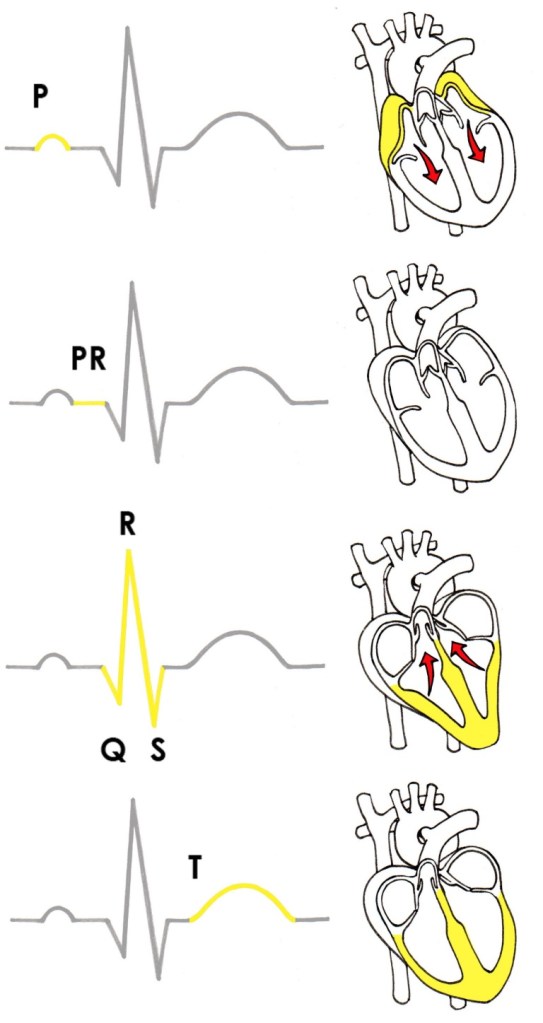
P Wave

•Positive wave

• Shape is up rounded deflection

• Cause: Depolarisation of atrial musculature.

• Duration: 0.1 sec

• Intensity: 0.1-0.12 mV

• Represents functional activity of atria.

Clinical Aspects:

1 Mitral stenosis: left atrium is hypertrophied and P wave is larger and prolonged.

2 Tricuspid stenosis: Right atrium is hypertrophied and P wave is taller but there is no change (normal) duration.

3 Atrial fibrillation: P wave disappears and is replaced by fine irregular oscillations.

4 Ectopic Pacemaker: (reverse) The impulses are sent from AV node to SA node.

QRS COMPLEX

• Q wave is often absent.

• Cause: Ventricular Depolarisation.

• Duration: 0.08 sec ( less than P wave)

• Intensity: 0.1 mV to 0.2 mV ( amplitude is more)

• R wave is 1 mV

• S wave is 0.4 mV

• Total Intensity is 1.5 mV to 1.6 mV

Clinical Aspects

1 Deep Q wave: more than 0.2 mV. This is seen Myocardial Infarction.

2 Tall R wave: more than 0.1 mV. This is seen in ventricular hypertrophy.

3 Low Voltage QRS Complex:  This is related to hormones and pericardial fluid. Hypothyroidism and Pericardial fluid around the heart.

4 QRS COMPLEX: Prolonged in bundle branch block.

T wave 

• Cause: Ventricular Repolarization.

• It’s positive wave because the direction of Ventricular repolarization is opposite to depolarization.

• Duration: 0.27

• Intensity: 0.3 mV

Clinical Aspects

1 Flattened T wave: old age.

2 Height increases: during exercise.

3 Inverted T wave: this is seen in myocardial infarction.

4 Tall and peaked T wave:  Hyperkalaemia.

U wave

• Positive round wave

• Repolarization of papillary muscled

• Duration: 0.08 sec

• Intensity: 0.2 mV

• Rarely seen

• Prominent in hypokalaemia.

P R interval 

• Onset of P wave to onset of QRS complex (PQ interval)

• Represents AV conduction time.

• Duration: 0.12 to 0.21 sec

Clinical Aspects

1 Prolonged PR interval: AV conduction block.

J Point 

• The meeting point of QRS complex with ST segment.

• It represents the end of Depolarisation and beginning of repolarization.

• At this point, no current flows around heart.

Written by Anisha Valli

Dentowesome Author Internship (DAI) program

Hey everyone!
We are launching the Dentowesome Author Internship (DAI) program for this month! If you have wanted to contribute or write about dentistry but you haven’t been able to – this is your chance! 🙂  

For this project, you can write mnemonics and small posts. After submitting 25 articles, you will be awarded with certificate 🙂 

But to participate in the Dentowesome Author Internship (DAI) program you must have:
1. Ideas (whether it be cool facts, mnemonics or presenting a usual fact in an unusual way – I will help you out with this.)

2. Willingness to write on a timely basis (because ideas not brought to a reality are no fun!)

If you are interested, email me on dentowesome@gmail.com with “DAI” in the subject and we can take it forward from there 🙂

I am so excited about this!!! 😀  

PS: At the end of the project, if you enjoy being a guest author and you wish to continue with us, you’re always welcome to join the team and be a permanent author.  

Dentowesome study group on Whatsapp: The Official invitation

What’s the study group for?
A bunch of dental students from all over the world, discussing study related concepts!
You may share your experiences, what you studied today, ask interesting questions to help other people learn or simply revise, ask doubts about things you don’t understand, answer other people or just tell a fact you learnt that fascinates you.
We learn something new on a daily basis ❤

How do I sign up for the group?

All you’ve got to do is message me your number. You can email me at dentowesome@gmail.com with “Whatsapp study group” in the subject.

Important: Make sure you include your proper country code when you email me your number. (Otherwise your number won’t be displayed in my Whatsapp list and I might miss you out!)

After you have emailed me your number, you’ll receive instructions from us. 

The group is for dental students only. We do not add pharmacy / nursing / pre med students.

“I want to join but.. I’m hesitant because I’ll be sharing my number to a lot of people.”
It’s risky, I know, but we have solutions – Block users. I have added over 200 people so far and they are loving it.

We highly encourage students to report misbehaving people to the admins and necessary action will be taken.

~ Anisha