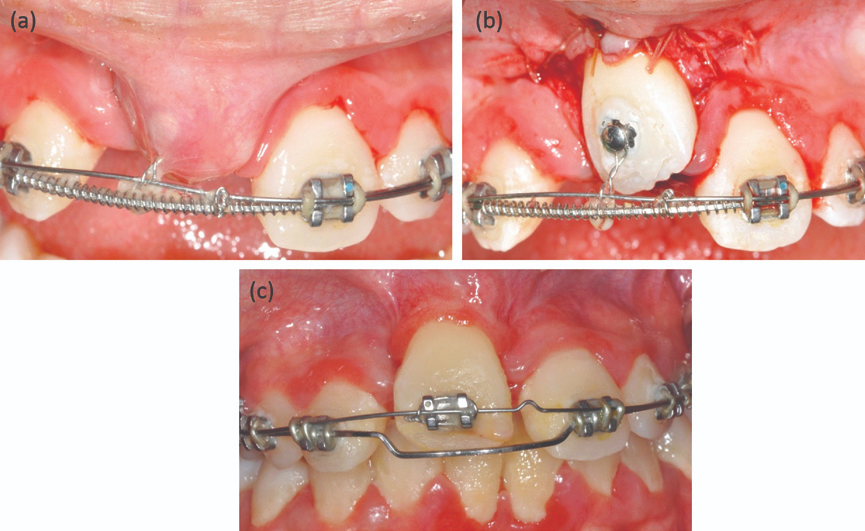
Soft-tissue management of labially positioned unerupted teeth

When orthodontists treat unerupted or impacted teeth (especially in the anterior region), several complications can occur:

  • Tooth devitalization (loss of vitality)
  • Re-exposure or uncovering after surgery
  • Ankylosis (tooth fused to bone)
  • External root resorption
  • Damage to adjacent teeth
  • Marginal bone loss
  • Gingival (gum) recession

➡️ These complications can prolong treatment, cause esthetic problems, and even lead to tooth loss.

Why These Problems Happen

Historically, clinicians focused on surgically exposing the tooth (“uncovering”) to bring it into the arch.
However, the soft tissue (gingiva) around the tooth was often not given enough attention.

Most early surgical techniques, such as “simple complete exposure,” focused only on getting to the tooth, without considering:

  • What kind of mucosa (attached gingiva vs. alveolar mucosa) covered it
  • How that tissue would behave once orthodontic movement began

Why Soft Tissue Type Matters

There are two main kinds of oral mucosa:

  1. Attached gingiva (masticatory mucosa):
    • Firm, tightly bound to bone
    • Designed to resist mechanical stress and prevent muscle pull on the gum margin
    • Ideal marginal tissue around a tooth
  2. Alveolar mucosa:
    • Movable, thin, and elastic
    • Poor at resisting muscle pull or inflammation
    • Not suitable as a marginal tissue

If a tooth is uncovered and surrounded only by alveolar mucosa, the tissue tends to get inflamed easily, which can lead to bone loss and gingival recession as the tooth is moved orthodontically.

What the Ideal Surgical Approach Should Do

Instead of just exposing the tooth, the surgical goal should be to:

  • Ensure that a band of attached gingiva surrounds the crown once the tooth is exposed.
  • Create a healthy, functional marginal tissue environment before starting tooth movement.

This provides several key advantages:

  1. Prevents the need for repeated dressings or barriers to keep the tooth exposed
  2. Allows faster and smoother tooth movement (no soft-tissue obstruction)
  3. Prevents gingival recession and bone loss during orthodontic traction

Why Inflammation Is a Risk Factor

Periodontal experience shows that tooth movement in the presence of inflammation is risky — it can accelerate bone loss.
Since alveolar mucosa is prone to inflammation, it’s unsafe to move a tooth unless it’s surrounded by healthy attached gingiva.

Thus, the uncovering procedure must integrate periodontal principles — ensuring that the final gingival condition supports tooth health and stability.

ORTHODONTIC CONSIDERATIONS BEFORE SURGERY

Why create space before uncovering the tooth?

There are two main reasons:

  1. For eruption and alignment:
    • If adequate space isn’t available in the arch, the unerupted tooth has no place to move into.
    • So, before any surgical exposure, orthodontic space creation ensures there’s enough room for the tooth to erupt or be moved into proper alignment.
  2. For surgical soft-tissue management:
    • The edentulous (toothless) space left in the arch is covered by attached gingiva, which can be used as a donor site.
    • This tissue can then be repositioned apically or laterally as a partial-thickness flap to cover the exposed tooth crown after surgery — ensuring the presence of healthy, attached gingiva around the tooth.

SURGICAL PROCEDURE: STEP-BY-STEP LOGIC

Anesthesia and incision:

  • Local infiltration anesthesia is administered.
  • The surgeon makes an incision along the ridge in the edentulous area — where the impacted tooth lies beneath.

Determining incision design:

  • The height (incisogingival dimension) of the incision depends on how much attached gingiva is present on the adjacent teeth or its opposite tooth (antimere).
  • If there’s plenty of attached gingiva nearby, a larger flap can be created and repositioned.

Flap elevation and bone removal:

  • Vertical releasing incisions are made to free the attached gingiva.
  • Connective tissue over the unerupted tooth is gently removed.
  • Bone is removed only up to the height of contour of the crownnot beyond the cementoenamel junction (CEJ).

⚠️ Why stop at the CEJ?
Because this is the zone where the dentogingival attachment (junctional epithelium + connective tissue attachment) naturally forms.
If bone is removed beyond the CEJ, it can disrupt this zone and increase the risk of gingival recession — something confirmed in animal (monkey) studies.

PLACEMENT OF ATTACHED GINGIVA (THE GRAFT STEP)

Where and why to place it:

  • The graft (attached gingiva) is positioned to cover:
    • The CEJ, and
    • About 2–3 mm of the crown.

This positioning serves three biologic and mechanical purposes:

  1. Establishing stable attachment:
    • It helps form a healthy supra-alveolar connective tissue attachment between the tooth root (cementum) and alveolar bone.
    • This ensures periodontal stability and prevents bone loss.
  2. Creating a proper epithelial seal:
    • Masticatory mucosa (keratinized attached gingiva) provides a strong, protective epithelial barrier.
    • This seal prevents bacterial ingress and inflammation — something alveolar mucosa cannot achieve.
  3. Allowing safe tooth movement:
    • As the tooth is orthodontically pulled into the arch, tension develops in the gingiva.
    • If the gingiva is attached higher (more coronally), it can accommodate slight apical repositioning during movement without losing its protective role.
    • In simpler terms — the gum margin “moves with the tooth” instead of receding.

POST-SURGICAL STEPS

  • Sutures are placed on both sides (mesial and distal) to hold the graft stable over the tooth.
  • periodontal dressing is placed for 7–10 days to protect the surgical site and allow:
    • Reattachment of the tissue to the tooth
    • Epithelial healing over the area
  • Once the dressing is removed:
    • bonded orthodontic bracket is attached directly to the tooth.
    • Light orthodontic forces are applied immediately to begin eruption or alignment.

🔑 Light force is critical — it allows physiologic movement without jeopardizing the new soft tissue attachment.

Why This Method Works Better

The described surgical exposure technique (with attached gingiva placement) is particularly advantageous for teeth with delayed or retarded eruption.
It provides both biologic and mechanical benefits that improve eruption success and tissue health.

What Actually Delays Eruption: Bone or Soft Tissue?

  • Traditionally, it was thought that bone acts as the main physical barrier delaying eruption.
  • However, clinical and biologic observations show that this is not true unless the tooth is ankylosed (fused to bone).

👉 The rate of bone remodeling (turnover) is actually faster than the rate of remodeling in the overlying soft tissue.

➡️ Therefore, the soft tissue — not the bone — is often the main factor that slows eruption or impedes tooth movement.

Managing Long-Distance Tooth Movement

When a tooth has to travel a large distance to reach the arch:

  • The surrounding gingiva may begin to “bunch up” as the tooth moves.
  • In such cases, minor excision of excess tissue may be required to achieve:
    • Ideal gingival contour,
    • Correct tooth positioning,
    • Long-term posttreatment stability.

The key to managing delayed eruption lies not in removing more bone but in controlling and reconstructing the soft tissue environment.
Creating a zone of attached gingiva around the uncovered tooth transforms the biologic response, allowing stable eruption and long-term periodontal integrity.

Understanding Herbst Appliance Mechanics: The Game-Changing Research Every Orthodontic Student Should Know 🦷⚙️

Hey future orthodontists! 👋 Ready to dive deep into one of the most fascinating pieces of research in functional orthodontics? Today we’re breaking down Voudouris et al.’s groundbreaking study on condyle-fossa modifications during Herbst treatment. This isn’t just another research paper – it’s a paradigm shift that changes how we understand functional appliances!

Why This Research Matters 🎯

For decades, we’ve been taught that functional appliances work through lateral pterygoid muscle hyperactivity. But what if that’s completely wrong? This study flips the script and introduces the revolutionary Growth Relativity Theory.

Study Overview 📊

Study ComponentDetails
Sample Size56 subjects total
Primate Subjects15 cynomolgus monkeys (Macaca fascicularis)
Human Subjects17 Herbst patients + 24 controls
Key Focus8 juvenile primates (24-36 months)
Treatment Duration6, 12, and 18 weeks
Activation Amount4-8mm progressive advancement

The Revolutionary Methodology 🔬

What made this study special? Three cutting-edge techniques that previous research lacked:

1. Permanent EMG Electrodes 📡

  • Old method: Temporary, transcutaneous electrodes
  • New method: Surgically implanted permanent electrodes
  • Muscles monitored: Superior and inferior lateral pterygoid, masseter, anterior digastric

2. Tetracycline Vital Staining 💡

  • Intravenous tetracycline injection every 6 weeks
  • Fluorescence microscopy with UV light
  • Result: Crystal-clear visualization of new bone formation

3. Computerized Histomorphometry 🖥️

  • Quantitative analysis of bone formation
  • Measured area and thickness of new bone
  • Statistical validation of results

The Shocking Results That Changed Everything 😱

What Everyone Expected vs. What Actually Happened

Traditional TheoryActual Findings
⬆️ Lateral pterygoid hyperactivity⬇️ DECREASED muscle activity
Muscle-driven growthViscoelastic tissue-driven growth
Unpredictable resultsConsistent, reproducible changes

Key Findings Summary 📈

  1. Super Class I Malocclusion Development: All experimental subjects developed severe Class I relationships
  2. Glenoid Fossa Remodeling: Forward and downward growth (opposite to natural backward growth)
  3. Condylar Growth Enhancement: Increased mandibular length in all subjects
  4. Muscle Activity Paradox: Growth occurred with DECREASED EMG activity

The Growth Relativity Theory Explained 🧠

Think of it like this: Imagine the retrodiskal tissues as a giant elastic band 🎸 stretched between the condyle and fossa.

Displaced Condyle ←→ [Stretched Retrodiskal Tissues] ←→ Glenoid Fossa
↓ ↓
Radiating Growth Radiating Growth

Clinical Scenario 💭

Patient: 14-year-old with severe Class II, mandibular retrognathism
Traditional thinking: “The Herbst will make the lateral pterygoid muscles work harder to grow the condyle”
Reality: The Herbst creates reciprocal stretch forces that stimulate bone formation through mechanical transduction, not muscle hyperactivity!

Treatment Contributions Breakdown 📊

The researchers found that achieving a 7mm change along the occlusal plane involved multiple factors:

Contributing FactorPercentage Contribution
Condylar Growth22-46%
Glenoid Fossa Modification6-32%
Maxillary ChangesVariable
Dental Changes~30%
Total Orthopedic Effect~70%
Total Orthodontic Effect~30%

Flowchart: Treatment Outcomes by Age

    Patient Age Assessment

┌─────────┴─────────┐
↓ ↓
Juvenile/Mixed Adolescent/Adult
Dentition Dentition
↓ ↓
High Condylar Limited Condylar
Growth Potential Growth Potential
↓ ↓
Significant Fossa Mainly Fossa
+ Condylar Changes Changes Only

Clinical Implications by Age 👶👦👨

Age GroupCondylar ResponseFossa ResponseClinical Recommendation
Juvenile (Mixed Dentition)High ✅High ✅Optimal treatment timing
AdolescentModerate ⚠️High ✅Good treatment timing
AdultLimited ❌Moderate ⚠️Consider alternatives

The Herbst-Block Design Innovation 🔧

Key design feature: 1.5mm posterior occlusal overlays

Why This Matters:

  • Vertical distraction of condyle from articular eminence
  • Prevents condylar resorption
  • Avoids TMJ compression
  • Optimizes stretch forces on retrodiskal tissues

Treatment Timeline and Bone Formation 📅

Progressive Changes Over Time

Time PointBone Formation AreaKey Observations
6 weeksEarly changesExtensive cartilage proliferation
12 weeks1.2mm averagePeak bone formation rate
18 weeksMaximum responseDoubled postglenoid spine thickness

Correlation: r = 0.95 between treatment time and bone formation! 📈

Clinical Decision-Making Flowchart 🗺️

  Class II Patient Evaluation

Age Assessment

┌─────────┴─────────┐
↓ ↓
Mixed Dentition Permanent Dentition
↓ ↓
Herbst with Consider Herbst vs
Occlusal Coverage Alternative Treatment
↓ ↓
Continuous Monitor for:
Activation - Condylar resorption
1-2mm every - Disk displacement
10-15 days - Relapse potential

Key Clinical Takeaways for Practice 💡

Do’s and Don’ts

✅ DO❌ DON’T
Use continuous activationRely on intermittent wear
Include occlusal coverageIgnore vertical dimension
Monitor for 6+ monthsExpect immediate results
Plan retention carefullyAssume permanent changes

Red Flags to Watch For 🚩

  1. Condylar resorption – prevented by proper vertical dimension
  2. TMJ pain – indicates excessive compression
  3. Rapid relapse – inadequate retention period
  4. Disk displacement – poor appliance design

The Retention Challenge 🔄

Critical Finding: Without adequate retention, positive condyle-fossa changes can relapse due to:

  • Return of anterior digastric muscle function
  • Perimandibular connective tissue pull
  • Natural tendency for condyle to seat posteriorly

Retention Protocol Recommendations:

  • Minimum 6 months active retention
  • Progressive reduction of appliance wear
  • Monitor muscle reattachment process
  • Long-term follow-up essential

Clinical Scenario Application 🎯

Case: 13-year-old female, Class II Division 1, severe mandibular retrognathism

Treatment Plan Based on Research:

  1. Herbst with occlusal coverage (NOT standard Herbst)
  2. Progressive activation 1.5mm every 2 weeks
  3. 12-week minimum treatment duration
  4. Expect 70% orthopedic response
  5. Plan extended retention phase

Expected Outcomes:

  • Forward fossa remodeling
  • Increased mandibular length
  • Super Class I result requiring finishing
  • Need for comprehensive retention protocol

Future Implications 🔮

This research suggests that functional appliances should be renamed “dentofacial orthopedic appliances” because they work through:

  • Viscoelastic tissue forces
  • Mechanical transduction
  • Growth modification, NOT muscle function

Study Limitations and Considerations ⚖️

Strengths:

  • Rigorous methodology with multiple validation techniques
  • Control groups and statistical analysis
  • Novel technological approaches

Limitations:

  • Animal model – translation to humans requires validation
  • Small sample size – justified but limits generalizability
  • Short-term follow-up – long-term stability unknown

Conclusion: Changing Clinical Practice 🎯

This groundbreaking research fundamentally changes how we understand functional appliances. The key shifts in thinking:

  1. From muscle hyperactivity → To tissue stretch forces
  2. From unpredictable results → To consistent orthopedic changes
  3. From simple tooth movement → To complex TMJ remodeling
  4. From empirical treatment → To evidence-based protocols

Memory Aid for Boards 📚

“VOUDOURIS RULES” 🧠

  • Viscoelastic forces drive change
  • Occlusal coverage prevents resorption
  • Undermining old muscle theories
  • Decreased EMG activity during growth
  • Orthopedic effects dominate (70%)
  • Underaged patients respond best
  • Retention critical for stability
  • Inferior-anterior fossa growth
  • Super Class I results expected

Questions for Self-Assessment 🤔

  1. What percentage of Herbst treatment effects are orthopedic vs orthodontic?
  2. Why does EMG activity decrease during successful treatment?
  3. What prevents condylar resorption in Herbst appliances?
  4. At what age is condylar growth potential highest?
  5. What is the Growth Relativity Theory?

Remember: This research doesn’t just change what we know about Herbst appliances – it revolutionizes our understanding of functional orthodontics entirely! 🚀

Keep studying, future orthodontists! The field is constantly evolving, and staying current with research like this will make you better clinicians. 📖✨