Post Extraction Uncontrolled Bleeding

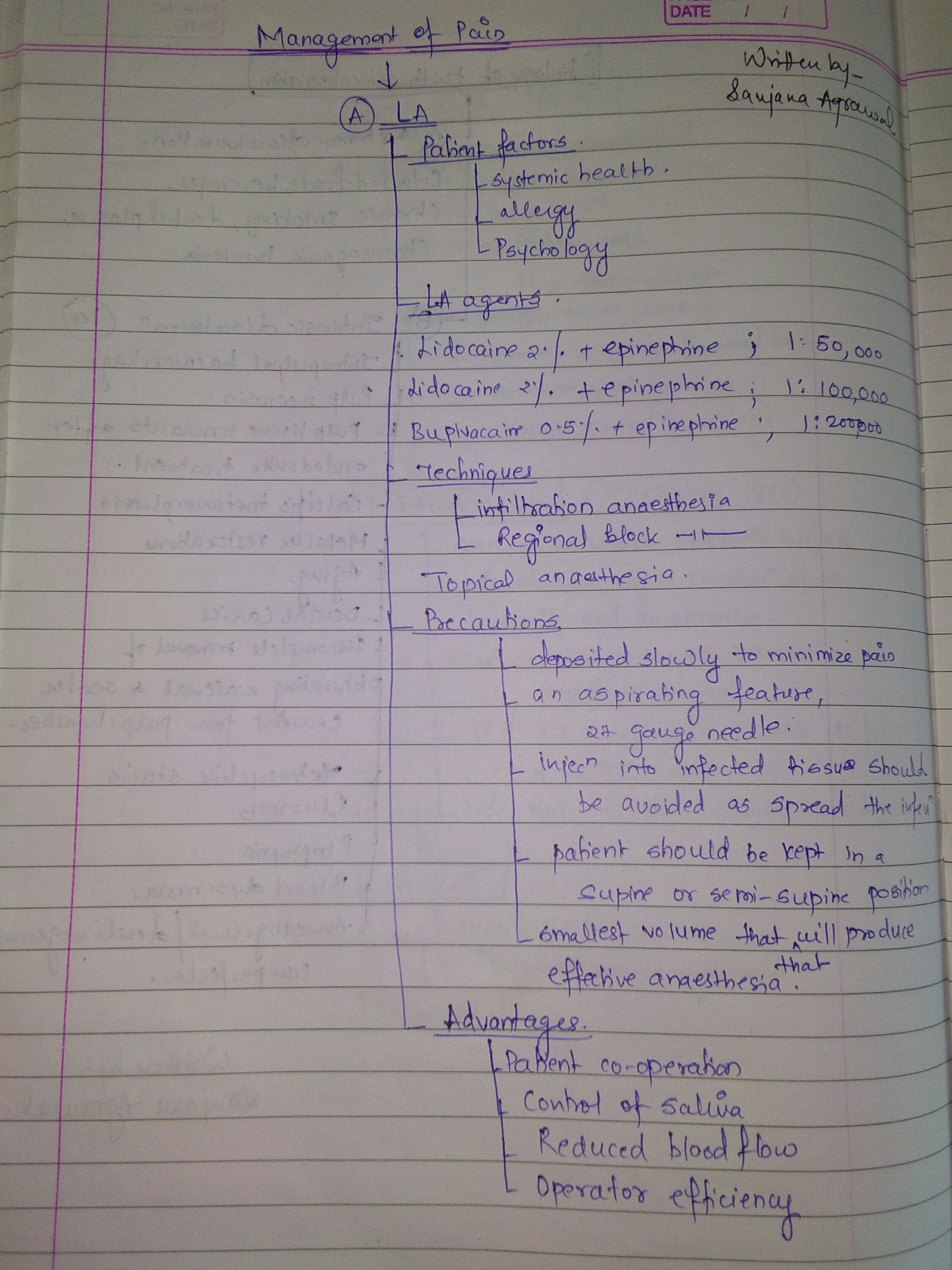
As private practice is one of the huge forms of practice in India for dentists, bleeding is an important complication encountered day in and day out. The idea of this post is to just have a Gist in the post Extraction bleeding control,many techniques are followed by many clinicians.so no technique is the gold standard for the control of Extraction bleeding.

In a clinical perspective, basics of bleeding control is proper evaluation of the preoperative blood investigation. It should be made mandatory for any kind of procedure either be a impression making or invasive oral surgery. Basic blood picture should comprise of CBC,BT,CT,PT, Thromboplastin Time, Complete Blood Sugar (CBG). Many ignore advising of PT and Thromboplastin Time but it can reveal bleeding disorders like hemophilia. If you suspect the patient to be having any renal or hepatic impairment do not hesitate to order for LFT and RFT. Though these tests cost some amount it’s important that patient is not harmed by our negligence after our procedure.

Post extraction bleeding is one of the commonest emergency for every dentist in a clinical setup. It can be arrested with packing of gel sponge and closing the area with sutures,if the Extraction site had not been closed with sutures.close inspection of the socket should be done and the previous formed clot in the socket should be retracted or removed by irrigation of the socket first with saline then with betadine and finally with again saline. After the induction of fresh bleeding from the socket pack the area with gel sponge and suture the socket. This gel sponge can degrade by itself ,so there will not be any need for reexploration of the site. There are many day to day update in the management of bleeding and new hemostats and hemostatic techniques are developing.

In cases where the haemostasis is not achieved even after the closure of the socket suspect for a systemic cause which might have been missed during pre-op evaluation.patients on oral anticoagulants usually have irreversible action of prevention of aggregation of Thromboxin A2 which is responsible for platelet aggregation.Even aspirin and Acetaminophen have revesible inhibition of Thromboxane A2. This history to be noted. Bleeding disorders like hemophilia A ,B,C can invlove the deficiency of the clotting factors hence, the PT and thromboplastin time can be prolonged. Vitamin K Antagonist therapy patients, malnutrition patients are suseptible to uncontrolled bleeding.

Proper evaluation of the patient preoperatively and keeping the conditions which can cause bleeding are to be kept in mind so that the clinician can rule out a diagnosis and refer to the appropriate specialist.

Common causes of bleeding which should always be in mind
  • Uncontrolled Diabetes Mellitus with irregular HbA1c level can also increase bleeding tendency
  • Patient under anti-platelet therapy like aspirin
  • Acetaminophen and NSAIDs like ibuprofen which are non selective COX inhibitor
  • Patient under blood thinners like warfarin,
  • Patient who are malnutritioned may be suseptible to prolonged bleeding.

Gametogenesis

The process by which gametes (aka, sex cells) mature.

  1. Origin and migration
  2. Mitosis
  3. Meiosis
  4. Maturation
  1. Origin and migration
    Primordial germ cells migrate from the yolk stalk to the posterior body wall during week 4.
  • They move through the dorsal mesentery, and travel to the body wall.
  • Here, they bilaterally give rise to the gonadal ridges.
  • The gonadal ridges differentiate to become testes or ovaries.
  1. Mitosis
    At the gonadal ridges, the primordial germ cells proliferate via mitosis.
  • Diploid primordial germ cell divide, produce 2 diploid daughter cells, it has 2 sets of chromosomes (2n).

During fetal months 2-5, the ovaries produce millions of germ cells, called oocytes; most of these cells will degenerate over time. This makes reproductive sense: women ovulate a single oocyte at a time, and ovulation itself is rare in populations where women spend most of their reproductive years pregnant or breastfeeding.

The testes produce sperm cells throughout life; millions of sperm cells are lost with each ejaculation, and only one is needed for fertilization.

  1. Meiosis
    Comprises two rounds of cell division and is unique to the gametes, has two key functions:
  • It reduces the number of chromosomes when diploid cells give rise to haploid cells.
  • It produces genetic diversity via independent assortment of chromosomes and crossing over.
  • Single diploid germ cell undergoes two rounds of cell division (MI and MII), and produces four haploid germ cells.
  1. Maturation

Oogenesis

  1. Oocyte nests
  • These nests nourish and support them in this early stage.
  1. Ovarian Follicle: Follicular cells surround the individual gametes when the oocyte nests break apart.
  • The oogonia enter meiosis I, and become primary oocytes.
  • The granulosa follicular cells produce estrogen (the physiology of the ovarian follicle is addressed in detail, elsewhere).
  1. FSH “recruitment” facilitates transformation to the antral stage
  • The antrum develops within the follicular cells, creating a space within the follicular cells.
  • Outer thecal cell layers are established (the exact mechanisms of recruitment and dominant follicle selection remain unknown).
  1. LH surge
  • The growing antral follicle continues to release increasing quantities of estrogen; above a given threshold, estrogen triggers release of luteinizing hormone (LH) from the anterior pituitary.
  • LH initiates the final stages of maturation, including the resumption of meiosis.
  1. Secondary oocyte
  • Upon completion of meiosis I, the gamete is referred to as a secondary oocyte, which will remain arrested in meiosis II unless fertilization occurs.
  1. Ovulation occurs when the oocyte, along with some of the surrounding follicular cells, break free from the ovarian follicle and are expelled from the ovary.

Spermatogenesis

  1. Testes cords
    Comprise primordial germ cells surrounded by Sertoli, aka, nurse cells.
  • Precursors to the seminiferous tubules that develop in adolescence.
  1. Meiosis I
    The male gametes enter meiosis I at the onset of puberty under the influence of retinoic acid.
    Type B spermatogonia give rise to primary spermatocytes.
  2. Meiosis II
    Completion of meiosis I produces secondary spermatocytes, which undergo meiosis II to give rise to spermatids.
  3. Spermatids transform and become immature sperm cells, with definitive heads and tails.
    The head holds the DNA and other cell machinery; the tail provides the cell with motility.

Summary of meiotic events

Female:

  • From birth (or sometime before birth) till puberty, the immature gametes enter, then pause, meiosis I. The DNA in these primary oocytes has replicated, but cell division has not occurred, so the cells are designated as 2n, 4 c (two sets of chromosomes, with double the DNA contents).
  • At puberty, FSH recruitment of follicles initiates completion of meiosis I and entry into meiosis II, which is again paused;
  • The product of meiosis I is the secondary oocyte (for simplicity, we ignore the polar bodies, which are addressed elsewhere).
  • The secondary oocyte contains one set chromosomes with double the DNA content: 1n, 2c.
  • Fertilization triggers metabolic activation and completion of meiosis II; the oocyte is now a true haploid with 1 set of chromosomes with their DNA content.

Male:

  • Male fetal gametes, the spermatogonia, are arrested in the pre-meiotic stage; because DNA has replicated, the chromosome number and DNA content is 2n, 4c.
  • Type B spermatogonia give rise to primary spermatocytes, which, after puberty, enter meiosis I.
  • Secondary spermatocytes are characterized by 1 set of chromosomes with twice the DNA content (1n, 2c).
  • After meiosis II completes, the resulting sperm cells are true haploids: 1 n, 1c.

Skull Foramina

VASCULATURE AND CRANIAL NERVES OF THE MAJOR SKULL FORAMINA

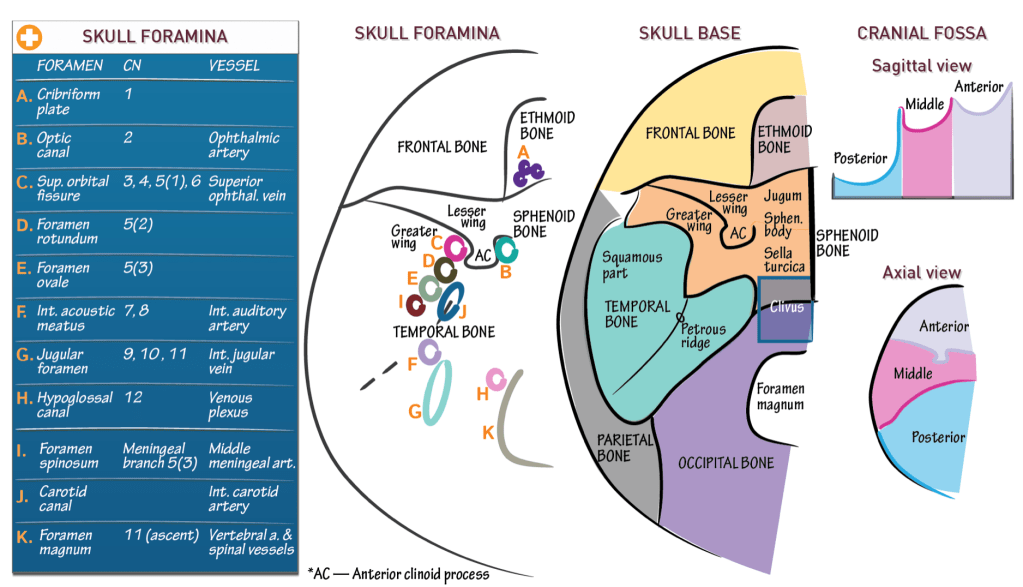
The skull foramina are the entry/exit sites of the cranial nerves through the skull base and the entry/exit sites of the major cranial vasculature through the skull base.

  • Within the ethmoid bone, lie the foramina of the cribriform plate.
    -They contain CN 1, the olfactory nerve bundles.
  • Next, medial to the anterior clinoid process, lies the optic canal and lateral to it, lies the superior orbital fissure.
    -CN 2 traverses the optic canal.
    -CNs 3, 4, and 6, and the first division of CN 5 pass through the superior orbital fissure.
  • Posterior to the superior orbital fissure, within the greater wing of the sphenoid bone, lies foramen rotundum, and posterior to it, lies foramen ovale.
    -CN 5 (2) traverses foramen rotundum (think of R2D2 from “Star Wars”).
    -CN 5 (3) traverses foramen ovale.
  • Along the petrous apex of the temporal bone, lies the internal acoustic meatus.
    -Both CNs 7 and 8 pass through it.

Clinical Correlation – 8th Nerve Palsy

  • Posterior to the internal acoustic meatus, lies the jugular foramen.
    -CNs 9, 10, and 11 pass through it.
  • Medial to the internal acoustic meatus, lies the hypoglossal canal.
    -CN 12 passes through it.

MAJOR VESSELS THAT PASS THROUGH THE SKULL FORAMINA

  • The ophthalmic artery traverses the optic canal.
  • The superior ophthalmic vein passes through the superior orbital fissure.
  • The internal auditory artery (aka labyrinthine artery) passes through the internal acoustic meatus.
  • The internal jugular vein passes through the jugular foramen.
  • The hypoglossal canal contains a venous plexus.
  • Posterior to foramen ovale, lies foramen spinosum.
    -The meningeal branch of CN 5(3) passes through foramen spinosum and the middle meningeal artery passes through it, as well.

Middle meningeal artery rupture is the major cause of epidural hematoma.

  • The carotid canal lies along the petrous ridge.
    -The internal carotid artery runs within it.
  • Foramen magnum lies in midline.
    -CN 11 passes up through foramen magnum (before it passes out of the cranium through the jugular foramen) and the vertebral arteries and spinal vessels traverse foramen magnum, as well.

THE CRANIAL FOSSAE

The three cranial fossa are the: anterior, middle, and posterior fossae.

The anterior cranial fossa

  • Lies anterior to the posterior aspect of the lesser wing of the sphenoid bone.
  • The basal portions of the frontal lobes lie within this fossa.

The middle cranial fossa

  • Lies between the anterior cranial fossa and the petrous ridge of the temporal bone.
  • The basal portions of the temporal lobes lie within this fossa.

The posterior cranial fossa

  • Lies posterior to the petrous ridge.
  • The cerebellum and brainstem lie within this fossa.

The anterior depression is the anterior cranial fossa, the middle depression is the middle cranial fossa, and the posterior depression is the posterior cranial fossa.

BONES OF THE SKULL BASE

  • The anterior one-third is the frontal bone.
  • The ethmoid bone, which comprises the steeply peaked crista galli and the surrounding cribriform plate, lies in midline.
  • Posterior to the frontal bone, lies the sphenoid bone.
  • The midline portion of the sphenoid bone is the sphenoid body.
    -It subdivides into the jugum sphenoidale, anteriorly, and the sella turcica, posteriorly.
    -The lesser wing of the sphenoid bone lies anteriorly, and the greater wing lies posteriorly.
    -Topographically, the lesser sphenoid wing angles up over the greater sphenoid wing, which rolls downward.
    -The protuberance lies along the posteromedial ridge of the lesser wing as the anterior clinoid process.
  • The temporal bone lies posterior to the greater wing of the sphenoid bone.
  • We see the petrous ridge and the squamous part of the temporal bone lies laterally.
    -The squamous part makes up the bulk of the external surface of the temporal bone, whereas the petrous part makes up the bulk of the internal surface.
  • Posteromedial to the temporal bone, lies the occipital bone; it extends back to the occiput.
  • In the anterior one-third of the occipital bone, lies the foramen magnum, which is the entry zone of the brainstem.
    -The combined anterior occipital bone and posterior sphenoid bone form the clivus, which is steeply sloped, and is a clinically important anatomical region.
  • Along the lateral edge of the skull base, lies the parietal bone.
    -The parietal bones make up much of the lateral and superior surfaces of the skull.