Viral Childhood Exanthems

  • Viral rashes are often caused by immune reactions to the virus and cell damage caused by the virus.
  • A key bacterial cause of rash is Streptococcus pyogenes, which causes Scarlet Fever.

Helpful distinguishers between the viral exanthems:

  • We can categorize them by the initial location and pattern of the rash.
    – Three viral exanthems tend to initiate on the face:
    Measles, rubella, and erythema infectiosum.
    – Chickenpox arises on the face/scalp and trunk.
    – Roseola infantum typically first appears on the trunk
    – Hand, Foot, and Mouth disease produces rash on the hands and feet, in the mouth.

Be aware that these are meant to be helpful generalizations, and may not always hold true; for example, hand, foot, and mouth disease can also produce rash on the buttocks.

  • Rash types:
    – Multiple rash types can exist at once.
    – Macules are flat, colored spots on the skin.
    – Papules are solid, raised areas; larger papules are called nodules.
    – Vesicular rashes comprise raised “pockets” of fluid in the skin.
  • The timing of the rash and presence of other symptoms can also help distinguish among the exanthems.
    – For example, some infections are associated with fever, malaise, and respiratory symptoms.
    – Knowing the time lapse between virus introduction and symptom appearance can also help, although the incubation periods of the various viruses often overlap and may include a wide range.

VIRAL EXANTHEMA

Hand, foot, and mouth disease:

  • Usually caused by Coxsackievirus A.
  • Average incubation period of 3-6 days.
  • Most common in children younger than 5.
  • As its name suggests, hand, foot, and mouth disease is characterized by a rash that can be macular, maculopapular, or vesicular on the hands, feet, and in and around the mouth.

Erythema infectiousum, aka, Fifth Disease

  • Caused by Parvovirus B19.
  • Average incubation period of 7 days
  • Tends to affect children 5-15 years old.
  • Initial symptoms can include fever, runny nose, headache; diarrhea is also possible.
  • These flu-like symtpoms are followed by a malar facial rash that spreads to the trunk and extremities.
    – Facial rash takes on a characteristic “slapped cheeks” pattern, whereas the rash on the extremities often comprises maculopapular rash in a “lacy” pattern.

Roseola infantum, aka, exanthema subitum

  • Most commonly caused by Human Herpes Virus 6, and sometimes Human Herpes Virus 7.
  • Roseola infantum is also sometimes called “6th disease”, because it was the 6th exanthema identified (erythema infectiosum was the fifth).
  • Average incubation period is 9 days.
  • Although disease can occur in a wide range of ages, it most commonly affects children younger than 2 years old.
  • Initial symptoms include a very high fever (exceeding 104 degrees Fahrenheit/40 degrees Celsius).
    – The fever lasts approximately 3 days, which is why Roseola infantum is sometimes called “3-Day Fever”.
  • Macular or maculopapular “blanching rash” arises first on the trunk.
    – “Blanching rash” means that when the skin is pressed upon, often with a clear glass, the rash fades from red to pale.
  • Another common finding are red uvulopalatoglossal spots, aka, Nagayama spots,.
  • A range of other symptoms, including gastrointestinal, respiratory, ocular, and auditory problems, can occur.
  • Febrile seizures are a common complication in roseola infantum.

Chickenpox

  • Caused by Varicella-Zoster virus (aka, Human Herpes Virus-3)
  • Average incubation period is 16 days.
  • Often affects children younger than 5.
  • Prior to rash, patients may experience fever, malaise, sore throat, and low appetite.
  • Rash is characterized by crops of lesions that pass through macular, vesicular, and crusted phases.
    – Lesions usually first appear on the head/neck, and spread to the rest of the body.
  • Clinical correlation: Shingles is an illness that occurs in adults upon reactivation of the Varicella-Zoster Virus; the reactivated virus is called Herpes-Zoster Virus.
    – Whereas the chickenpox rash is often itchy, the shingles rash can be very painful. Vaccination against Varicella-Zoster virus also prevents shingles.

Measles (aka, rubeola)

  • Caused by the Measles virus.
  • Average incubation period is 14 days.
  • Prior to rash, patients often experience Fever and the “Three C’s”Cough, Coryza (runny nose), and Conjunctivitis.
  • These symptoms are followed by a *maculopapular rash that begins on the face and neck and spreads.
  • Before the body rash, many patients also develop Koplik spots, which are spots along the palate and internal buccal surfaces (these spots are sometimes calked Koplik’s sign).
  • Serious complications from measles virus infection include potentially fatal pneumonia and encephalitis; vaccination helps to prevent these and other complications.

Rubella (aka, German measles)

  • Caused by Rubella virus.
  • Average incubation period is 14 days.
  • Rubella is characterized by the acute onset of a pink maculopapular rash that begins on the face and spreads.
    – The rash lasts about 3 days, so Rubella is sometimes called “3-Day measles” – careful not to confuse this with Roseola infantum, which is sometimes called “3-Day Fever.”
  • Some patients also have swollen lymph nodes in the neck area; systemic symptoms, such as headache, are mild if present.
  • Congenital rubella, which is contracted during fetal development, is associated with severe birth defects; this form of rubella can also be prevented by the rubella vaccine.

Davenport Diagram

DAVENPORT DIAGRAMS:

  • Davenport diagrams are graphic displays of acid-base states.
  • They illustrate the dynamic relationships between arterial blood pH, bicarbonate and non-bicarbonate buffers, and the partial pressure of carbon dioxide.
  • An isopleth represents all possible combinations of bicarbonate and pH values at a given carbon dioxide partial pressure.

4 simple acid-base disorders prior to compensation

Graph Features:

  • The x-axis tracks pH; the healthy homeostatic arterial blood value = 7.4
  • Values less than this reflect acidosis; values higher reflect alkalosis.
  • The y-axis tracks bicarbonate concentration; the healthy homeostatic value 24 millimolar.
  • Recall that, as bicarbonate concentration increases, pH becomes more alkaline.
  • Isopleth for a partial pressure of carbon dioxide of 40 mmHg.
  • A straight line to represent the combination of all non-bicarbonate buffer titration curves.

Disorders that cause the blood to become more acidic.

  • Metabolic acidosis occurs when the reduction in bicarbonate concentration lowers the pH.
    • Notice that, because this is a non-respiratory disorder, PaCO2 is unaffected.
  • Respiratory acidosis occurs when the lungs retain excess carbon dioxide, so the partial pressure of carbon dioxide is elevated above normal, which lowers the pH. – Recall that respiratory acidosis produces an elevated bicarbonate concentration, which is reflected in our graph.

Disorders that cause the blood to become alkalotic (aka, basic).

  • Metabolic alkalosis occurs when bicarbonate concentration is elevated.
    • As in metabolic acidosis, the PaCO2 remains on the 40 mmHg isopleth.
  • Respiratory alkalosis occurs when the lungs release too much carbon dioxide
    • Lowers the PaCO2 and increases pH.

Compensatory Mechanisms

  • The lungs and kidneys respond to acid-base disorders via compensatory mechanisms that bring pH back to normal.

When metabolic acidosis triggers release of carbon dioxide from the lungs, PaCO2 falls and pH increases.

  • Thus, our point of interest lies lower and to the right than on our original graph.
    • Shaded area represents all possible outcomes of partial compensation for metabolic acidosis; the extent of the original disturbance and the magnitude of compensation determine the specific blood outcome.

When respiratory acidosis triggers increased renal excretion of hydrogen ions and conservation of bicarbonate, pH increases.

  • The partial pressure of carbon dioxide remains elevated until the source of the disorder is treated, because the lungs are unable to expel CO2.

When metabolic alkalosis triggers respiratory and renal mechanisms to conserve hydrogen ions, pH lowers.

  • However, because the respiratory component of compensation requires conservation of carbon dioxide, its partial pressure remains elevated.

When respiratory alkalosis triggers renal mechanisms that conserve hydrogen ions, pH lowers.

  • But, until the source of the disorder is treated, the partial pressure of carbon dioxide will remain below 40 mmHg.

Perfect Compensation – Blood pH returned to 7.4

  • The blood profile end-states reflect both the original disorders and the compensatory mechanisms.

If the original disorder was metabolic acidosis or respiratory alkalosis, both the bicarbonate concentration and the partial pressure of carbon are reduced (isohydric hypocapnia).

  • In the case of metabolic acidosis, this new state is accounted for by:
    • The cause of the disorder, which was a low concentration of bicarbonate
      relative to hydrogen ions.
    • The respiratory component of compensation, which required increased release
      of carbon dioxide.
  • In the case of respiratory alkalosis, this new state is accounted for by:
    • The cause of the disorder, which was the excessive release of carbon dioxide, and,
    • Renal compensatory mechanisms that excreted bicarbonate.

If the original disorder was respiratory acidosis or metabolic alkalosis, both the bicarbonate concentration and the partial pressure of carbon dioxide are elevated above normal (isohydric hypercapnia).

  • In the case of respiratory acidosis, this is state is accounted for by:
    • The cause of the disorder, which was over-retention of carbon dioxide, and,
    • Renal compensatory mechanisms that conserved bicarbonate.
  • In the case of metabolic alkalosis, this state is accounted for by:
    • The cause of the disorder, which was an increased bicarbonate to hydrogen ion ratio
    • The respiratory component of compensation, which required increased carbon
      dioxide retention in the lungs.

Compound Disturbances:

  • If both metabolic and respiratory acidosis are in play, pH is reduced more so than if just one disorder was influencing pH; the shaded area shows the range of possible values that could result.
  • When alkalosis results from both metabolic and respiratory origins, pH is elevated more so than if only one disorder was present.
    • Be aware that while this information can tell us if there are one or two sources of the pH disturbance, it cannot tell us which preceded the other.

Viral Enteric & Hepatic Infections

  • The enteric viruses we’ll learn about are naked capsids that can withstand harsh stomach acids.
  • When symptomatic, illness is characterized by diarrhea and vomiting.
  • Outcomes are often worse for children and infants, due to malnutrition and dehydration stemming from fluid and electrolyte loss.
  • The causative viruses are transmitted via the fecal/oral route.
  • Hepatic viruses cause tissue damage and trigger inflammatory responses that produce the symptoms of infection.

Enteric Viruses

  • Cause acute gastroenteritis and are typically ingested via contaminated food and water.
    – Vomiting and diarrhea.
    – Other symptoms include possible fever, nausea, abdominal pain or cramping, and myalgia and malaise.
    – Rehydration and electrolyte therapy are common treatments.
  • Key viral causes of gastroenteritis:
    –  Norovirus is a leading cause of gastroenteritis in all age groups in the United States; outbreaks have been associated with contaminated shellfish.
    –  Adenovirus accounts for approximately 15% of hospitalized gastroenteritis cases, especially in infants. Recall that adenovirus also causes respiratory and ocular infections.
    – Astrovirus causes mild, watery diarrhea, most commonly in children.
    However, extra-intestinal infections can occur in immune-compromised patients; some viral genotypes, for example, have been associated with central nervous system infections.
    – Rotavirus is the leading cause of severe diarrhea worldwide in children under five years old; in premature neonates, rotavirus can manifest as necrotizing enterocolitis or hemorrhagic gastroenteritis.
    Because of the high morbidity and mortality associated with rotavirus, vaccination is recommended for all infants.
  • In immune compromised patients, particularly AIDS patients and transplant recipients, cytomegalovirus (CMV) and Epstein-Barr Virus are associated with gastroenteritis.
  • For a list of bacterial pathogens that induce enteric illnesses, see here.

Hepatic Viruses: Hepatitis Viruses A, B, C, D, and E,

  • Hepatitis is characterized by inflammation of the liver.
    – Acute hepatitis = Inflammation that lasts less than 6 months
    – Chronic hepatitis = Inflammation that lasts 6 months or longer
    – In some cases, hepatitis can lead to fulminant liver failure; write that this is characterized by rapid, acute livery injury with hepatic encephalopathy.
  • Vaccine availability varies for the hepatitis viruses, and there is no vaccine for Hepatitis C virus due to its heterogeneous nature.

Acute hepatitis

  • Hepatitis A, B, C, D, and E can cause acute hepatitis.
  • Symptoms include: Jaundice, nausea and vomiting, abdominal pain, dark urine, and joint pain, as well as low or no appetite and fatigue.
    – Liver failure is possible with acute hepatitis, but rare.
  • General features of acute hepatitis histopathology:
    – Ballooning degeneration: hepatocytes are unusually large, with a “whispy” look
    – Spotty necrosis throughout the liver tissue
    – Mononuclear cell infiltrate
    – Councilman bodies, which are shrunken, acidophilic cells.
  • Hepatitis A and E only cause acute hepatitis, not chronic.
    – Both viruses are transmitted via the fecal-oral route, often via contaminated water.
    – No carrier state for these Hepatitis viruses.
    – Both typically cause mild and self-limiting acute hepatitis; fulminant liver failure is possible but rare.
    – An important exception is that Hepatitis E infection has high mortality rates in pregnant women, especially during the third trimester.

Chronic hepatitis

  • Caused by Hepatitis BD, and C.
  • Chronic infections can lead to scarring, cirrhosis, and cancer.
    – Smoking, alcohol use, age, sex, and population seem to increase the risk of disease progression.
  • Hepatitis viruses B, D, and C are transmitted via body fluids
    – Carrier states exist
    – Hepatitis B can be transmitted from mother to neonate during childbirth.
    – Hepatitis C often produces extra-hepatic effects, including cryoglobulinemia vasculitis and B-cell non-Hodgkin’s lymphoma, and other immune mediated and inflammation mediated diseases.
    – Hepatitis D is often called the “Delta agent”; though infection with Hepatitis D, alone, does not produce illness, when combined with Hepatitis B, it makes infection worseand increases the risk of Fulminant liver failure.
  • Hallmarks of Hepatitis B and C histopathology:
    – Hepatitis B often produces “ground glass” hepatocytes; the tiny grains in the cytoplasm are from viral protein accumulation.
    – Hepatitis C infection is characterized by lymphocyte aggregates and follicles, especially around the portal tracts;
    bile ducts are often damaged, and, steatosis (also called fatty change) can also occur.

CHRONIC MYELOID LEUKEMIA

Leukemias are malignant Neoplasms of the haematopoetic stem cells characterized by diffused replacement of bone marrow by Neoplastic cells with or without involvement of the peripheral blood.

➡️ Chronic leukaemia is a disease of insidious onset, affecting middle aged & young adults (CML)

🔅CLINICAL FEATURES:

  1. Gradually developing Anaemia
  2. Hepatosplenomegaly (In CML, a massive splenomegaly reaching upto the umblicus) Therefore, acute pain due to splenic infarction
  3. Bleeding tendencies
  4. Hypermetabolism
  5. Bone pain
  6. Juvenile CML: Lymph node enlargement, frequent infections, haemorrhagic manifestations & facial rash

🔅LAB. FINDINGS:

  • Thick and sticky & shows a wide buffy coat in the haematocrit tube
  • Anaemia – Moderate, normocytic normochromic
🔘 1 lakh - 5 lakh/cu.mm

🔘 Differential count reveals more mature forms in Peripheral smear, complete spectrum of granulocytes, myelocytes & band cells (50%)

🔘 Blast cell > 10% of leukocytes

🔘 Phases:
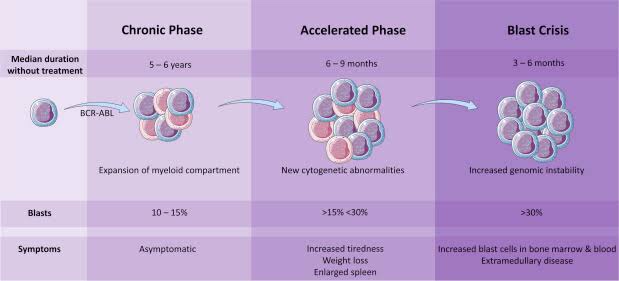
1. Chronic phase:

➡️ Myeloproliferative disorder – excessive proliferation of myeloid cells & mature segmented Neutrophils

➡️ Basophils upto 10% (feature of CML)

2. Accelerated phase:

  • ⬆️ Anaemia
  • Blast count: 10-20%
  • Basophils: 20%
  • Platelet: ⬇️ 1 lakh/µl
  • Leucocytosis

3. Blastic phase: Myeloid blast crisis in CML resembles AML >20%
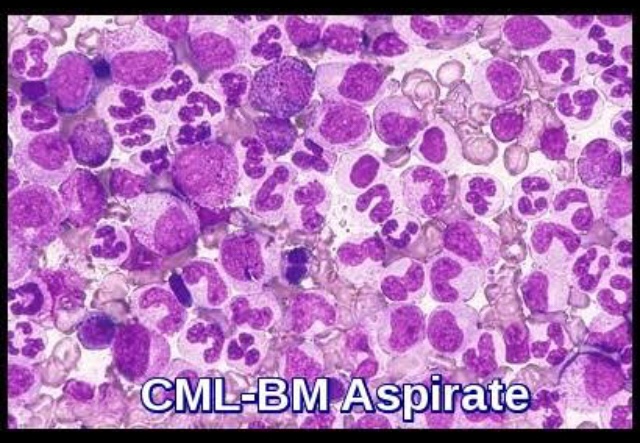
  1. Cellularity: Hypercellular fat spaces replaced by Myeloid cells.
  2. Myeloid cells: ⬆️ M:E ratio
  3. Erythropoiesis: Normoblastic
  4. Megakaryocytes: Conspicuous, smaller in size
  5. Chromosomal abnormalities: The philadelphia chromosome is present in about 90% of the cases of CML

• neutrophil alkaline phosphatase (NAP) activity is markedly reduced in CML

🔅TREATMENT:

  • The standard treatment for chronic phase CML is a tyrosine kinase inhibitor (TKI) like imatinib oral therapy. Imatinib works by reducing the production of abnormal white blood cells.
  • Allogenic bone marrow transplants.
  • Interferon was once the best treatment for CML, but now, the tyrosine kinase inhibitors are the mainstay of treatment and interferon is rarely used. To treat CML, this drug is most often given as a daily injection (shot) under the skin. It may also be injected into a muscle or vein. It’s given for many years.
  • Chemotherapy: Today, chemo may be used to treat CML when the TKIs have stopped working. It’s also used as part of a stem cell transplant.
  • Others:
  • Splenectomy
  • Splenic irradiation
  • Leukapheresis

🔘 Splenectomy and splenic irradiation have been used in patients with large and painful spleens, usually in the late phase of CML. This is rarely needed in patients whose disease is well controlled.

🔘 For those patients unable to tolerate chemotherapy, leukapheresis is a viable option.

Dr. Mehnaz Memon🖊


References:

  1. Textbook of Pathology, Harsh Mohan; Internet articles
  2. Image source: Google