Variation of patterns of malocclusion by site of pharyngeal obstruction in children

As an ortho student, you keep hearing “check adenoids, check tonsils, check breathing.” By the end of this blog, you should be able to predict the likely malocclusion pattern just from knowing where the child’s airway is obstructed – and explain the logic behind it to parents and ENTs, not just quote it.

The core question Nunes asked

Nunes & Di Francesco (2010) studied 114 mouth-breathing, snoring children (3–12 years) with tonsillar and/or adenoid enlargement, all seen in an ENT clinic.​

They asked a very simple but powerful question:

“Is the site of lymphoid obstruction (adenoids, tonsils, or both) associated with specific patterns of malocclusion (sagittal / transverse / vertical)?”

Obstruction was graded objectively: tonsils (Brodsky 1-4), adenoids (cephalometric 0-100%). Orthodontic exams classified sagittal (I/II/III), transverse (normal/crossbite), and vertical (normal/open/deep) relationships.

The groups:

  • Non-obstructive (small tonsils/adenoids)
  • Isolated obstructive tonsils
  • Isolated obstructive adenoids
  • Combined obstructive adenoids + tonsils​

LIKELY AIRWAY OBSTRUCTION → EXPECTED MALOCCLUSION

A. Adenoid + Tonsil Hypertrophy

  • 🔹 Common occlusion: Class II
  • 🔹 Transverse: Posterior crossbite common
  • 🔹 Skeletal pattern: Vertical growth tendency
  • 🔹 Clinical hint: Retropositioned mandible, narrow maxilla

B. Isolated Tonsillar Hypertrophy

  • 🔹 Common occlusion: Class III tendency
  • 🔹 Mechanism: Forward tongue posture
  • 🔹 Watch for: Lower incisor proclination

C. Isolated Adenoid Hypertrophy

  • 🔹 Usually Class I or mild Class II
  • 🔹 Often associated with maxillary constriction

TRANSVERSE DIMENSION (KEY RED FLAG 🚩)

  • Posterior crossbite prevalence ↑ in all airway obstruction types
  • Early maxillary expansion = functional + airway benefit

VERTICAL RELATIONSHIP

  • ☐ Open bite / Deep bite
  • ⚠️ Not directly site-dependent
  • Influenced by:
    • Facial type
    • Oral habits (thumb sucking, tongue thrust)

Is this malocclusion causing airway issues, or is the airway issue causing this malocclusion?
Airway obstruction causes the malocclusion. Nunes 2010 shows enlarged adenoids/tonsils (64.9% combined obstructive) drive specific patterns: combined → Class II (43.2%) via backward mandibular rotation for airflow; tonsils only → Class III (37.5%) via forward tongue thrust. Mouth breathing narrows palate → 36.8% posterior crossbite (vs 6.9-16.4% controls/population). Reverse (malocclusion → airway) not supported—it’s functional matrix disruption (Moss theory).

If I correct the teeth without correcting the airway, will this case relapse?
Yes, high relapse risk. Obstruction persists → ongoing tongue displacement, mandibular posture changes, dolichofacial growth continue post-ortho. Adenotonsillectomy normalizes GH → mandibular growth boost, but without it, ortho stability fails as functional drivers (mouth breathing) remain. Early ENT + ortho (pre-spurt) prevents irreversibility.​

Am I seeing a dental problem or a functional growth problem?
Functional growth problem. 36.8% crossbite, site-specific sagittal shifts (P=.02) signal airway-altered craniofacial development, not isolated dental misalignment. Class I appears “normal” but hides constricted arches → future crowding; true dental issues lack this obstruction-malocclusion signature.

Will correcting the airway allow self-correction of growth?
Partial self-correction possible pre-spurt: surgery normalizes GH, boosts condylar/mandibular base apposition → some malocclusion improvement. Not full—ortho often needed for transverse (crossbite), residual sagittal discrepancies.

In Class II: Is the mandible retruded due to posture or true deficiency?
Posture-driven retrusion from airway obstruction. Nunes shows combined adenoid+tonsil enlargement (64.9% sample) correlates with Class II (43.2% vs population 12.6%), caused by backward mandibular rotation—child opens posture for airflow through narrow palate, displacing mandible posteriorly. Not primary skeletal deficiency; functional adaptation becomes skeletal if untreated pre-spurt.​

In Class II: Is the head posture influencing jaw position?
Yes, head posture reinforces retrusion. Mouth breathing → forward head tilt + downward chin to compensate airway restriction, locking mandible in distal position and promoting dolichofacial growth (vertical dominance). Nunes links this cycle: obstruction → tongue flop → posture change → Class II signature (P=.02 sagittal association).​

In Class III: Is tongue pressure from tonsillar obstruction contributing?
Yes, directly. Isolated tonsillar enlargement (7%) drives Class III (37.5% vs population 1.9%)—tonsils narrow oropharynx, forcing tongue forward/downward against lower anteriors, proclining incisors and shifting mandible mesially. Adenoids alone (12% Class III) lack this lower-level pressure effect.​

In Class III: Is this a true skeletal Class III or a pseudo-Class III?
Pseudo-Class III (functional). Forward tongue thrust from tonsils creates mesial molar relation + lower incisor procline, mimicking skeletal but reversing post-tonsillectomy via normalized tongue posture and mandibular growth (GH normalization). True skeletal lacks airway trigger; differentiate via tonsil grade + tongue eval

Alt-RAMEC: Is It Really Moving the Maxilla—or Just Waking It Up in Class III Malocclusion?

Ladies and gentlemen, orthodontic residents of the jury—
Today we talk about Class III malocclusion, aka “the maxilla that refused to show up to growth spurts.”

You know the type.
Mandible loud.
Maxilla shy.
Parents hopeful.
You? Exhausted.

Enter stage left: Alt-RAMEC—the protocol that doesn’t shove the maxilla forward…
…it gaslights the sutures into giving up.

Traditional RME says:

“Open the suture. Hope for the best.”

Alt-RAMEC says:

“Open it. Close it. Open it again. Close it again.
Do this for 9 weeks until the circummaxillary sutures question all their life choices.”

Designed for prepubertal Class III patients (around 9–10 years old) with maxillary retrognathia, Alt-RAMEC isn’t about instant gratification.
It’s about preparation—like stretching before a marathon, except the marathon is facemask protraction and the stretching is controlled skeletal chaos.

Understanding the Core Problem

The traditional approach combines RME with facemask therapy, operating on the assumption that expansion forces disarticulate the circumaxillary sutures, making the maxilla more responsive to protraction.​

But here’s the limitation: conventional RME applies continuous expansion, which may not optimally mobilize all the sutures surrounding the maxilla. The zygomaticomaxillary, zygomaticotemporal, and other circummaxillary sutures might need a different mechanical stimulus to truly “loosen up” the entire nasomaxillary complex.

The 9-Week Protocol: Step-by-Step

The implementation is straightforward but requires precise patient compliance:

  • Week 1: Expand 1mm per day (two turns morning, two turns evening)
  • Week 2: Constrict 1mm per day (same activation schedule)
  • Repeat this alternating pattern for 9 consecutive weeks

Pause for thought: Before reading the results, ask yourself:

  • How much forward movement of point A would you consider clinically significant in a 9-week orthopedic protocol?
  • Which structures beyond the maxilla might be affected by these alternating forces?
  • Could this protocol have unintended effects on the airway or facial soft tissues?

What the Evidence Shows

A landmark 3D study by Yilmaz and Kucukkeles followed 20 prepubertal patients (mean age 9 years 8 months) through the complete 9-week Alt-RAMEC protocol using CBCT and 3D facial photography. Their findings challenge some assumptions while validating others

Skeletal Effects (Alt‑RAMEC Alone)

MeasurementMean Change
Point A (AP)+0.9 mm forward
Point A (Vertical)+0.9 mm downward
Point A transverse width+5.5 mm
Nasal width (INC r–l)+3.0 mm
Zygomaticomaxillary width+1.6 mm
Zygomaticotemporal sutures~0.5–0.8 mm

Pearl: Transverse effects >> sagittal effects

These findings confirm that Alt-RAMEC forces extend beyond the midpalatal suture, affecting the entire circummaxillary complex and producing a triangular expansion pattern, with differential vertical and transverse displacement of adjacent bones.

Note: 3mm point A advancement in Alt RAMEC versus 1.6mm for conventional RME


Soft Tissue Changes

AreaChange
Alar width+1.7 mm
Subalare width+1.1 mm
Lips / profileNo significant change

Airway Changes

CompartmentChange
Anterior nasal airway↑ ~376 mm³
Nasal cavity↑ ~4630 mm³
Total airway↑ ~5320 mm³
Pharyngeal airwayNo significant change

These airway improvements occur without facemask therapy, suggesting Alt-RAMEC alone may benefit patients with constricted nasomaxillary complexes and breathing concerns.

In what clinical scenario might the 9-week timeline conflict with your practice’s typical treatment sequencing?

ScenarioTypical SequencingAlt-RAMEC Conflict
Conventional RME + Facemask3-4 weeks expansion → immediate protraction (4-6 months) Adds 5-6 extra weeks before protraction ​

Multi-Phase Protocol Overlaps

Two-phase treatments sequence expansion/protraction into Phase I (6-12 months total), followed by comprehensive fixed appliances after 3-6 months observation. Alt-RAMEC extends Phase I initiation, delaying Phase II bonding when second molars erupt, potentially compressing timelines

Patient Growth Phase Transitions

Mixed dentition timing (ages 7-9) is ideal for early intervention, but a 9-week commitment delays facemask protraction, which typically follows 3-4 weeks of conventional RME. If a patient nears late mixed dentition or cervical stage 2, postponing protraction risks reduced skeletal response as maxillary sutures stiffen.

Seasonal and Compliance Conflicts

Summer vacations or school holidays often prompt parents to request faster starts, but Alt-RAMEC’s extended activation spans breaks, disrupting compliance monitoring. Practices with bimonthly recalls find the weekly parental turns challenging without interim checks, unlike shorter RME phases.

How does the double-hinged screw’s center of rotation near the maxillary tuberosity compare biomechanically to standard Hyrax expanders in finite element models?

Expander TypeCenter of RotationMaxillary Movement PatternStress Distribution
Standard HyraxAnterior (near ANS)Posterior rotation + buccal tippingConcentrated anteriorly
Double-Hinged Alt-RAMECPosterior (tuberosity area) Parallel forward displacement Balanced across sutures​

Understanding the Biomechanics and Clinical Indicators of Maxillary Expansion and Protraction in Class III Patients

Early correction of Class III malocclusion is one of the most debated areas in orthodontics. Should you intervene early or wait until growth is complete?
Peter Ngan’s landmark review gives us clear, clinically grounded answers—based on evidence, long-term outcomes, and growth prediction.

1. Why Treat Class III Early?

In 1981, Turpin suggested early treatment only when positive conditions exist—such as:

  • Convergent facial type
  • Anterior functional shift
  • Symmetrical condyle growth
  • Mild skeletal discrepancy
  • Some growth potential remaining
  • Good cooperation
  • No strong family history of mandibular prognathism

If these factors are negative, waiting until growth completes may be wiser.

What 20 more years of evidence taught us

Class III patients with maxillary deficiency respond very well to maxillary expansion + facemask therapy.

2. What Happens Biomechanically During Expansion + Facemask Protraction?

A prospective clinical trial on 20 skeletal Class III patients showed consistent and predictable changes after 6–9 months:

A. Skeletal Effects

  • Forward displacement of the maxilla
  • Backward + downward rotation of the mandible
  • Increase in lower facial height

B. Dental Effects

  • Proclination of maxillary incisors
  • Retroclination of mandibular incisors
  • Molar relationship overcorrected to Class I or II

C. Occlusal Effects

  • Correction of anterior crossbite
  • Reduction of overbite

Takeaway: Expansion loosens circummaxillary sutures → facemask applies orthopedic anterior pull → mandible rotates down/back → overjet improves.

3. Stability Depends on Overcorrection

A 4-year follow-up revealed:

  • 75% maintained positive overjet OR end-to-end incisor relation
  • Relapse occurred only in patients with excess horizontal mandibular growth

Why overcorrect?

Because mandibular growth continues into puberty, and many patients experience late forward mandibular growth.

So you must end with:

  • Slight overjet
  • Class I/II molar relationship
  • Adequate overbite

This overcorrection creates a buffer against future mandibular growth.

4. Why Response Varies: The Growth Problem

Some patients protract beautifully; others barely change.
Why?
→ Because mandibular growth is highly variable and not fully predictable.

As Creekmore & Radney famously said:

“The same treatment does not elicit the same response for all individuals since individuals do not grow the same.”

Therefore, to manage Class III effectively, you must understand growth prediction tools.

5. Predicting Mandibular Growth: Key Analyses for Ortho Students

A. Björk’s 7 Structural Signs

Using a single cephalogram, Björk looked at:

  • Condylar head inclination
  • Mandibular canal curvature
  • Lower border contour
  • Symphysis inclination
  • Interincisal angle
  • Intermolar angle
  • Lower anterior facial height

These signs indicate mandibular rotation tendencies.


B. Symphyseal Morphology (Aki et al.)

Anterior mandibular growth is associated with:

  • Reduced symphysis height
  • Increased depth
  • Low height:depth ratio
  • Large symphysis angle

This is a simple indicator for future prognathism.


C. Schulhof Prediction (Rocky Mountain Data System)

Uses deviations in:

  • Molar relation
  • Cranial deflection
  • Porion position
  • Ramus position

Sum > 4 = higher risk of excessive mandibular growth (accuracy ~70%).


D. GTRV (Growth Treatment Response Vector) — A Must-Know Tool

GTRV =
Horizontal A-point growth ÷ Horizontal B-point growth

  • Norm (6–16 yrs): 0.77
  • < 0.60 → likely to need surgery later

This helps decide whether early treatment is beneficial or whether growth is too unfavorable.


E. Discriminant Variables with 95% Predictive Accuracy

Studies identified variables strongly predicting success:

  • Condylar head inclination
  • Maxillo–mandibular vertical relationship
  • Mandibular arch width
  • Mandibular position
  • Ramus length
  • Corpus length
  • Gonial angle

Combining these increases predictability dramatically.

6. Clinical Indicators: Who Is an Ideal Candidate for Facemask Therapy?

Best Candidates

✔ Skeletal Class III with retrusive maxilla
✔ Hypodivergent growth pattern
✔ Functional anterior shift
✔ Moderate overbite
✔ Good cooperation
✔ No strong family history of mandibular prognathism

Why Overbite Helps

It helps stabilize the corrected overjet and prevents relapse.

7. Special Considerations: Hyperdivergent Patients

These patients can worsen vertically.

Recommendation:

  • Use a bonded palatal expander → controls vertical eruption
  • Retention phase →
    • Mandibular retractor or
    • Class III activator with posterior bite block

Vertical control is the priority here.

What Should Students Take Away From This?

✔ Maxillary expansion + facemask is powerful

Especially before the pubertal growth spurt.

✔ Overcorrect and hold

Aim for Class I/II molar and positive/edge-to-edge overjet.

✔ Growth prediction determines long-term success

Use:

  • Björk analysis
  • Symphyseal morphology
  • Schulhof system
  • GTRV analysis
  • Cephalometric predictors

✔ Mandibular growth is the biggest spoiler

Failures typically occur due to horizontal mandibular surge, not poor treatment execution.

✔ Not every Class III child is a facemask candidate

Case selection → Success.

Conclusion

Understanding the biomechanicsgrowth prediction, and treatment indicators allows you to approach Class III treatment scientifically—not guesswork.

Protraction Facemask Therapy: What 14 Studies Taught Us

Class III malocclusion has always been orthodontics’ plot twist — unpredictable, stubborn, and full of surprises. For decades, clinicians believed the villain was a big, bad mandible. Turns out? Many children actually have a retruded maxilla, not a hypergrown mandible.

Cue the protraction facemask — an appliance designed to pull the maxilla forward during childhood, before growth makes the situation harder to fix.

But here’s the real question every orthodontic student should be asking:

👉 Does the facemask actually work?
And if yes, by how much, in whom, and under what conditions?

A group of researchers (Kim et al., 1999) got tired of the confusion and did something smart:
They conducted a meta-analysis — essentially combining data from 14 acceptable studies out of 440 initially screened — to find real, clinically meaningful answers.

🔍 Why a Meta-Analysis Was Needed

Research on facemask therapy was messy:

  • Different appliances
  • Different ages
  • Different force levels
  • Different study designs
  • Many case reports, few controlled trials

And because each study had small sample sizes, the orthodontic world couldn’t agree on:

  • the best age to start treatment
  • whether palatal expansion helps
  • how much skeletal vs dental effect is actually achieved

A meta-analysis solves this by pooling data to reveal the big picture.

1. Overall Effects of Facemask Therapy

ParameterDirection of ChangeClinical Meaning
SNA↑ increasesMaxilla moves forward
SNB↓ decreasesMandible rotates down-back
ANB↑ increases (~2.8° mean)Skeletal relationship improves
Wits↑ improves (4–5 mm)Sagittal correction achieved
Mandibular plane angle↑ increasesDown-back rotation of mandible
Palatal plane angleSlight ↓Mild clockwise tipping
Upper incisor inclination↑ labial proclinationDental compensation
Lower incisor inclination↓ uprightingChin-cup and soft tissue effects
Point AMoves forwardSkeletal protraction confirmed

2. Expansion vs. Non-Expansion Groups (RPE vs No RPE)

FindingRPE GroupNon-Expansion GroupInterpretation
Maxillary forward movementSimilarSimilarBoth effective
Mandibular rotationSimilarSimilarSimilar skeletal effect
ANB improvementSimilarSimilarNo major difference
Upper incisor proclinationLESSMORE (+2.8°)RPE reduces dental side-effects
Treatment durationShorterLongerRPE may speed skeletal effect
Overall skeletal responseSlightly more favorableSlightly less favorableRPE enhances orthopedic effect

3. Younger vs. Older Age Groups

Age GroupTreatment ResponseMagnitude of AdvantageClinical Interpretation
Younger patients (4–10 yrs)Larger skeletal change+0.6° SNA, +1.0° ANB, +1.3 mm WitsEarlier = better
Older patients (10–15 yrs)Still responds wellSlightly reduced effectStill worth treating
Overjet correctionMore skeletalMore dentalYounger = orthopedic, Older = dentoalveolar
VariationHigher in youngerLower in olderYounger growth less predictable

4. Expected Treatment Effects (Averaged Across 14 Studies)

VariableCombined Mean ChangeInterpretation
SNA+1.7°Maxillary advancement
SNB–1.2°Mandibular backward rotation
ANB+2.79°Significant skeletal correction
Wits+4–5 mmSagittal improvement
Upper incisor torque+7°Labial flaring
Lower incisor torque–3°Uprighting
Point A horizontalForward movementConfirms orthopedic action
Total treatment duration~6–12 monthsTypical clinical protocol

🎒 What Ortho Students Should Understand by the End

Here is the logical framework you must take away:

1. Class III ≠ always mandibular excess

Maxillary retrusion is common → treat the right jaw.

2. Facemask therapy produces both skeletal and dental changes

But the skeletal component is real, reproducible, and meaningful.

3. Early treatment works best, but late mixed dentition still responds

Don’t write off 10–12-year-olds.

4. Expansion improves efficiency, but doesn’t determine success

It’s an enhancer, not a prerequisite.

5. Meta-analysis helps us see beyond isolated case reports

This study cuts through the clinical noise to reveal clear trends.

Glenoid Fossa Position in Different Facial Types

If you think orthodontics is only about teeth and jaws, think again.
The temporomandibular joint (TMJ)—especially the glenoid fossa—quietly influences some of the most important facial patterns you diagnose every day:

  • Class II retrusion vs. Class III prognathism
  • High-angle vs. low-angle growth patterns
  • Deep bites, open bites, vertical maxillary excess
  • Mandibular rotation direction

And yet, most students rarely analyze the fossa position.

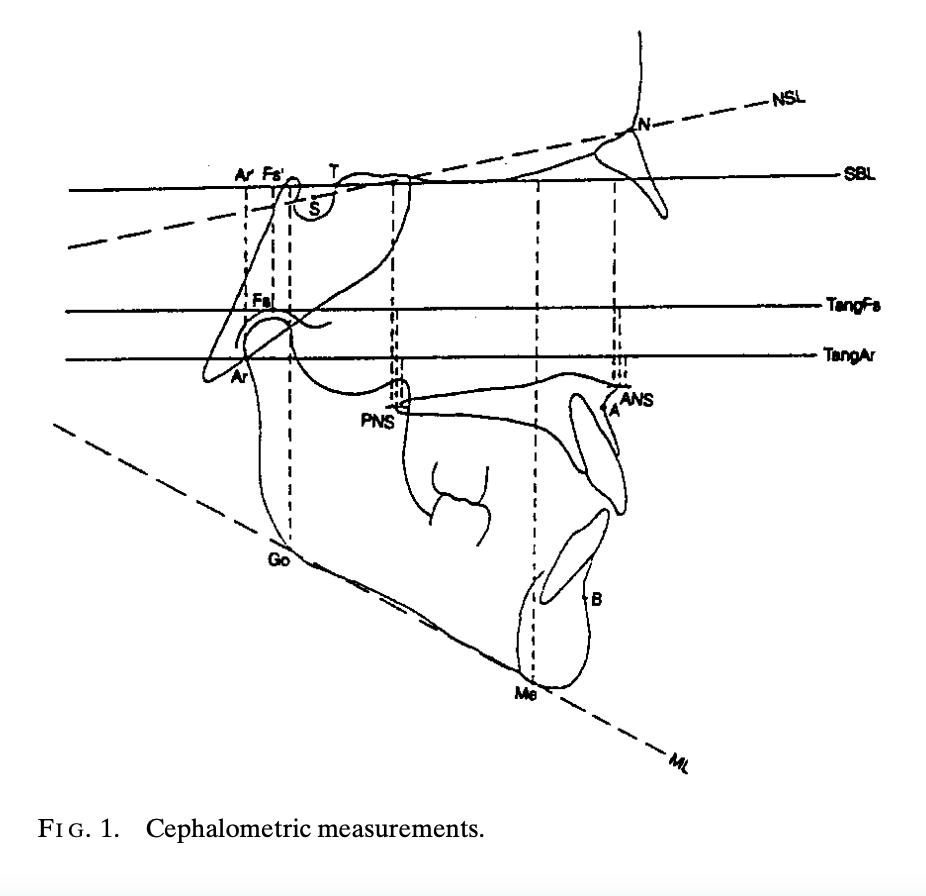
Baccetti et al. (1997) decided to change that.

The Big Question

Does the position of the glenoid fossa differ between Class I, II, III and between high-, normal-, and low-angle facial types?
If yes—can this help us diagnose better?

Spoiler: YES. And the vertical dimension tells a story even more strongly than the sagittal one.

THE STUDY AT A GLANCE

Sample

  • 180 children (7–12 years) — equal males/females
  • Pretreatment cephalograms
  • Clear glenoid fossa outline required
  • Divided into 9 subgroups:
    • Class I, Class II, Class III
    • Low-, normal-, high-angle
    • Combined internally for controlled comparison

Why this is important?

Because it removes age/sex bias → differences truly reflect facial type, not growth/sex variation.

What Exactly Did They Measure?

Two planes of interest:


1. Sagittal (Anterior–Posterior) TMJ Position

Key indicators:

  • T–Fs’: Distance from sella wall (point T) to fossa summit projection
  • T–Ar’: Distance from point T to articulare projection

Shorter distances = fossa positioned more posteriorly.


2. Vertical (Cranial–Caudal) TMJ Position

Key indicators:

  • Fs–Fs’
  • Ar–Ar’
  • TangFs–PNS and TangAr–PNS
  • SBL–MeSBL–GoSBL–ANS

These measure how high or low the fossa sits relative to the cranial base and nasal spines.

Takeaway:
Vertical indicators tell you far more than sagittal ones.

THE LOGIC OF THE FINDINGS

Let’s break them down so they make intuitive sense.


1. Sagittal Findings (Class I vs II vs III)

Class II → Glenoid Fossa is More Posterior

A posterior fossa places the condyle backward → enhances mandibular retrusion → increases ANB.

This fits what you see clinically:

  • Class II often have posteriorly positioned condyles
  • Functional appliances can remodel the fossa anteriorly (as noted in prior studies)

Class III → Glenoid Fossa is More Anterior

An anteriorly placed fossa gives the mandible a “forward hinge.”
This contributes to:

  • Lower ANB
  • Apparent mandibular prognathism

Logical link:
The fossa location magnifies or mitigates jaw relationships.


2. Vertical Findings (Normal vs Low vs High Angle)

This is where the study becomes extremely clinically valuable.

High-Angle Patients → Glenoid Fossa is More Cranial (Higher Up)

A high-positioned fossa elevates the condyle → encourages vertical growth pattern → clockwise rotation → long-face appearance.

Clinical correlation:

  • Hyperdivergent faces
  • Increased mandibular plane angle
  • Open bite tendencies
  • Posterior rotation of mandible

Low-Angle Patients → Glenoid Fossa is More Caudal (Lower Down)

A low-positioned fossa → condyle sits lower → reduces vertical dimension → promotes horizontal growth.

Clinical correlation:

  • Short face
  • Deep bite tendencies
  • Strong chin
  • Forward mandibular rotation

And the most important part:

The posterior nasal spine (PNS) is an excellent reference point for evaluating fossa height.


VERTICAL > SAGITTAL

The authors emphasized that vertical differences were more pronounced, more consistent, and more diagnostically useful than sagittal differences.

This means:

If you want to understand a patient’s growth pattern and mandibular rotation tendencies, analyze fossa height.


Clinical Logic — Why Does Fossa Position Matter?

Understanding fossa position helps you answer critical orthodontic questions:


A. Why does a patient grow clockwise vs counterclockwise?

High fossa = clockwise rotation (high-angle)
Low fossa = counterclockwise rotation (low-angle)


B. Why do some Class II patients look worse even after camouflage?

Because a posterior fossa inherently pushes the mandible back.


C. Why do functional appliances work better in some children?

Certain fossa shapes/positions favor forward condylar adaptation.


D. Why are some deep bites so stubborn?

Low-angle → low fossa → strong masticatory musculature → deep bite tendency.


Key Cephalometric Pearls You Should Remember

1. Class II = posterior fossa

2. Class III = anterior fossa

3. High-angle = high fossa

4. Low-angle = low fossa

5. Vertical position is the best diagnostic clue


Practical Clinical Use (Student Cheat Sheet)

If you see a HIGH-ANGLE face…

Expect:

  • High fossa
  • Clockwise rotation
  • Weak chin
  • Open bite risk
  • Need for vertical control

If you see a LOW-ANGLE face…

Expect:

  • Low fossa
  • Counterclockwise rotation
  • Strong chin
  • Deep bite risk
  • Avoid excessive uprighting/extrusion of molars

If you see a CLASS II face…

Check:

  • Is the fossa posterior?
  • Is the retrusion skeletal or positional?

If you see a CLASS III face…

Check:

  • Is the mandible truly prognathic?
  • Or is the fossa anteriorly placed?

Why This Study Matters Today (Even in CBCT Era)

Although the study used 2D cephalograms, the concept is timeless:

TMJ position is not the result of teeth; it helps shape the face.
Understanding fossa position allows you to predict growth and plan treatment wisely.

Today, CBCT gives even clearer visualization—but the same principles apply.


Final Takeaway for Ortho Students

If you understand this one idea, you have mastered the essence of the paper:

The glenoid fossa is not a passive socket—it actively influences sagittal and vertical facial patterns.
Its position helps determine whether a patient grows long, short, forward, or backward.

Once you learn to read it, the TMJ becomes one of your most powerful diagnostic tools.

Lateral Pterygoid Hyperactivity Hypothesis – Why It Was Abandoned

1. ORIGINAL THEORY (1970s–1980s)

Proposed by: McNamara, Petrovic
Claim:

  • Functional appliances → mandible advanced → LPM hyperactivity
  • Hyperactive LPM → traction on condylar cartilage → accelerated mandibular growth

Clinical relevance back then:
Cornerstone explanation for functional appliance effects.


2. WHY THE THEORY FAILED

A. Anatomical Evidence

  • LPM does NOT attach directly to the condylar disc.
  • It attaches to anterior capsule, not fibrocartilage.
  • Other muscles (temporalis, masseter) also influence disc region.
    ➡️ Traction theory anatomically unsupported.

B. Biomechanical Contradiction

  • Functional appliances shorten the LPM (mandible forward).
  • Shortened muscles do not reflexively hyperactivate.
    ➡️ Hyperactivity in a shortened muscle = biomechanically illogical.

C. Myectomy (LPM Removal) Studies

  • LPM surgically removed (Whetten, Johnston).
  • Condylar growth still occurred.
  • Some blood supply disruption possible, but:
    ➡️ Growth did not rely on LPM traction.

D. Modern EMG Findings

Using refined EMG and longitudinal monitoring:

  • Functional appliance therapy → decreased LPM postural activity
  • ↓ LPM activity → increased, not reduced, condylar growth
    Researchers: Auf Der Maur, Pancherz, Ingervall, Bitsanis
    ➡️ Opposite of original hypothesis.

3. CURRENT UNDERSTANDING (Modern Paradigm)

What actually promotes condylar growth?

  • Sustained forward mandibular positioning
  • Viscoelastic stretch of posterior periarticular tissues
  • Altered joint-space loading
  • Improved retro-condylar vascular perfusion
  • Functional adaptation of soft tissues
    ➡️ Growth results from stable repositioning, not muscle hyperactivity.

4. PRACTICAL CLINICAL TAKEAWAYS

✔ Functional appliances work—but not because of LPM hyperactivity
✔ Continuous wear > part-time wear (stability > force)
✔ Condylar remodeling depends on tissue stretch & vascular changes
✔ LPM helps maintain position but does not stimulate growth
✔ Growth is a multifactorial adaptive response, not a muscle-traction effect

Cranial Base Morphology in Class III Malocclusion

When we think of Class III malocclusion, our minds instantly jump to “mandibular prognathism,” “maxillary deficiency,” or that unmistakable concave profile. But what if we told you that the story begins much deeper—in a region most clinicians rarely visualize: the cranial base.

A fascinating study by Chang et al. (2005) reveals how subtle changes in the cranial base shape can quietly set the stage for a Class III facial pattern long before the first molar even erupts.

🔍 Why the Cranial Base Matters

The cranial base serves as the architectural foundation for:

  • The position of the mandible
  • The forward placement of the maxilla
  • TMJ inclination
  • Facial profile development

Think of it as the “orthodontic motherboard.”
If it develops differently, everything built upon it shifts.

1. The Big Finding: A Shorter Posterior Cranial Base

The study compared 100 Class III children with 100 normal controls. The most striking difference?

👉 The posterior cranial base was significantly shorter in Class III subjects.

This included reduced:

  • S–Ar
  • Pc–Ar
  • Pc–Ba
  • Pc–Bo
  • Ar–PM
  • Bo–PM

This matters because the posterior cranial base guides the position of the condyle.
A short base = the TMJ sits more forward → the mandible follows → Class III appearance emerges.

Clinically:
Ever seen a child with mild mandibular projection but no clear functional shift?
Think posterior cranial base deficiency.

2. The Saddle Angle Story: More Acute Angulation

The study found:

  • N–S–Ar and N–Pc–Ar angles were more acute in Class III children.

This means the cranial base is more bent—a phenomenon sometimes called “cranial base kyphosis.”

Why it matters:

A more acute saddle angle shifts the glenoid fossa forward → the mandible comes along for the ride.

This is a skeletal pattern—not a habit, not a posture.

4. The Cranial Base Pattern Is Set Early—Very Early

Several classic studies say show that:

  • Cranial base shape develops prenatally
  • The saddle angle remains remarkably stable through childhood
  • Variations appear early and persist

This explains why:

  • Class III patterns often run in families
  • Interceptive treatment is most effective before growth accelerates
  • Prediction of Class III progression often depends on baseline cranial-base morphology

Final Thought

Class III malocclusion is not simply a “big mandible vs small maxilla” problem.

It’s a developmental story—one rooted in the very foundation of the skull.

Understanding cranial-base morphology gives orthodontists a sharper lens to diagnose, counsel, and treat Class III patients—particularly in their formative years.

Growth & Treatment Planning Hints

  • Shortened, flexed posterior cranial base
    → Expect stronger skeletal Class III tendency.
    → Earlier interceptive approaches (facemask + RME, chincup, functional orthopedics) may be more justified.
  • Cranial base near normal, but Class III present
    → Consider dominant roles of maxillary retrusion, mandibular overgrowth, or local factors.
  • Rapid visual check on lateral ceph
  • Look at posterior base: S‑Ar, Pc‑Ar, Pc‑Ba, Ar‑PM, Ba‑PM, Bo‑PM.
  • Assess saddle region: N‑S‑Ar and N‑Pc‑Ar.
  • Scan midface profile: Gl‑N‑Rh.

RAPID MAXILLARY EXPANSION (RME): Sagittal & Vertical Effects in Class I, II, III

Rapid Maxillary Expansion (RME) is one of the most powerful orthopedic tools available during growth. While most of us associate RME with “widening the palate” and correcting crossbites, its influence extends far beyond the transverse plane.

A landmark study by Farronato et al. evaluated 183 growing patients—Class I, II, and III—and revealed that RME also drives important sagittal and vertical changes. These effects vary significantly depending on the skeletal class, which is critical when planning early treatment.

This blog breaks down these findings into practical clinical insights you can apply from your very next patient.

🔍 Why RME Matters Beyond Transverse Correction

When the Hyrax appliance opens the midpalatal suture, it triggers a chain reaction:

  • Circummaxillary sutures loosen
  • Maxilla may reposition
  • Mandible adapts to new occlusal contacts
  • Vertical dimensions can shift

These effects can help or hinder skeletal correction—if you understand how they behave in each malocclusion.

🔹 CLASS I

Sagittal

  • ANB ↓ slightly (–0.34°)
    → Mild improvement toward Class I

Maxilla & Mandible

  • No significant sagittal movement
  • Slight downward–backward rotation of palatal plane

Vertical

  • No significant N–Me change
  • Mandibular plane: unchanged

👉 Clinical Impact

  • Improves transverse deficiency without disturbing sagittal or vertical balance.

Class I kids are like the straight-A students who also volunteer and play violin.
You expand them and—poof!—they get wider.
That’s it.

No tantrums. No drama. No sagittal plot twists.

Sagittally? Nothing much.
Vertically? Eh.
ANB changes by, what, –0.34°?

It’s like telling someone you changed your hairstyle and they say,
“Really? I… can’t see it.”

🔹 CLASS II

Sagittal

  • SNB ↑ (+2.25°) → Mandible moves forward (statistically significant)
  • ANB ↓ (–1.81°) → Skeletal Class II improves
  • SNA unchanged (maxilla stable)

Mechanism

  • Expansion “releases” the mandible → spontaneous forward posturing (McNamara effect)

Vertical

  • No significant anterior facial height increase
  • Palatal plane rotates down–back (slight)

👉 Clinical Impact

  • RME can improve Class II sagittal pattern in early mixed dentition.
  • Mandibular advancement occurs mainly during retention.

Ah, Class II.
The ones whose mandibles have been sitting back like they’re too cool to show up on time.

Enter RME.

Suddenly the mandible pops forward like:
“I’m here! I’m fabulous! I’m 2.25° more fabulous!”

SNB goes up.
ANB goes down.
Orthodontists everywhere go,
“Sweet mother of cephalometrics, it actually worked!”

It’s like giving someone better shoes and suddenly they walk straighter.

🔹 CLASS III

Sagittal

  • SNA ↑ (+0.81°) → Maxilla moves forward
  • SNB ↓ (–1.35°) → Mandible rotates down–back
  • ANB ↑ (+2.16°) → Significant correction toward Class I

Vertical

  • N–Me ↑ (+0.84 mm) → Increased anterior facial height
  • Downward–backward rotation of mandible & palatal plane

👉 Clinical Impact

  • RME improves early skeletal Class III by:
    ✓ Forward translation of maxilla
    ✓ Clockwise rotation of mandible

Now, Class III…
These kids don’t just enter the clinic.
They storm in with a plotline.

RME hits them and BAM—
the maxilla moves forward (+0.81°),
the mandible rotates down and back like it’s trying to avoid an awkward conversation,
and ANB shoots up like a Broadway finale (+2.16°).

Meanwhile, vertical height increases too.
Because of course it does.
Why do one thing when you can do five?

Class III kids after RME look like they’ve had a character arc.
Like they went to Paris and “found themselves.”

Summary of Cephalometric Changes After RME

ParameterClass IClass IIClass III
Maxillary Position (SNA)No significant changeNo significant change↑ SNA (maxilla moves forward)
Mandibular Position (SNB)No significant change↑ SNB (mandible moves forward)↓ SNB (mandible rotates down–back)
ANB Angle↓ slightly (minor Class I improvement)↓↓ significantly (Class II improves)↑↑ significantly (Class III improves)
Palatal Plane (SN–SNP.SNA)↑ (down–back rotation)↑ (down–back rotation)↑ more (significant rotation)
Anterior Facial Height (N–Me)No significant changeNo significant change↑ increased vertical height
Mandibular Plane (SN–GoGn)No significant changeNo significant changeMild ↑ (not always significant)
Posterior Facial Height (S–Go)No significant changeNo significant changeNo significant change

Clinical Interpretation of RME Effects

Clinical AspectClass IClass IIClass III
Sagittal EffectMinimalMandible moves forward → improves Class IIMaxilla advances + mandible rotates back → improves Class III
Vertical EffectStableStableVertical dimension increases (N–Me ↑)
Overall Skeletal CorrectionMildModerateStrong
Most Active PhaseActive + RetentionMainly retentionActive phase
Risk AreasFewFewVertical increase in hyperdivergent cases

Mechanism Behind RME Changes

EffectHow It Happens
Mandibular forward shift (Class II)Removal of transverse “lock” → lower arch can posture forward (McNamara effect)
Maxillary forward movement (Class III)Expansion affects circummaxillary sutures → allows slight anterior displacement
Palatal plane rotationDown–back rotation from suture opening → common to all classes
Increase in N–Me (Class III)Maxilla forward, mandible back/down

A Study of the Mandibular Closure Path in Angle Class III Relationship

Class III cases can be tricky—because what you see clinically may not always be what’s truly happening skeletally.
A major reason for this confusion is the mandibular closure path.

In simple terms, you must ask:

👉 Does the mandible really sit forward?
or
👉 Is it just sliding forward because the incisors collide during closure?

This distinction is essential for correct diagnosis and avoiding overtreatment.

True vs Pseudo Class III — The Core Difference

FeatureTrue Class III 😬Pseudo Class III 🙂
CauseSkeletal discrepancyPremature incisor contact
Forward mandibular shift❌ Minimal / None✅ Present (functional slide)
Ceph ANBNegative due to skeletalImproves when edge-to-edge
ProfileConcaveStraight / near normal
TreatmentGrowth modification / SurgeryRemove interference + limited ortho

Why Functional Shifts Matter So Much

A patient may appear severely Class III when teeth are in habitual occlusion.
But once you guide them into edge-to-edge, the face and ceph often tell a different story.

This happens because many Class III patients have a:

Functional forward mandibular displacement

Also described as:

  • forward displacement
  • functional protrusion
  • anterior slide
  • mandibular slide

🦷 Premature incisor contact → Mandible slides forward → Posterior teeth finally occlude

This functional shift can exaggerate the skeletal discrepancy and lead to misdiagnosis.

The closure path also involves a vertical component. As the mandible moves forward, it may also rotate downward, further altering the apparent skeletal relationship

What Actually Happens During Closure (Based on the Study)

1. Closure begins → incisors touch edge-to-edge

→ This causes an initial forward shift of the mandible.

2. As closure continues → condyles move backward

→ This cancels most of the forward movement.

3. Final result

✅ Most Class III patients show little to no real mandibular displacement when the posterior teeth are in occlusion.

This means the apparent Class III worsening is mostly positional, not skeletal.

Role of Overbite in the Functional Shift

Overbite depth determines how much shift can happen:

Deep overbite

➡️ Less functional forward displacement
➡️ Hinge closure pushes condyles backward effectively

Shallow overbite

➡️ More chance of a genuine functional slide
➡️ Slight displacement may persist even in full occlusion

What Two Cephs Really Tell You

Taking both:

  1. Edge-to-edge ceph, and
  2. Habitual occlusion ceph,
    usually does not dramatically change your skeletal assessment.

Typical Changes Seen

ParameterEdge-to-edgeHabitual OcclusionInterpretation
SNB↓ by ~3°Hinge closure effect, not forward displacement
ANB↑ by ~3°Mostly due to vertical change from overbite

Key insight:

The ANB difference is largely due to vertical position changes—not true mandibular forward movement.

When Does Residual Functional Shift Still Matter?

For most patients → minimal to none.

But in patients with shallow overbite (<4 mm) a small functional shift may be measurable:

  • SNB decreases slightly (≈ –0.4°)
  • ANB increases slightly (≈ +0.28°)

These differences are statistically significant, but rarely large enough to alter your diagnosis.

Practical Chairside Screening

A. Suspect Pseudo-Class III if:

  • A noticeable forward jump during closure
  • Edge-to-edge looks less Class III
  • Shallow overbite
  • Strong anterior interferences

B. Suspect True Skeletal Class III if:

  • No forward shift on closure
  • Edge-to-edge still looks Class III
  • Deep overbite (hinge movement dominates)
  • Minimal ceph difference between both positions

Should You Take Two Cephs?

According to the study:

❗ Routine second ceph is not necessary in most cases.

Habitual occlusion ceph is usually sufficient because:

  • The functional slide is often neutralized during full closure.
  • Skeletal interpretation remains largely unchanged.

✔ Use a second ceph only when evaluating a suspected functional shift.

Quick Exam Tips

  • When asked about functional mandibular slide in Class III, emphasize rotation vs. translation.
  • Remember the relationship between overbite depth and angular changes.
  • Understand the clinical implications of study results: Use edge-to-edge ceph only when absolutely necessary.
  • For cephalometric interpretation, ANB changes can be influenced by vertical mandibular rotation.
  • Be able to describe how mandibular closure path affects ceph interpretation.

Class III malocclusion: a comparison of extraction and non-extraction techniques

Class III malocclusions aren’t just “reverse overjet cases.” They involve a combination of:

  • Skeletal discrepancies (maxillary deficiency, mandibular prognathism, or both)
  • Dental compensations (retroclined lower incisors, proclined upper incisors)
  • Growth patterns (vertical growers complicate everything)
  • Functional shifts (apparent vs true Class III)

The difficulty?
Growth often exacerbates the problem—especially mandibular growth. So the treatment plan you choose at 12 years of age can dramatically influence whether that patient avoids or needs orthognathic surgery at 18.

1. Non-Extraction Approach

👉 When to choose:

  • Mild–moderate Class III
  • Little or no mandibular crowding
  • Early permanent dentition
  • Forward functional shift present
  • Patient accepts extraoral appliances

2. Extraction Approach

👉 When to choose:

  • Marked lower arch crowding
  • Dental compensation is needed to correct overjet
  • Patient is in the late mixed/early permanent dentition
  • Non-compliance expected for extraoral appliances
ParameterNon-Extraction + HeadgearExtraction + Fixed Appliances
Upper IncisorsProclinedUsually stable / mild retroclination
Lower IncisorsSpontaneous retroclinationControlled orthodontic retroclination
MandibleDownward–backward rotationTends to grow forward
ANB ChangeImprovesMinimal improvement
ProfileMore convex, softer appearanceMostly dental correction
Best ForMild skeletal Class IIICrowding cases
Treatment TimeShorterLonger
Long-term StabilityDepends on growth controlDepends on dental compensation

👩‍⚕️👨‍⚕️ What Exam Answers Must Include

If an examiner asks:
“How would you decide between extraction and non-extraction in Class III?”

Your ideal answer should include:

  1. Crowding analysis (most important)
  2. Growth pattern & age
  3. Severity of skeletal discrepancy
  4. Incisor inclination (U1-SN, L1-MP)
  5. Soft tissue profile
  6. Compliance for extraoral appliances
  7. Future orthognathic surgery considerations

🧩 Clinical Case Tip for PG Examination

  • A skeletal Class III child with minimal lower crowding, reverse overjet, and acceptable profile → Non-extraction + headgear
  • A Class III adolescent with >5 mm crowding, upright upper incisors, and camouflaging need → Extraction-based camouflage

Remember

Class III = growth-driven problem.
Your treatment choice must consider future mandibular growth and potential need for surgery.