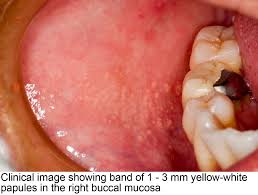
What are Fordyce granules? How does it occur ?
- Firstly it isn’t a disease as the name says it.
- Rather this can be called a developmental anomaly.
- It is characterised by heterotopic collection of sebaceous glands in various sites of the oral cavity.
- It is said that the occurance of sebaceous glands in the mouth may be by inclusion in the oral cavity of the ectoderm.
- This has some of the potentialities of skin during the development of the maxillary and the mandibular processes during the embryonic life.
Clinical features-
1.Appearance-
- as yellow spots, seperated
- or forming large plaques
- project slightly above the suface of tissue
2. Site of appearance- found frequently in a bilateral symmetical pattern
- mucosa of cheeks (opposite the molar teeth)
- inner surface of lips
- retromolar region
- tongue
- gingiva
- palate
- frenum
Besides the oral cavity they also appear in the oesophagus ,the female genital tract ,cervix uteri, male genitilia ,nipples, palms ,soles ,parotid ,larynx and the orbit .
3. Usually seen more in adults than children . This is due to the better development of sebaceous glands and hair system is not seen until puberty.
Histology
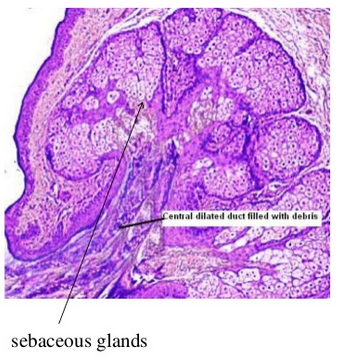
- These are heterotopic collection of sebaceous glands and they are identical with those that are seen in the skin.
- But they are unassociated with hair follicles and hair shaft from the gingiva. (this may be a very rare occurance )
- Glands are located superficially.
- There may be few or many lobules.
- They are grouped around one duct or more ducts and they open at the surface of the mucosa .
- The ducts may show keratin plugging.
Treatment-
It requires no treatment.
source – textbook of oral pathology shafers and google images .

 Dentowesome