By Dr Musaddika Shaikh Dentowesome @drmusaddikashaikh
Blood :- It is body fluid in body that delivers necessary substance like oxygen,nutrients to cell and transports metabolic waste away from cell.

- Total blood volume :- 5-6litres 80ml/kg body weight
- Viscosity :- 4-5 litres
- Ph :- 7.4
- Specific gravity :- 1.040-1.060
Composition :-
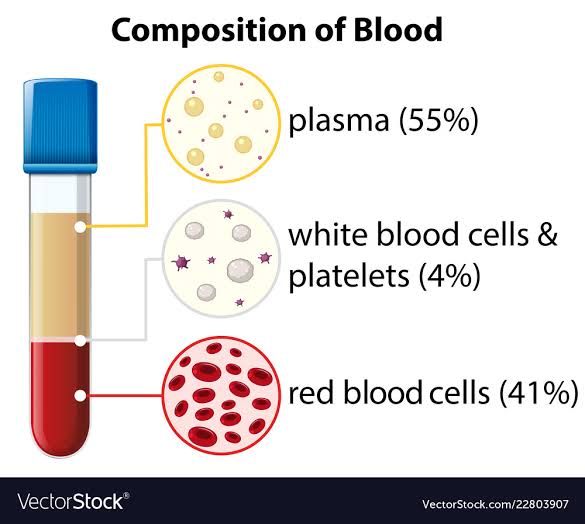
Anti coagulated sample of blood allow to stand in a tube,it settles cells and plasma.
A) Cells :- Cellular element is 45% of total blood volume called packed cell volume. 1. RBC/Erythrocytes :- Normal count 5million cu.mm. 2. WBC/Leucocytes :- Normal count 4000-11000 cu.mm. 3. Platelets/Thrombosis :- Normal count 1.4-4 lakh cu.mm
B) Plasma :- It is clear,straw colored with 55% of total volume. It contains 91% water+9% organic+1%inorganic substances. a) Inorganic substance:- 1. Na+,Ca+,HCO3(extracellular) 2. k+,Mg,Po4 (intracellular). 3. Ferrous and ferric oxide. b) Organic substance :- 1. Plasma protein. 2. Sugar. 3. Fat 4. Hormone
Non protein nitrogenous substance :- 1. Urea :- 20-40% mg% 2. Uric acid :- 2-4% mg% 3. Creatine :- 1-2% mg% Other substance are fat, phospholipids, glucose.

Functions :-
- Respiratory :- blood transprt oxygen from lungs to tissues and CO2 from tissues to lungs.
- Nutritive :- absorb food material,glucose,amino-acid,fatty acid and vitamins.
- Excreatory :- blood transport metabolic waste.
- Heamostatic function :- to regulate normal cell function by heamostasis
- Regulate body temperature :- regulate body temperature by buffer system.
- Chemical :- regulate negative feedback machanism and defence system for inflammation.
Reference :- Books Human physiology for bds A.K Jain. Google website texasheart.org , britannica.com , vectorstock.com

 Dentowesome