Bimaxillary protrusion is a common orthodontic condition marked by protrusive and proclined upper and lower incisors, coupled with increased lip prominence. While predominantly seen in African American and Asian populations, it is not limited to any single ethnic group. This condition often leads patients to seek orthodontic treatment due to the aesthetic concerns of protruding lips and dentition.
Soft Tissue and Hard Tissue Correlation
Orthodontic studies present two conflicting perspectives on the relationship between incisor retraction and lip position:
- Strong Correlation: Some studies demonstrate a direct relationship between incisor and lip retraction.
- Weak Correlation: Some studies suggest that soft tissue changes do not proportionally mirror dental movements due to variables like growth, lip tonicity, and anchorage.
Four retrospective studies on bimaxillary protrusion treatment provided valuable insights:
| Study Findings | Upper Lip Retraction (mm) | Lower Lip Retraction (mm) | Nasolabial Angle Increase (°) |
|---|---|---|---|
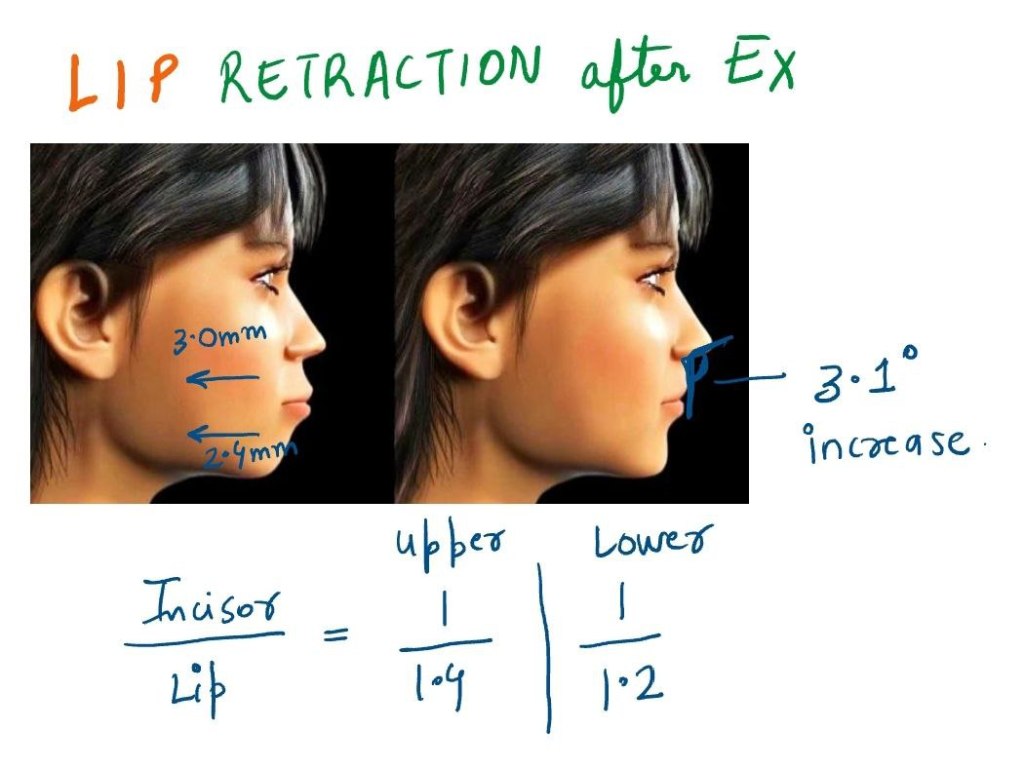
| Caplan et al. (2009) | 3.0 | 2.4 | Not significant |
| Tan et al. | 2.7 | 2.0 | 10.5 |
| Lew | 3.2 | 4.5 | 10.0 |
| Bills et al. | 3.0 | 2.4 | 3.1 |
Incisor Retraction and Lip Retraction Ratios
| Study | Upper Lip to Incisor Retraction | Lower Lip to Incisor Retraction |
|---|---|---|
| Caplan et al. | 1:1.4 | 1:1.2 |
| Other Studies | 1:2.2 | 1:1.75 |
Clinical Implications
- Four-premolar extractions effectively reduce lip procumbency in bimaxillary protrusion.
- Nasolabial angle tends to increase post-treatment.
 Dentowesome