Dental investments and refractory materials (part 2 )

GYPSUM BONDED INVESTMENTS

Thermal behaviour of gypsum

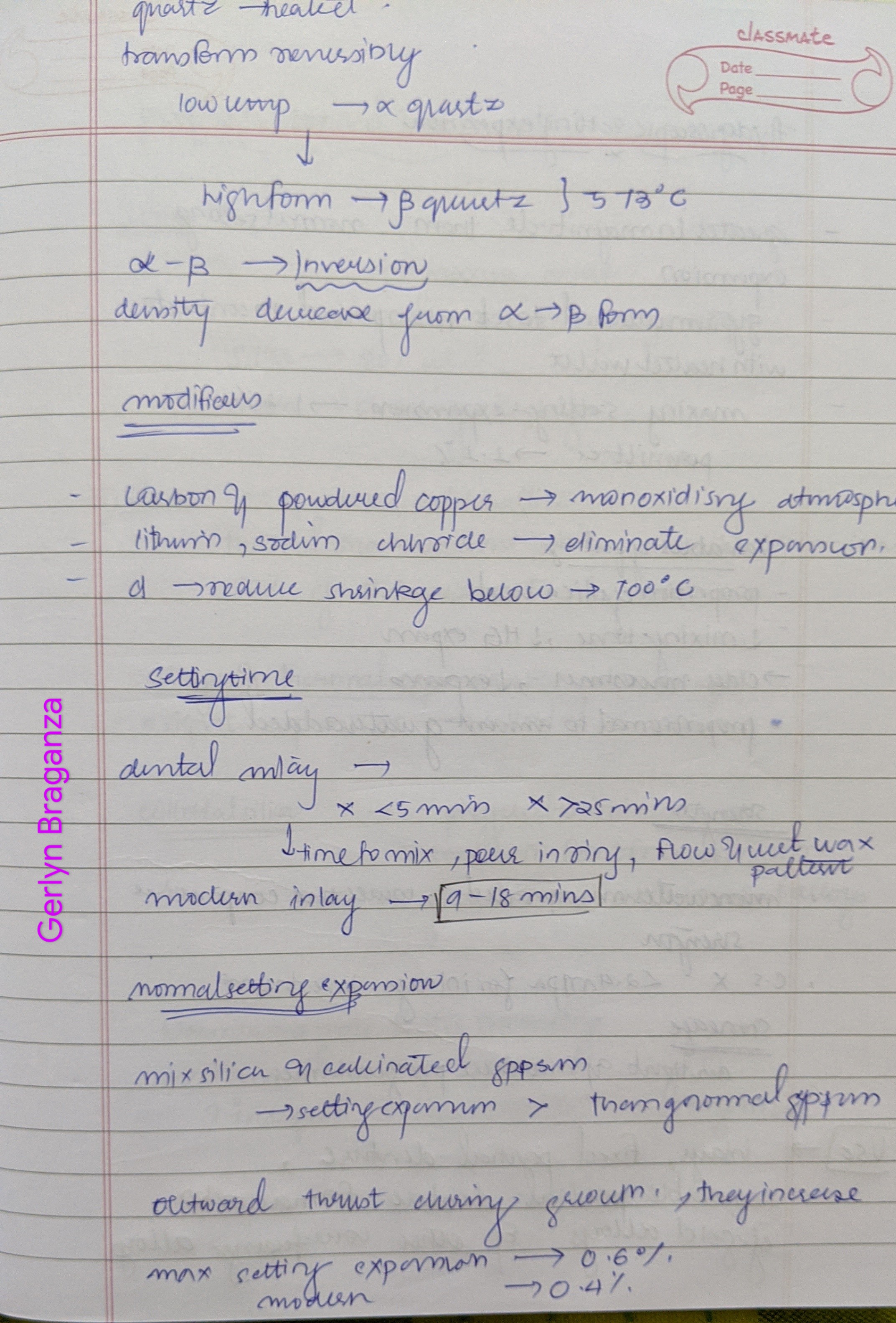
When gypsum is heated to a high temperature, it shrinks and fractures. At 700 °C, it shows slight expansion and then great amount of contraction. The shrinkage is due to decomposition and release of sulphur dioxide .

It contaminates the casting with sulphides of silver and copper .

Hence gypsum bonded investments are not heated above 700°C.

PHOSPHATE BONDED INVESTMENTS
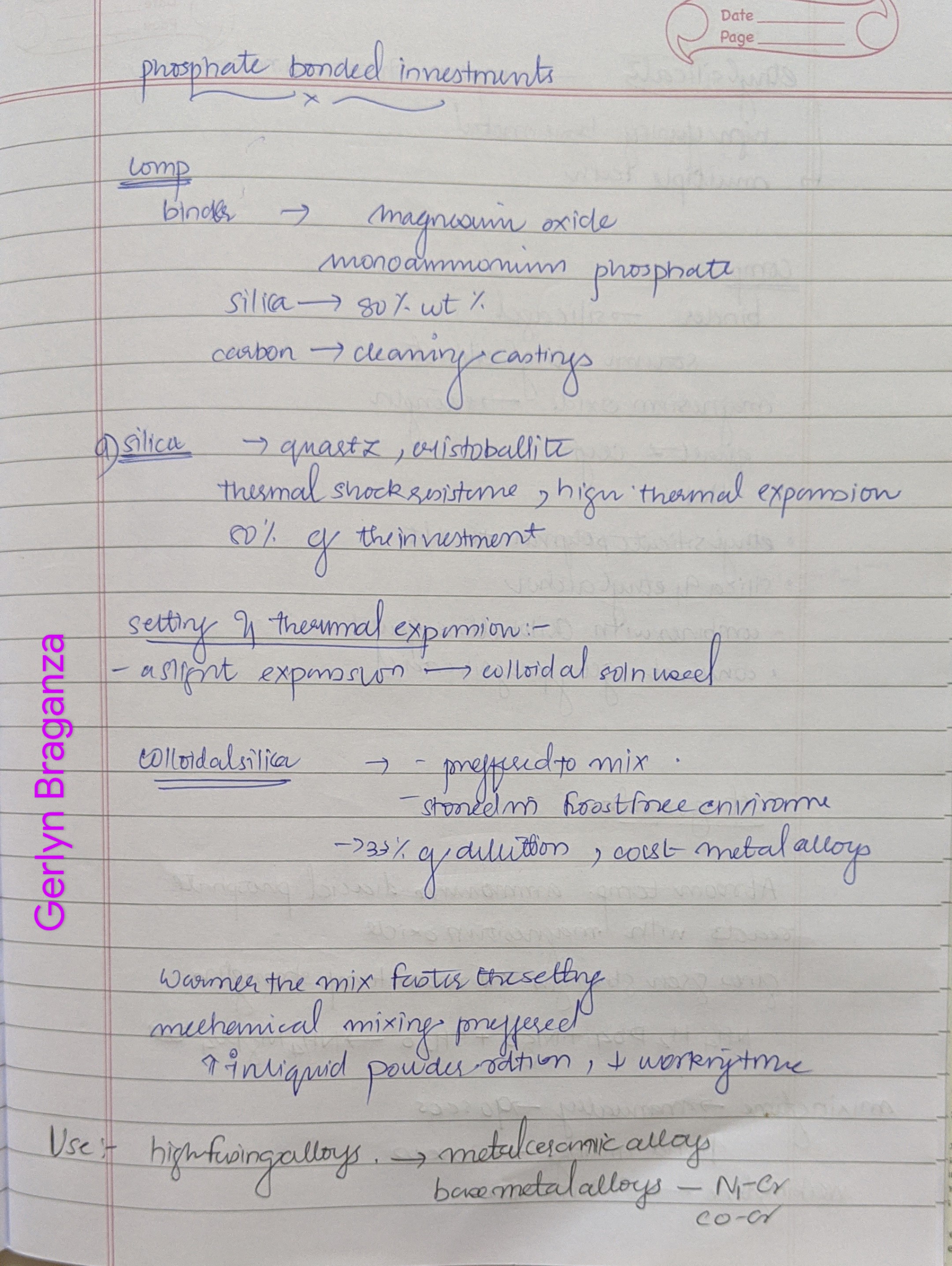
EXPANSION

  1. Wax pattern expansion The heat during setting allows a significant expansion of the wax pattern
  1. Setting expansion This is around 0.7 to 1%.
  2. Thermal expansion Ranges from around 1 to 1.5%.

The amount of expansion is adjusted by the manufacturer for each product depending on the alloy it is intended for.

STRENGTH –

Wet strength ranges from 4-10Mpa

And dry strength is the strength under high temperatures.

SILICA BONDED INVESTMENTS

The silica is the binder. It is derived from ethyl silicate or aqueous dispersion of colloidal silica or sodium silicate.

TYPES

Based on the binder used two types may be seen. One such investment consists of silica refractory, which is bonded by the hydrolysis of ethyl silicate in the presence of hydrochloric acid.

The product of the hydrolysis is the formation of a colloidal solution of silicic acid ethyl alcohol.

Ethyl silicate has the disadvantage of containing inflammable components which are required for manufacture

Sodium silicate and colloidal silica are more commonly used as binders because of the above disadvantage.

These investments are supplied along with two bottles of special liquid. One bottle contains dilute water soluble silicate solution such as sodium silicate.

Source – basic science of dental materials manappallil

Dental investments and refractory materials (part 1)

A refractory is a non metallic material with can with stand high temperature without degrading , softening or losing its strength.

A investment is a ceramic material which is suitable for forming a mold into which a molten metal or alloy is cast. The process is called investing

REQUIREMENTS OF AN INVESTMENT MATERIAL

  1. The investment mold must expand to compensate for the alloy shrinkage, which occurs during the cooling of the molten alloy.
  1. The powder should have a fine particle size to give a smooth surface to the casting.
  2. The manipulation should be easy. It should have a suitable setting time.
  3. The material should have a smooth consistency when mixed.
  4. The set material should be porous enough to permit air in the mold cavity to escape easily during casting.
  5. At higher temperatures, the investment must not decompose to give off gases that may corrode the surface of the alloy.
  1. It must have adequate strength at room temperature to permit handling, and enough strength at higher temperatures to withstand the impact force of the molten metal.

GENERAL COMPOSITION of INVESTMENTS

All investment materials contain a refractory, a binder and modifiers.

REFRACTORY

A refractory is a material that will withstand high temperatures without decomposing or disintegrating, e.g. silica.

Allotropic forms Silica exists in at least four allotropic forms.

Quartz

Tridymite

Cristobalite

Fused quartz

They serve two functions

  1. Act as a material that can withstand high temperatures.
  2. Regulate the thermal expansion.

BINDER

A material which will set and bind together the particles of refractory substance,

e.g. gypsum, phosphate and silicate. The common binder used for gold alloys is dental stone (alpha hemihydrate).

The investments for casting cobalt chromium alloys use ethyl silicate, ammonium sulphate or sodium phosphate.

CHEMICAL MODIFIERS

Chemicals such as sodium chloride, boric acid, potassium sulfate, graphite, copper powder or magnesium oxide are added in small quantities to modify properties.

Source – basic science of dental materials – manappallil