REITER’S SYNDROME

Reiter’s syndrome is associated with urethritis, balanitis, conjunctivitis, and mucocutaneous lesions.

 It is a disease of unknown aetiology, although there is evidence of an infec- tious origin.

It is one of the most common complications of non-specific urethritis and it clinically mimicks gonorrhoea, although the urethral discharge is negative for Neisseria.

CLINICAL FEATURES

>Reiter’s syndrome is more prevalent in young adult men, usually between 20 and 30 years of age. 

>The male-to-female ratio is 9:1. 

>There is a typical tetrad of manifestations: non- gonococcal urethritis, arthritis, conjunctivitis, and mucocutaneous lesions. 

>Urethritis may be the first sign. The urethral discharge is usually associated with itching and burning sensation. 

>The arthritis is often bilaterally symmetrical and usually polyarticular.

 >Conjunctivitis is often so mild as to be overlooked. 

>The skin lesions are similar to those seen in keratoderma blennorrhagica and consist of red or yellow keratotic macules or papules which eventually desquamate.

Oral Manifestations

Sites—it is seen on the buccal mucosa, lips and gingiva.

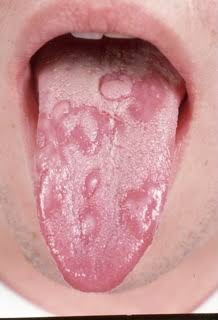
Oral lesions appear as painless, red, slightly elevated areas, some- times granular or even vesicular, with a white circinate border on the buccal mucosa, lips, and gingiva. 

The palatal lesions appear as small, bright red purpuric spots, which darken and coalesce, while the lesions on the tongue closely resemble ‘geographic’ tongue.
Laboratory Findings

The patients usually have a mild leukocytosis, an elevated erythrocyte sedimentation rate, and pyuria.

  • Differential Diagnosis
  • • Geographic tongue and stomatitis—no skin changes, no visceral lesions are seen.
  • • Pustularpsoriasis—Auspitz’ssignpresent.
    • Behcet’ssyndrome—nourethritis,aphthaewithredhalo.
  • • Stevens-Johnson syndrome—acute appearance, moresevere clinical course, no arthritis or urethritis.
    • Benign mucosal pemphigoid—blister formation, nourethritis, found in older patients.
Histologic Features
The microscopic findings are not diagnostic. They consist of parakeratosis, acanthosis, and polymorphonuclear leukocyte infiltration of epithelium, sometimes with mi- croabscess formation similar to psoriasis. The connective tissue shows a lymphocyte and plasma cell infiltrate.
  • Management
  • • Spontaneous remission—many patients undergo spontaneous remission.• Antibiotics—incasesymptomaticpatient,doxycycline or minocycline may be given.
  • • Analgesics—nonsteroidalanti-inflammatorydrugsare given to manage arthritis.
  • • Immunosuppressiveagents—immunosuppressiveagents like azathioprine and methotrexate are given in cases of most resistant cases.

REFERENCE- SHAFER’S TEXTBOOK OF ORAL PATHOLOGY [8TH ED} AND ANIL GHOM TEXTBOOK OF ORAL MEDICINE

WEGNER’S GRANULOMATOSIS

Wegener’s granulomatosis is a disease of unknown aetiology, which basically involves the vascular, renal and respiratory systems. It involves the nose, paranasal air sinuses, lower respiratory tract, gut, joints, nervous system, and kidneys. Involvement of the kidney is the common cause of death.

This disease is caused by an abnormal immune reaction secondary to a nonspecific infection or a hypersensitivity reaction to an unknown antigen.

Clinical Features

>Wegener’s granulomatosis may occur at any age, although the majority of cases are in the fourth and fifth decadesof life.

 >There is a slight predilection for occurrence in males.

 >It is best described as a multisystem disease, which is usually first characterized clinically by the development of rhinitis, sinusitis, and otitis or ocular symptoms.

 >The patient soon develops a cough and hemoptysis as well as fever and joint pain. 

>Hemorrhagic or vesicular skin lesions are also commonly present. 

>Granulomatous lesions of the lungs are found on the chest radiograph, while the glomerulonephritis, which develops ultimately, leads to uraemia and terminal renal failure.

 >In nervous system, sensory neuropathy may be an occasional finding.

>Prognosis—the disease is usually fatal, with mean survival time of 5 months. Death occurs due to involvement of kidney.

Oral Manifestations

Involvement of the gingiva has been the most common and characteristic manifestation, and is termed as strawberry gingivitis.Gingival lesions may manifest as ulcerations, friable granular lesions, or simply enlargements of the gingiva. 

The inflammatory process starts in the interdental papilla and spreads rapidly to the periodontal structure and leads to bone loss and tooth mobility. 

Palate—orallesionstypicallyincludeulcerationofthe palate by extension of nose lesions and destruction of nasal septum. This will lead to perforation of palate.

• Teeth—theremaybelooseningofteethwithinsomecases spontaneous exfoliation. After extraction of teeth patient is usually noticed poor healing.

Laboratory Findings

Laboratory findings include anaemia, leukocytosis, elevated erythrocyte sedimentation rate, and hyperglobulinaemia. Because of kidney involvement, haematuria is common, as well as the finding of albumin, casts, and leukocytes in the urine. Circulating immune complexes have been demonstrated in some patients, but this is not a consistent finding.

Histologic Findings

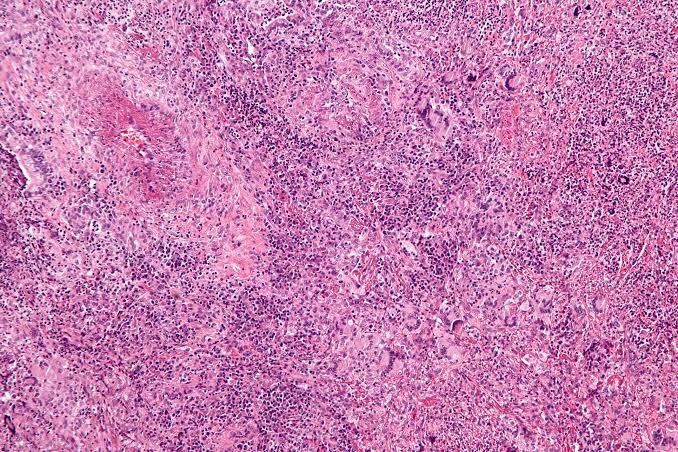
Wegener’s granulomatosis presents a pattern of mixed inflammation centred around the blood vessels. 

The lesions in the upper respiratory tract and lungs consist of giant cell necrotizing granulomatous lesions showing vasculitis. 

Oral biopsy specimens show pseudoepitheliomatous hyperplasia and subepithelial abscesses. The gingival and other lesions show a nonspecific granulomatous process with scattered giant cells.

Diagnosis

  • Clinical diagnosis—typical strawberry gingivitis with necrotic ulceration in the oral cavity.
  • Laboratorydiagnosis—cytoplasmiclocalizationispresent with Wegener’s granulomatosis. Histopathologically chronic inflammatory cells and multinucleated giant cells are found.
  • Differential Diagnosis
  • Agranulocytosis, leukemia, lymphoma—diagnosis by blood picture, possibly histology.
  1. Management
    • Cotrimoxazole—it is combination of trimethoprim and sulfamethoxazole. It has proved to be effective as an adju- vant or sole therapy in both localized and generalized forms.
    • Corticosteroids—regimenofcyclophosphamide12mg/ kg body weight/day with prednisolone 1 mg/kg body weight have been utilized to obtain complete remission.
    • Others—other treatment modalities includes cyclo- sporine, intravenous pooled immunoglobulin, and local irradiation.

REFERENCE- SHAFER’S TEXTBOOK OF ORAL PATHOLOGY {8TH ED} AND ANIL GHOM TEXTBOOK OF ORAL MEDICINE

BECHET’S SYNDROME

  • Behçets disease (BD) was initially described by the Turkish dermatologist Hulusi Behçet as a triad of symptoms including 

                        1. Recurring oral ulcers, 

                         2.Recurring genital ulcers, and 

                         3.Eye involvement.

ETIOLOGY

  • The cause of BD is unknown, 
    • but immune dysregulation, 
    • including circulating immune complexes, 
    • autoimmunity, cytokines, and 
    • heat shock proteins, 
    • major factor in the pathogenesis of BD.

CLINICAL MANIFESTATIONS

  • Highest incidence is in young adults between the ages of 25 and 40.
  • The most common site of involvement is oral mucosa. 
  • The genital area is the second most common site of involvement and presents as ulcers
  • The eye lesions consist of uveitis, retinal vasculitis, vascular occlusion, optic atrophy, and conjunctivitis. 
  • Blindness is a common complication of the disease, and periodic evaluation by an ophthalmologist is necessary.

  • Positive pathergy is defined as  an inflammatory reaction  forming within 24 hours of a needle puncture scratch, or saline injection.
  • A positive pathergy test, which is performed by placing a 20 gauge needle 5 mm into the skin of the forearm. The test is positive if an indurated papule or pustule greater than 2 mm in diameter forms within 48 hours.

ORAL MANIFESTATIONS

  • The most common single site of involvement is the oral mucosa. 
  • Recurring oral ulcers appear in over 90% of patients; these lesions cannot be distinguished from RAS .
  • Some patients experience mild recurring oral lesions; others have the deep large scarring lesions characteristic of major RAS.
  • These lesions may appear anywhere on the oral or pharyngeal mucosa.

Histologic Features

The microscopic findings are not diagnostic. They consist of parakeratosis, acanthosis, and polymorphonuclear leukocyte infiltration of epithelium, sometimes with mi- croabscess formation similar to psoriasis. The connective tissue shows a lymphocyte and plasma cell infiltrate.

Laboratory Findings

The patients usually have a mild leukocytosis, an elevated erythrocyte sedimentation rate, and pyuria.

DIFFERENTIAL DIAGNOSIS

  • Sweet Syndrome : oral ulcers, conjunctivitis, episcleritis, Inflamed tender skin papules or nodules.
  • Erythema Multiforme: erosions, target(iris) lesions.
  • Pemphigoid: bullae, erosions.
  • Pemphigus : erosions, flaccid skin bullae.
  • Reiter syndrome: ulcers, conjunctivitis,
  • Herpes simplex virus
  • Lupus erythematosus

TREATMENT

The management of Behçet’s syndrome depends on the severity and the sites of involvement.

  • Azathioprine combined with prednisone has been shown to reduce ocular disease as well as oral and genital involvement.
  • Pentoxifylline, which has fewer side effects than do immunosuppressive drugs or systemic steroids, has also been reperted to be effective in decreasing disease activity, particularly of oral and genital lesions.
  • Dapsone, colchicines and thalidomide have also been reported to be effective to treat mucosal lesions of Behcet’s disease.

REFERENCE- BURKET TEXTBOOK OF ORAL MEDICINE AND SHAFER’S TEXTBOOK OF ORAL PATHOLOGY {8TH EDITION}

Major Histocompatibility Complex ( MHC)

Transplants from one individual to another member of the same species (‘allografts’) are recognised as foreign and rejected.

Gorer (1930) identified the antigens responsible for allograft rejection in inbred mice that led to the discovery of the major histocompatibility complex (MHC).

The MHC in humans is known as the human leukocyte antigen (HLA) complex.

HLA complex

Histocompatibility antigens mean cell surface antigens that evoke immune response to an incompatible host resulting in allograft rejection.

These alloantigens are present on surface of leucocytes in man and are called human leucocyte antigens (HLA) and the set of genes coding for them is named the HLA Complex.

The HLA complex of genes is located on short arm of chromosome 6 and is grouped in three classes

Class I

HLA-A, HLA-B and HLA-C

Class II

HLA-DR, HLA-DQ and HLA-DP (All of these are present within HLA-D region of HLA complex.)

Class III ( Complement loci encode for C2, C4 and Factor B of complement system and tumour necrosis factors (TNF) alpha and beta)

A locus is the position where a particular gene is located on the chromosome.

HLA loci are multiallelic i.e. the gene present on the locus can be any one of several alternative forms (alleles).

Each allele determines a distinct antigen. There are 24 alleles at HLA-A locus and 50 at HLA-B. HLA system is very pleomorphic. Every individual inherits one set of HLA-genes from each parent.

1.Class 1 MHC Antigens (A, B, C)

The MHC class I antigens are present on the surface of all nucleated cells. They are involved in graft rejection and cell mediated cytolysis. The cytotoxic T cells (CD8) recognise MHC class I antigens for their action.

2 Class II MHC Antigens (DR, DQ and DP)

They have a very limited distribution and are principally found on the surface of macrophages, monocytes, activated T-lymphocytes (CD4) and B-lymphocytes. They are primarily responsible for the graft-versus-host response and the mixed leukocyte reaction (MLR).

3.Class III MHC Antigens

Class III genes encode C2, C4 complement components of the classical pathway and properdin factor B of the alternative pathway.

HLA complex

Source – textbook of microbiology for dental students – harsh mohan