MCQs on Preliminary Surgical Procedures for Cleft Patients

Single-Best Answer Questions

  1. The most common surgical procedures for cleft patients include:
    • A. Cheiloplasty, palatoplasty, and rhinoplasty
    • B. Cheiloplasty, palatoplasty, and alveolar bone grafting
    • C. Palatoplasty, rhinoplasty, and alveolar bone grafting
    • D. Cheiloplasty, rhinoplasty, and orthognathic surgery
  2. The C-flap technique is a modification of:
    • A. Millard rotation-advancement flap
    • B. Fischer’s technique
    • C. Intravelar veloplasty
    • D. Furlow palatoplasty
  3. The primary goal of postoperative care after lip surgery in cleft patients is:
    • A. To prevent infection
    • B. To promote wound healing
    • C. To improve facial aesthetics
    • D. To correct speech problems
  4. Laser therapy is used in scar management after lip surgery to:
    • A. Reduce scar tissue
    • B. Improve skin texture
    • C. Enhance wound healing
    • D. All of the above

Multiple-Choice Questions

  1. Which of the following factors influence the timing of lip and palatal repair in cleft patients?
    • A. Severity of the cleft
    • B. Patient’s age
    • C. Surgeon’s preference
    • D. All of the above
  2. What are the potential complications associated with lip surgery in cleft patients?
    • A. Dehiscence
    • B. Notching
    • C. Fistula formation
    • D. All of the above
  3. Which of the following techniques can be used for palatal repair in cleft patients?
    • A. Furlow palatoplasty
    • B. Veau-Duhamel palatoplasty
    • C. Intravelar veloplasty
    • D. All of the above

True or False Questions

  1. Lip and palatal repair are always performed simultaneously in cleft patients.
  2. The C-flap technique is a traditional method for lip repair.
  3. Postoperative massage is recommended to reduce scar tissue in cleft patients.
  4. Laser therapy is a new and experimental approach to scar management.
  5. Silicone gel can be used to help prevent scar contracture in cleft patients.

Answers to MCQs on Preliminary Surgical Procedures for Cleft Patients

Single-Best Answer Questions

  1. B. Cheiloplasty, palatoplasty, and alveolar bone grafting
  2. A. Millard rotation-advancement flap
  3. B. To promote wound healing
  4. D. All of the above

Multiple-Choice Questions

  1. D. All of the above
  2. D. All of the above
  3. D. All of the above

True or False Questions

  1. False
  2. False
  3. True
  4. False
  5. True

CLEFT LIP AND PALATE- PART 2 – CLASSIFICATION, CLINIC FEATURES AND MANAGEMENT

Muhad Noorman P, Final year Team dentowesome.

CLASSIFICATIONS OF CLEFT LIP AND PALATE

Davis & Ritchie classification (1922)

Veau’s (1931)

Harkins and associates(1962)

Kernahan’s Classification (1971)

Spina (1974)

Tessiers’s Classification.

VEAU’S CLASSIFICATION

Group 1- Cleft of soft palate only
Group 2 – Cleft of hard and soft palate extending
no further extending than involving incisive foramen, (secondary palate only)
Group 3 – Complete unilateral cleft, extending from uvula
to incisive foramen in the midline, then deviating the one side and usually extending through the alevolus at the position of the future lateral incisor
Group 4- Complete bilateral cleft, extending forward through incisive foramen to alevolus. Premaxilla, suspended from the nasal septum .
Asian population have highest frequency often 

CLINICAL FEATURES:-

Incidence- 1in 500,With african population the lowest at 1in 250. Cleft lip alone more common in males. Isolated Cleft palate more common in female. 50% are syndromic, and are born with other congenital abnormalities.Cleft lip appear as unilateral / bi lateral. Line of cleft start on lateral part of upper lip and continues through philtrum of alveolus between lateral incisor and canine. When cleft lip continues from incisive foramen through palatal suture middle in palate,cleft lip with palate (unilateral/bilateral) present . . Cleft palate appears with involving soft palate only, involving uvula (bifid uvula),isolated cleft palate also.
.Patient have significant physical and physiological effects like, difficulty in eating and drinking with regurgitation of food to nose.
. Speech problem
. Ear infection: Malposition of Eustachian tubes result in middle ear infection
.Cosmetic deformities.

MANAGEMENT 

Management of Cleft lip and palate require, multidisciplinary coordinated approach by specialist including maxillofacial surgeon, pediatric surgeon, anesthetist, Prosthodontist, Orthodontist, Speech pathologist, otolaryngology ,audiologist  etc..

Management is aimed at closure and correction of lip and palate, secondary correction of palatal fistulae, orthodontic management of malocclusion, Orthognathic surgery, Rhinoplasty,and providing prosthesis for patients.

Pre operative criteria selected by physicians for surgery is Millards Rule of 10’s
1) 10lb weight
2) 10mg/l of haemoglobin
3) 10 weeks of age

  SURGICAL MANAGEMENT
1) Primary : Closure of lip & palate
2) Secondary : Closure of palatal fistula, Pharygoplasty  ,Bone grafting, orthodontic management Rhinoplasty and Scar revision.

Reference: Oral and Maxillofacial surgery, Balaaji. Textbook of general surgery for dental students, SRB

CLEFT LIP AND CLEFT PALATE- Part 1 ( Introduction, Etiology, Syndromes and embryogenesis)

Muhad Noorman P , team dentowesome, final year.

Cleft palate and Cleft lip comprises the complex of Orofacial clefts . Both comprises congenital malformations affecting oro-facial region.
Failure of fusion of nasal and maxillary process leads to cleft of primary palate which can lead to unilateral and bilateral. Cleft of secondary palate is medial, Varies from bifid uvula to complete cleft palate up to incisive foramen.

Etiology:-
Clinically, Isolated Cleft palate
and Cleft lip with or without Cleft palate has been established.

Factors playing  role in Development of Orofacial cleft comprises

1)Heredity (40%of cleft lip and 20% cleft lip appear genetically- single gene/polygenic mutation, Monozygotic twins far likely to get)
2)Nutritional disturbances (experimentally proved in rat fed on abnormal dietary regimen caused cleft palate) mostlty- Riboflavin,Folic Acid Deficiency.

3) Physiologic, Emotional stress, Traumatic also thought to cause
4) Circulating Alcohol ,Drugs ,toxins.
5)Environmental Factors– Teratogens (phenytoin, methotrexate, Corticosteroid, Sodium Valproate)
6)Syndromic Clefting
Treacher collins syndrome
Pierre Robin Syndrome
Stickler syndrome
Oro Facial Digital syndrome
Trisomy of 13,18
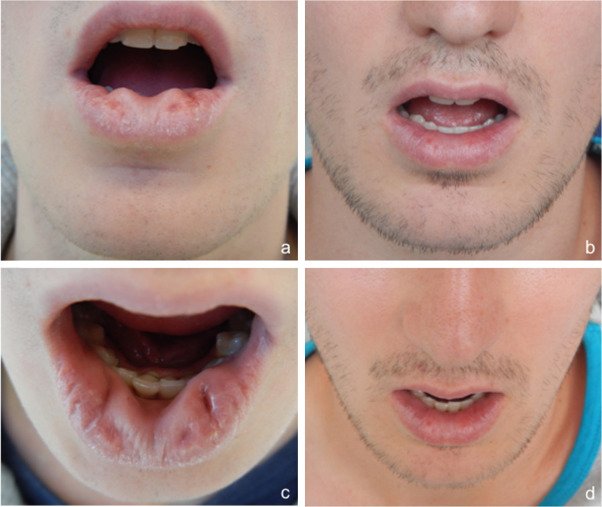
Van Der Voude syndrome ( lip pit syndrome, autosomal dominant , deletion of 1q32 , clinically presenting with cleft lip and palate and medial pits on lower lips on vermillion border.Also include ankyloglossia,high arch palate ,maxillary hypodontia and sygnathia)

EMBRYOGENESIS AND CLEFTING

During sixth and seventh weeks of development upper lips forms when median nasal process merges each each other and  fuses with maxillary process of 1st branchial arches. Mid portion of upper  lip is derived from median nasal process, lateral derived from maxillary process. Lateral nasal process involved in ala of nose. Primary palate is formed from merging of median nasal process to form intermaxillary segment, which give rises to premaxilla
(bone including 4 incisor teeth). Secondary palate make up 90% of palate formed from maxillary process of first branchial arches.Defective fusion of median nasal process with maxillary process forms cleft lip. Failure of palatal shelves to fuse result in cleft palate
45% are Cleft lip with palate
30% Cleft palate alone
25% with isolated cleft lip


Vander Woude syndrome with lower lip pits.
Van der Woude Syndome with lip pits , Cleft lip and palate.

Reference:- Textbook of maxillofacial surgery- Balaji. Textbook of embryology- Inderbir Singh. Neville Oral pathology. Images credits : Image 1 – Internet medscape (https://emedicine.medscape.com/article/950823-overview

Image 2 :- Internet, Children Hospital of Philadelphia , ( https://www.chop.edu/conditions-diseases/van-der-woude-syndrome)