Burning Palate and Chest Pain: Connecting Oral Health to Systemic Risk

Clinical view of the patient’s palate. Burning Mouth Syndrome or Something More? A Case of Dual Diagnosis

An 80-year-old patient presents to the office with a chief complaint of a continuous burning feeling on his palate. Upon examination you find that the patient is extremely sensitive.When you finish your examination, the patient complains of sudden chest pain. He starts to sweat and has labored breathing.

Q: What is your diagnosis of the patient?

  • Medical: There are a number of possibilities for the patient to have chest pain and labored breathing. The patient might be experiencing an acute myocardial infarction, hyperventilation, or angina pectoris.
  • Dental: The patient has a Candida species infection, which is a gingival disease of fungal origin. It is also known as atrophic (erythematous) candidiasis.

Q: How will you manage the patient if he is having a myo-cardial infarction?

  1. Stop the dental procedure
  2. Administer oxygen to the patient at 4 to 6 liters per minute
  3. Call emergency medical services (EMS) immediately.
  4. Administer nitroglycerin from the emergency kit (if pain continues, most likely not angina)
  5. Administer aspirin (fibrinolytic properties):
    Give the patient 325 mg of non-enteric-coated aspirin to chew if they have no contraindications (e.g., allergies or bleeding disorders)
  6. Monitor vital signs
  7. Keep the patient in a comfortable seated position to minimize strain on the heart.
  8. Manage the patient’s pain with opioids (morphine) or nitrous oxide

Q: What is your approach to treating the dental condition of this patient?

First treat the condition with a topical antifungal (eg, nystatin or clotrimazole troches) applied to the tissue side of the denture four to six times a day for 2 to 3 weeks. If the fungal infection persists,treat the patient with 100 mg fluconazole daily.

@dr.mehnaz


REFERENCESPERIODONTAL REVIEW : A STUDY GUIDE / DEBORAH TERMEIE.
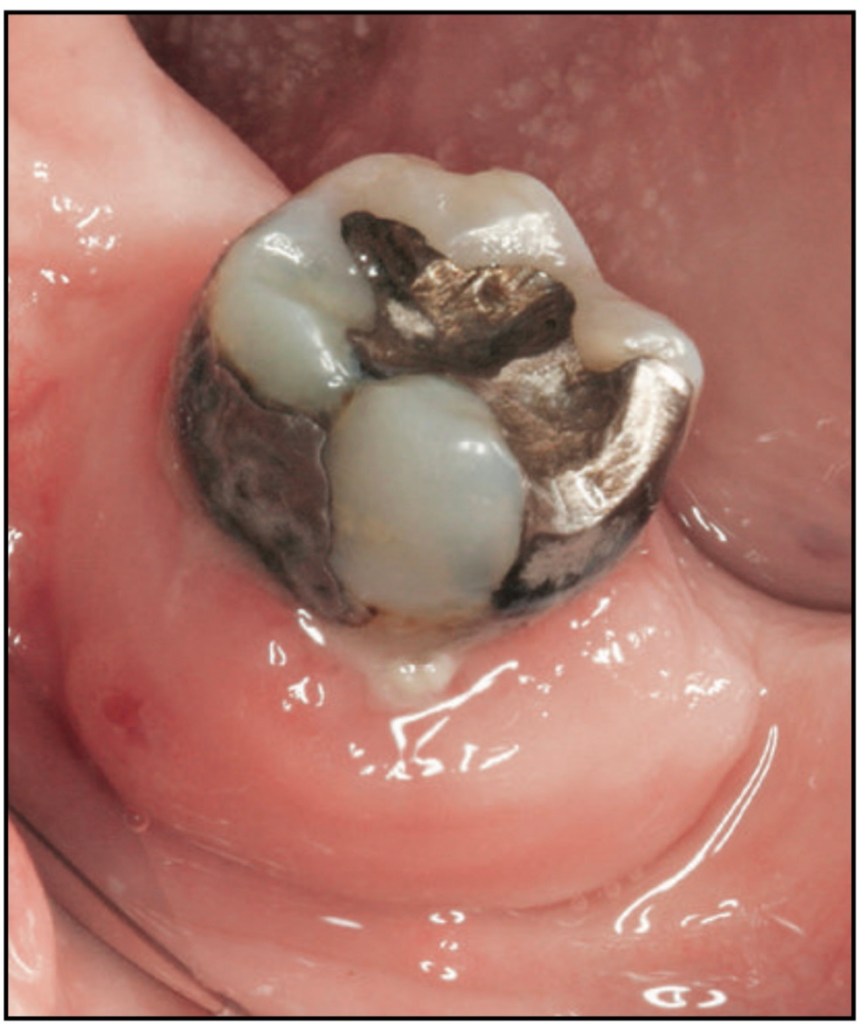
Decoding Oral Malodor: Managing a Mandibular Molar Abscess in a Medically Complex Patient

When Bad Breath Signals Trouble: A Case of Mandibular Molar Abscess

The patient is a 65-year-old man complaining of oral malodor. His dentist referred him to you to access the mandibular right second molar because of swelling, pus, and soreness. When he sits in your chair, he seems disoriented and irritable.When you look in his mouth, you find generalized inflammation of the gingiva and an abscess on the buccal aspect of the mandibular right second molar with suppuration. Charting demonstrates an 8-mm facial pocket and 6-mm palatal and interproximal pockets.

Q: What is your diagnosis of the patient?

Medical:

There are a number of reasons for the patient to appear dazed and irritable:

  • Hypoglycemia or hyperglycemia
  • Alcohol or drug overdose
  • Hyperthyroidism or hypothyroidism
  • Cerebrovascular incident

Dental:

  • The patient may have diabetes mellitus–associated gingivitis related to the endocrine system, under the heading of gingival diseases modified by systemic diseases, which is a subcategory of dental plaque–induced gingival diseases.
  • The patient has a periodontal abscess, which is a subclassification of abscesses of the periodontium.

Q: What could have led to the abscess formation?

  • Diabetes: According to Bjelland et al,18 multiple periodontal abscesses may result from uncontrolled hyperglycemia. Rees19 listed multiple or recurrent periodontal abscesses among the possible indications of undiagnosed or poorly controlled diabetes mellitus.
  • The abscess may also be caused by a preexisting periodontal pocket in association with bacteria at the depth of the pocket.
  • A foreign body can also cause a periodontal abscess.

Q: How will you treat the periodontal abscess?

  • I would ask the patient if he has seen his physician recently and whether he knows his hemoglobin A1c levels to determine if the abscess may be associated with diabetes (only his medical doctor can make that diagnosis).
  • An incision at a 90-degree angle to the long axis of the tooth will drain the exudate.Without removal of the cause (foreign body, bacteria, or calculus), the abscess will recur. If this is not possible, extraction might be necessary.
  • Antibiotics and analgesics should be prescribed. A follow-up with a dentist is also needed.
  • Saline Rinse: Advise warm saline rinses to reduce discomfort and promote healing.

Dentowesome | @dr.mehnaz


References: Periodontal review : a study guide / Deborah Termeie.

STAGES OF GINGIVITIS #NEETMDS #Pearls

  1. Stage 1 – Initial stage
    1. Starts at 2 – 4 days after beginning of plaque accumulation 
    2. Increase vascularity 
    3. Increase GCF flow 
    4. Stage of subclinical gingivitis = no clinical changes
    5. Immune cells = PMNs are main line of defense
    6. Important feature = increase in GCF flow 
  2. Stage 2 – Early stage
    1. Early lesion evolves from initial lesion 4 – 7 days after the beginning of plaque accumulation 
    2. Clinical signs appear in this stage
      1. BOP 
      2. Erythema 
    3. Important feature = clinical signs appear 
    4. Immune cells = lymphocytes 
    5. Collagen destruction increases
      1. 70% of collagen fibers are affected
      2. Main fiber groups involved
        1. Circular 
        2. Dentogingival
  3. Stage 3 – Established lesion
    1. Severely inflamed gingiva/chronic gingivitis 
    2. It occurs for 14 – 21 days after the beginning of plaque accumulation 
    3. Immune cells = Plasma cells 
    4. Important feature = change in color, size, texture 
    5. Bluish hue on the reddened gingiva
      1. Blood flow sluggish 
      2. Impaired venous return 
  4. Stage 4 – Advanced lesion
    1. Gingivitis progresses to periodontitis 
    2. CT loss 
  • Gingivitis is T-cell lesion 
  • Periodontitis is B cell lesion 
  • When gingivitis is dominated by T cells = Contained gingivitis 
  • Term subclinical gingivitis was coined by LINDHE, synonym of stage 1 
  • Number of transmigrating leukocytes and amount of GCF = between 6 to 12 days of gingivitis = these values become maximum 

Age Changes in the Periodontium #NEETMDS #Pearls

GINGIVAL EPITHELIUM 

  1. Keratinization = decreases 
  2. Epithelium = thinner 
  3. JE migrates apically 
  4. Width of attached gingiva – decreases 

GINGIVAL CONNECTIVE TISSUE 

  1. Collagen
    1. Soluble to insoluble 
    2. Denser and coarser
    3. Mechanical strength of collagen decreases
    4. Number of
      1. Collagen fibers decrease 
      2. Elastic fibers increase
  2. Periodontal Ligament
    1. Collagen decrease 
    2. Number of cells increase 
    3. Tensile strength decrease
  3. Cementum
    1. Width increases 
  4. Alveolar bone
    1.  Weaker 
    2. Amount of cortical and compact bone decreases 

Anatomy of the Periodontium #NEETMDS #Pearls 

Gingiva divided into

  1. Marginal 
  2. Attached
  3. Interdental papilla

Marginal gingiva 

  1. Demarcated from attached gingiva by free gingival groove – this is also called marginal groove 
  2. Width = 1 mm 
  3. Gingival Zenith = most apical point on the marginal gingival scallop 
  4. It’s dimensions vary between 0.06 to 0.96 mm

GINGIVAL SULCUS 

  1. V shaped space/ Crevice 
  2. On one side – there is tooth tooth, on other side – gingival epithelium 
  3. Depth
    1. Ideal = 0 mm – germ free individuals and controlled environment 
    2. Histological sections = 1.8mm [ 0-6mm]
    3. Probing depth at apical termination of probe = 2-3mm 

ATTACHED GINGIVA 

  1. Firm and resilient 
  2. Demarcated from alveolar mucosa by – mucogingival junction
  3. Width of attached gingiva
    1. Greatest in maxillary incisors 3.5 -4.5 mm and mandibular incisors 3.3 – 3.9 mm 
    2.  Least in maxillary premolars 1.9 mm and mandibular premolars 1.8mm
    3. Width of attached gingiva increases with age in supraerupted teeth 

INTERDENTAL GINGIVA / PAPILLA

  1. Occupies gingival embrasure 
  2. Shape can be pyramidal/col 
  3. Col covered by non keratinized epithelium 

MICROSCOPIC FEATURES OF GINGIVA 

Composed of epithelium and connective tissue 

Gingival epithelium 

  1. Type = stratified squamous epithelium 
  2. Cells
    1. Principal cells = Keratinocytes = bulk 
    2. Melanocytes 
    3. Langerhans cells 
    4. Merkel cells 
    5. B,c,d = non keratinocytes 
  3. Four layers 
    1. Stratum corneum 
    2. Stratum granulosum 
    3. Stratum spinosum 
    4. Stratum basale 
  4. Three types of epithelium on basis of differentiation
    1. ORTHOKERATINIZED
      1. Stratum corneum = NO Nucleus 
      2. Keratin hyaline granules are evenly dispersed in Stratum granulosum
    2. PARAKERATINIZED
      1. No Stratum granulosum 
      2. Stratum corneum = retains PYKNOTIC nuclei 
    3. NON-KERATINIZED
      1. 2 layers are present = basale and spinosum 
      2. Upper most cells = retain VIABLE nucleus 

KERATINOSOMES OR ODLAND BODIES

  1. Modified lysosomes 
  2. Found in Stratum spinosum 

MELANOCYTES 

  1. Found in basal layer and spinosum layer
  2. Function = production of melanin 

LANGERHANS CELLS 

  1. Seen in suprabasal level
  2. Antigen presenting cells 
  3. Part of reticuloendothelial system 
  4. Contain birbeck granules 

MERKEL CELLS 

  1. Basal and Spinosum = deep layers
  2. Act as tactile receptors 

BASAL LAMINA

  1. Connecting link between epithelium and connective tissue 
  2. Thickness – 300 to 400 A and lies 400 A beneath the epithelial basal layer 
  3. Consists of two layers
    1. Lamina lucida
      1. Rich in laminin protein
    2. Lamina densa
      1. Rich in collagen type 4
  4. Basal lamina is connected to connective tissue by Hemidesmosomes ** and Anchoring Fibrils (750 nm)

KERATINIZATION OF ORAL MUCOSA IN DECREASING ORDER 

  1. HARD PALATE = most keratinized 
  2. Buccal mucosa = least keratinized 

OUTER EPITHELIUM 

  1. Covers the crest or outer surface of marginal gingiva and attached gingiva 
  2. 0.2-0.3 um

SULCULAR EPITHELIUM 

  1. Lines gingival sulcus 
  2. Non keratinized**
  3. Semi permeable 

KERATINS

  1. K1, k2, k10-k12 = epidermal type differentiation 
  2. K6 and k16 = proliferation specific 
  3. K5 and k14 = Stratification specific 
  4. K19 = present in parakeratinized epithelium and absent in orthokeratinized epithelium 

JUNCTIONAL EPITHELIUM 

  1. Non keratinized 
  2. Langherhans cells are absent 
  3. Thickness
    1. Early – 3-4 cells 
    2. Later – 10 – 20 cells 
  4. Length = 0.25 – 1.35 um 
  5. Formed by REE + OE
  6. Attachments
    1. Attached to tooth by internal basal lamina 
    2. Attached to CT by external basal lamina 
  7. Produces = Laminin from lamina lucida of basement membrane 
  8. Dentogingival unit
    1. Junctional Epithelium + Gingival fibers 
    2. Function = brace gingiva against tooth 

BLOOD SUPPLY TO THE GINGIVA 

  1. Supraperiosteal arterioles 
  2. Arterioles emerging from interdental septa 
  3. Vessels of periodontal ligament 

GINGIVAL FIBERS 

  1. Dentogingival group
    1. Found in maximum number 
  2. Alveologingival group 
  3. Circular group 
  4. Dentoperiosteal 
  5. Transeptal fiber group 

SUPRACRESTAL FIBERS 

  1. Type of transseptal fibers
  2. Important fibers during relapse of orthodontic treatment 

PERIODONTAL LIGAMENT

PERIODONTAL FIBERS

  1. Principal fibers
    1. made up of collagen type 1 
    2. Produced by fibroblasts 
  2. Transseptal fibers
    1. Gingival + periodontal 
    2. Reconstructed even after bone loss**
  3. Alveolar crest fibers
    1. Prevent extrusion 
    2. Resist lateral forces 
  4. Horizontal fibers
  5. Oblique fibers
    1. Largest group of fibers 
    2. Resist vertical forces
  6. Apical fibers = absent in incomplete roots 
  7. Interradicular fibers 

RESISTANCE TO IMPACT OF OCCLUSAL FORCES (SHOCK ABSORPTION)

  1. TENSIONAL THEORY 
    1. Major importance to PDL
    2. Best forces = longitudinal forces 
    3. Worst forces = torsional forces 
  2. VISCOELASTIC THEORY 
    1. Dental fluids helps in transfer of forces 

CEMENTUM 

  1. Avascular tissue
  2.  Forms the outer covering of anatomical root 
  3. Two types
    1. Primary cementum
      1. Acellular cementum
      2. Forms before eruption
      3. Covers 1/3rd of root 
    2. Secondary cementum
      1. Cellular cementum
      2. Formed after eruption 
      3. Covers apical third of root 
  4. Main sources of collagen fibers in cementum
    1. Extrinsic fibers
      1. Produced by fibroblasts – called as Sharpey’s fibers**
    2. Intrinsic fibers
      1. Produced by cementoblasts
  5. Cementum classification by schroeder**
    1. Acellular afibrillar cementum
      1. No cells/fibers
      2. Formed by cementoblasts 
      3. Found as coronal cementum 
      4. Thickness – 1 to 15um 
    2. Acellular extrinsic fiber cementum
      1. Contain only sharpey fibers and lack cells 
      2. Formed by both fibroblasts and cementoblasts 
      3. Found in cervical third of roots 
      4. Thickness = 30 to 230 um 
    3. Cellular mixed stratified cementum
      1. Both intrinsic and extrinsic fibers + cells 
      2. Formed by both fibroblasts and cementoblasts 
      3. Present in apical third of roots and furcation
      4. Thickness = 100 to 100um
    4. Cellular intrinsic fiber cementum
      1. Cells 
      2. Formed by cementoblasts 
      3. Fills resorption lacunae

1, 4 = produced by cementoblasts only 

2 and 4 = cementoblasts + fibroblasts 

INTERMEDIATE CEMENTUM 

  1. Poorly defined zone near Cementodentinal junction
  2. Contains remnants of HERS embedded in calcified ground substance 

INORGANIC CONTENT OF CEMENTUM (45-50%)

  1. Bone = 65 – 70%
  2. Enamel = max content = 92- 96%
  3. Dentin = 50 – 60%

CEMENTOENAMEL JUNCTION 

  1. 60 – 65% = C overlaps E
  2. 30% = butt joint = C and E just meet 
  3. 5 – 10% = C and E does not meet

CEMENTODENTINAL JUNCTION 

  1. When RCT is performed, the obturating material should be at the CDJ 
  2. CDJ is 2 – 3 um wide 

ANKYLOSIS 

  1. Resorption of PDL
  2. Direct connection between tooth and bone 
  3. Cementum resorption is present 

ALVEOLAR PROCESS 

  1. External plate of thick cortical bone 
  2. Inner socket wall of compact bone = also called alveolar bone proper 
  3. Seen as Lamina dura in radiographs 
  4. Histologically
    1. Series of openings = cribriform plates
    2. Through which neurovascular bundles pass 
  5. Supporting alveolar bone = made up of cancellous bone
  6. Basal Bone = unrelated to teeth but it is the most apical part of alveolar bone/jaw 
  7. Interdental septum consists of cancellous supporting bone which is enclosed within a compact border

AUGMENTATION CORONAL TO RECESSION 4m*

  1. Free gingival autograft = give by miller
  2. Free connective tissue autograft = LEVINE
  3. Laterally positioned flap = GRUPE AND WARREN
  4. Semilunar coronally positioned flap = TARNOW
  5. Subepithelial CTG = LANGER
  6. GTR = PINE AND PRETO
  7. Pouch and tunnel technique = AZZI 

Laterally positioned flap

  1. TO COVER isolated areas of recession around a single tooth 
  2. Adequate vestibular depth 
  3. Variant = double papilla flap
  4. Disadv = compromised blood supply 

Coronally positioned flap 

  1. To cover 2-3 mm of recession 
  2. Done on multiple teeth 
  3. Best for maxillary anterior teeth
  4. Pt who have Thick gingival biotype = Good prognosis 

Semilunar coronally positioned flap

  1. Used to cover recession of 1 mm 
  2. Slight recessions in anterior regions 

Subepithelial CTG 

  1. Large and multiple areas of recessions 
  2. NELSON graft = better blood supply = bilaminar or subpedicle CTG 

GTR

  1. Maxillary area only 
  2. 5mm recessions = more than 4.98 mm 

POUCH AND TUNNEL = It allows for CREEPING REATTACHMENT of marginal gingiva.

LASER 

  1. Light amplified stimulated emission of radiation 
  2. RESTING state to emission state. Now it give energy to go back to resting state from emission = CIRCLE FLOWCHART
  3. CO2 and Nd:Yag = mc used
  4. TYPES = soft tissue and hard tissue
Soft tissue Hard tissue
gingiva, tongue, mucosaAffinity towards water and pigmentPrimary effect is heating Diode, Nd:YAG and C02 lasersDiode = 655 – 980Nd;yag = 1064CO2 = 10600enamel and boneAffinity for water and hydroxyapatite’Erbium lasers with wavelength 2780, 2790, 2740
  1. Donot requires LA because laser seals terminal nerve endings 
  2. Less bleeding = because coagulation of blood vessels 
  3. Healing by laser is by secondary intention = scar formation as we dont close wound and no sutures needed 
  4. Hence, For large wounds = less aesthetic 
  5. Healing is slower but less postoperative pain 
  6. Less requirements of medications 
  7. AREAS WHERE LASERS CAN BE USED
    1. Incisions and Excisions = 
      1. disimpaction of third molar = mucopain or benzocaine is applied on mucosa with laser. 
      2. Application of mucoseal = for biopsy 
    2. Dipigemenations 
      1. Gingiva = brownish and blackish 
      2. Melanin = epithelium or superficial layer of connective tissue
      3. Painless procedure 
      4. Heals within 2 weeks and gingiva appears pink 
      5. No bleeding
    3. Pain management
      1. Tmj pain 
      2. Trigeminal neuralgia 
    4. PHOTODYNAMIC THERAPY 
      1. Special use = deep pockets not accessible with instruments and bacteria is still remaining 
      2. Methylene blue or toluidine blue = taken by bacterial cells but not by healthy cells
      3. Laser will generate free radicals = will kill the bacterial cells deep in the pocket 
    5. Low level laser therapy = Triple L 
      1. Fixed wavelength but you can increase the energy source 
      2. More power= more energy = cut faster in thicker tissue. If thin tissue = it leads to charring of tissue 
      3. LLL is used for healing of 
        1. recurrent aphthous stomatitis
        2. herpetic ulcers
        3. Mucositis
        4. lichen planus
        5. pemphigus lesions 
      4. LLL stimulate fibroblasts and collagen fibers = healing potential is increased 

SPLINTS 4m ***** 2m***

  1. Splinting is the process by which you join two or more than two teeth and convert them into rigid and fixed units. 
  2. Hence, this heals the periodontal tissue around the tooth
  3. Objective = Create an environment where tooth movement is restricted within physiological limits = hence improves the function and comfort of the patient 
  4. Rationale = 
    1. to control the forces on teeth and redirect forces on long axis of tooth = most damaging is torsional and horizontal forces 
    2. To establish physiological occlusion 
    3. To serve as stabilizing force
    4. To increase patient comfort when teeth are mobile
    5. To evaluate state of teeth 
  5. INDICATIONS 
    1. To prevent migration of teeth that have been repositioned 
    2. In severe periodontal cases 
    3. In surgical and nonsurgical procedure where teeth are difficult to stabilize 
    4. During orthodontic treatment when you are migrating teeth 
    5. TFO in lower anterior teeth 
    6. Grade 1 and 2 = check and evaluate the mobility status 
  6. CONTRAINDICATIONS
    1. Grade III mobility without eliminating causes such as inflammation
  7. Disadvantage 
    1. Maintenance of oral hygiene is compromised
    2. Phonetics 
    3. Tooth structure loss 
    4. Interproximal wear 
    5. Gingiva and perodontium can be damaged 
  8. BIOMECHANICS 
    1. Convert many mobile teeth into multirooted rigid unit 
    2. Hence, increases area of root resistance 
    3. It alters the center of rotation 
    4. Intrusive forces are tolerated better 
  9. REQUIREMENT 
    1. Have as many firm teeth as possible 
    2. It must not interfere with occlusion 
    3. It must not irritate the pulp 
    4. It must not compromise oral hygiene maintenance 
    5. Interdental embrasure must not be blocked by splint 
    6. Esthetically acceptable 
    7. Must not cause trauma to periodontium 
    8. Easy to fabricate 
  10. CLASSIFICATION 
    1. Temporary = 6 weeks
    2. Provisional = few months -6 months
    3. Permanent 
    4. Intracoronal = Into the enamel = remove the enamel and place the splint 
    5. Extracoronal = over the enamel
    6. According to material
      1. Bonded = with stainless steel wire and composite 
      2. Braided = like sutures

IMPLANTS

  1. Its threaded titanium structure = cover screw
  2. Above it we place abutment and over it we place crown 
  3. We use implant to replace missing teeth 
  4. No PDL around the implant = directly connected to tooth
  5. Biological width around tooth = 2mm 
  6. Biological width around implant = 4 mm 
  7. Implant is made up of bio titanium and alloys like aluminum and validium 
  8. Large surface area of implant is MUST = better connection with bone aka osseointegration = given by BRANEMARK 
  9. Time required for osseointegration = less time in mandible = less than 4-6 months = this time is called Loading time 
  10. Sandblasting or acid etching the surface area = better connection 
  11. Earlier we use plane surface = less surface area than threaded surface 
  12. FACTORS 
    1. Density of bone = less density = Primary stability of implant is less and mobile 
    2. Location of bone and anatomical structures
      1. Posterior mandible = inferior alveolar nerve
      2. Posterior maxilla = maxillary sinus 
      3. Inferior mandible = mental nerve
      4. These structures needs to be avoided when placing the implant 
  13. DRILLING 
    1. First instrument used is PILOT drill of 2 mm  
    2. Minimum diameter of implant = 3.3 mm 
    3. Minimum Length of implant = 8 mm 
    4. Different dimensions based on available bone available by manufactures 
    5. Bone must not overheat = must increase beyond 47*c 
    6. Motor revolutions = 800 -1200 rpm must = below this RPM = heating of bone happens
    7. We also used coolant and irrigant so bone doesn’t overheat 
    8. If bone is overheated = causes necrosis and connection with bone will be impossible 
    9. Bacterial infections and debris must be absent 
  14. 0.5 mm of bone around the implant 
  15. From adjacent tooth = 1.15 mm
  16. Distance between two implants = 3 mm 
  17. 2gm of amoxicillin before 30 mins of implant placing 
  18. If implant is of 4mm size = drill site must be less than 4 mm for tight fit of implant into bone

PERI IMPLANTITIS

  1. Inflammation around loaded implant when its on function and prosthesis attached to it aka crown
  2. Types =
    1. peri mucositis = soft tissues around implant is involved = reversible
    2. Peri Implantitis = hard tissues aka bone around implant is involved = irreversible 
  3. CAUSES
    1. Poor oral hygiene 
    2. Uneven forces
    3. Smoking 
    4. Osteoporosis 
    5. Residual cement 
  4. Signs and symptoms 
    1. Bleeding and redness 
    2. Bone loss around implant 
    3. Probing depth = greater than 5 mm
    4. Pus formation 
    5. Crown is mobile = because abutment is loosening 
  5. If less than 5 mm probing depth, no bone loss and implant made up of titanium = the treatment is 
    1. Scaling 
    2. Antibiotics
    3. 0.2% CHX mouthrinse
    4. If bone loss is 2 mm = we will not open the flap. Same treatment as above
    5. If bone loss = 3-5 mm = crestal bone loss around implant = regenerative surgery needed