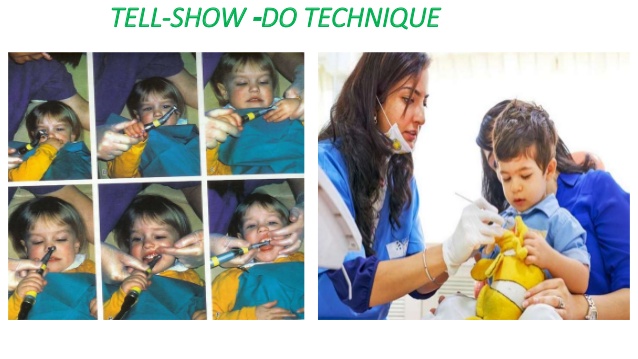
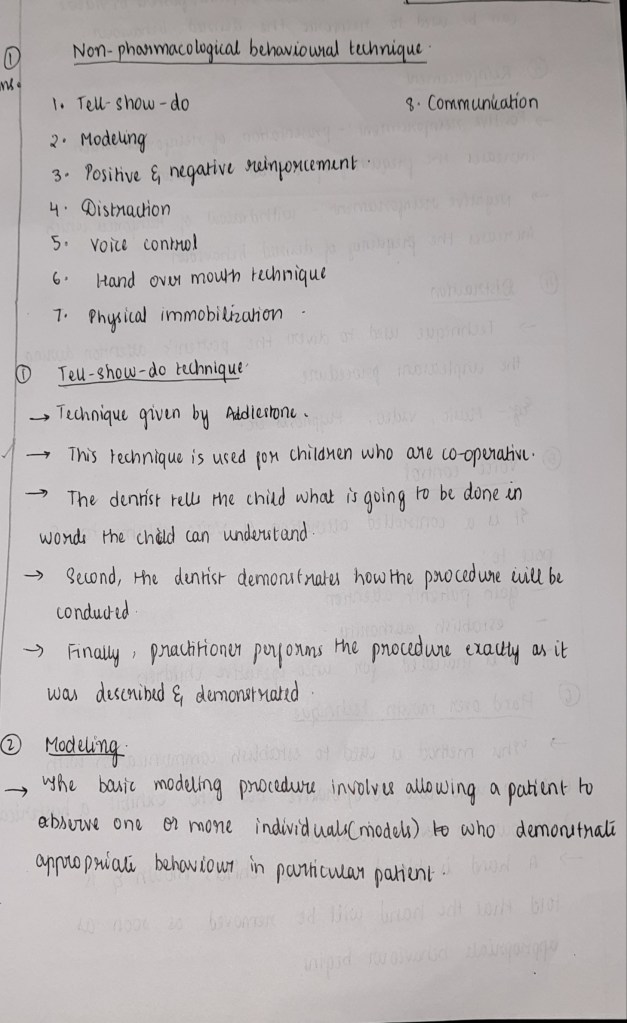
TELL: The technique involves verbal explanation of procedures in phrases appropriate to the development level of the patient.
SHOW: Demonstrations for the patient of the visual, auditory, olfactory & tactile aspects of the procedure in a carefully defined, non threatening sett.
DO: And then, without deviating from the explanation & demonstration, completion of the procedure.
This technique is used with communication skills (verbal and nonverbal) & positive reinforcement.
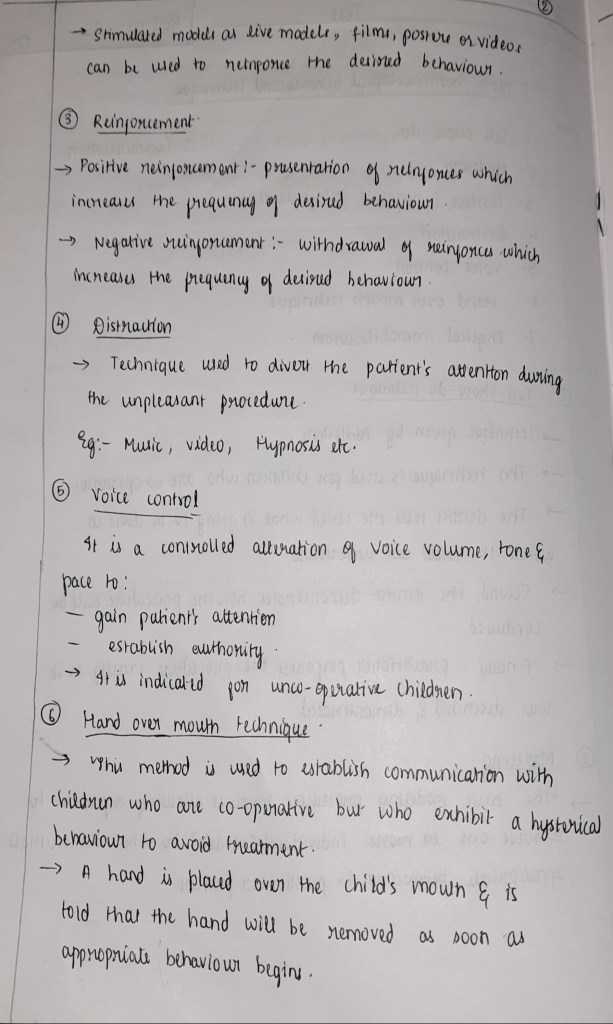
( Positive reinforcement is the presentation of reinforces which increases the frequency of desired behavior)
Most often we get frustrated by studying for days before exams, often we fail to recollect or forget while writing exams. It’s a quite natural process for a human body to forget. However there are tricks to master our hippocampus and remember for long. Excelling in exams are only possible based on how much you remember topics.
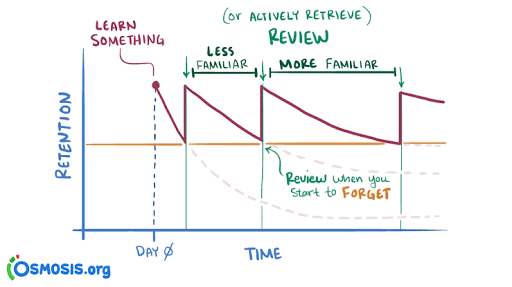
According to Ebbinghaus curve of forgetting information is lost from brain and we’re inable to recollect it.A typical graph of the forgetting curve purports to show that humans tend to halve their memory of newly learned knowledge in a matter of days or weeks unless they consciously review the learned material.
In oder to master long term memorization, we need to practice following methods
Revision : You still remember, A for apple and mitochondria is power house of cell. Constant and frequent revison makes your hippocampus to convert short term memory to long term memory.
Spaced repetition learning technique Review Your Notes. Within 20-24 hours of the initial intake of information, make sure the information is written down in notes and that you have reviewed them. Recall the Information for the First Time. Recall the Materials Again. Study It All Over Again Difficult topics are checked regularly while easy topics could be reviewed occasionally
Take a break method Study for 20 minutes take a 5 minute break repeat pattern for 3 to 4 hours. It helps to gain more focus, At the end you’ll be happy for the productive hours. Without break in intervals your brains rejects input eventually your output becomes non productive. Mastering this techinque daily, your graph of productivity hits up.
Use body movements while learning,helps to Tigger muscle memory.
Make a story to memorize long topics. Pieces of information are always connected each other when a story link is given.
Organise your study table. Neat study table and fresh environment boost your intake . Bright light, fresh air, erect spine enhance brain functioning. Feel comfortable stay away from cluttered environment
Try to understand what you learn, things you understand and studied are memorised 9 times.
Learn opposite things .
Switch your topics frequently. Similiar memory get’s intermixed (interference theory).
Things learned at the beginning and end are most memorized. Plan your topics accordingly.
Dicatate your topics and record in dictaphone you can download in your phone. Hear audios before you sleep, going to a beach or restaurant… Brain makes short term memory to long term memory while relaxed.
Visualise your topics. You still remembers the colour of precipitate and titration from your 12th chemistry lab practicals. Visualized memory is far beyond your imaginations.
Read first from books, 2 or 3 days later watch related topics videos from Youtube or any informative apps. Audio+ video learning brushes your previous stored information
Always make use of Sticky notes of alternating colours (prefer light colours- eye rejects dark colour for long time. Use sticky notes apps In your phone screen ( numericals, years etc.could be written in it).
Last days before your exams should be used for rough reading or revison not for studying. Brain rejects things learned in stressed or a state of anxiety .( Your neurotransmitters makes it mess. Respect them 🤣)
Credits : 1) Forgetting curve definition:Wikipedia. Image : Internet. 2) Spaced repetition technique images from Internet and Osmosis.org website . Spaced repetition method content from Google.
It is also called as ‘congenital teeth’, ‘fetal deciduous teeth’, ‘dentition proceox’ and ‘natal and neonatal teeth’. There is premature eruption of teeth or teeth like structures that are present at birth.
Natal teeth are the teeth which are present at the time of birth and neonatal teeth are the teeth which are present within 30 days after the birth.
Etiology
Hereditary—superficial position of tooth germ.
Hormonal influence—eruption accelerated by febrileincident or hormonal stimulation.
Classification
Mature—they are fully developed in shape and comparable in morphology to the primary teeth. Prognosis is relatively good.
Immature—their structure and development is incomplete. Poor prognosis of teeth.
Clinical features
Appearance—teeth may be conical or may be normal in size and shape and opaque yellow-brownish in color.
Signs—they are hypermobile because of their limited root development. Within relatively short time, premature erupted tooth will become stabilized and other teeth of the arch are erupted. Teeth appear to be attached to a small mass of soft tissue.
Significance—some teeth are so much mobile that there is danger of displacement and possible aspiration and in this case, removal is indicated.
Riga fede ulcer—there is ulceration of the ventral surface of the tongue caused by the sharp incisal edges. It leads to interference with proper suckling and feeding and thus the neonate is at risk of nutritional deficiency.
Associated syndromes—it may associate with syndromes like Ellis-van Creveld syndrome and cleft palate.
Management
Extraction—extraction of the teeth should be carried out if it is causing inconvenience during suckling, interference with breastfeeding and causing traumatic injury.
NOTE- Extraction should be done after 10th postpartum day due to the inability of the clotting but nowadays, it is no longer considered because of prophylactic administration of vitamin K as a standard procedure in most of the hospitals.
Rounding of sharp angle—the other option that may be used is rounding of the sharp angle of incisal edges of teeth.
Retaining the tooth—if not necessary, tooth should not be removed.The preferable approach, however, is to leave the tooth in place and to explain to the parents the desirability of maintaining this tooth in the mouth because of its importance in the growth and uncomplicated eruption of the adjacent teeth.
A retained natal or neonatal tooth may cause difficulty for a mother who wishes to breast-feed her infant. If breast-feeding is too painful for the mother initially, the use of a breast pump and bottling of the milk are recommended. However, the infant may be conditioned not to “bite” during suckling in a relatively short time if the mother persists with breast-feeding. It seems that the infant senses the mother’s discomfort and learns to avoid causing it.
REFERENCE- MC DONALD TEXTBOOK OF PEDODONTICS AND ANIL GHOM TEXTBOOK OF ORAL MEDICINE






 Dentowesome