FOCAL EPITHELIAL HYPERPLASIA(HECK DISEASE)

HPV- induced local epithelial hyperplasia.

ETIOLOGY

Caused by HPV-B and HPV-32

CLINICAL FEATURES

SEX- no gender prediliction

AGE- Children

SITE- labial, lingual, buccal mucosa.

clinical presentation

  • LESION-
    • Papular in nature
    • broad based
    • same colour as skin-pale/white.
  • 0.3-1 cm, discrete ,well demarcated plaques
  • smooth surfaced/flat topped are commonly seen.
  • they cluster closely together that they give COBBLE STONE/FISSURED APPEARANCE.

HISTOLOGIC FEATURES
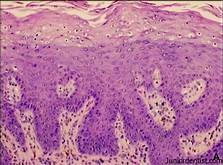
  • ACANTHOSIS of oral epithelium.
  • RETE RIDGE FORMATION
    • normal
    • but are indented, confluent and club-shaped
  • MITOSOID CELL
    • Result from viral alteration of the cells.
  • PAPPILARY PROJECTIONS.

TREATMENT

  • Conservative excisional biopsy.
  • Spontaneous regression is observed.

FORDYCE GRANULES

A developmental anomaly characterized by heterotrophic collections of sebaceous glands at various sites in oral cavity.

ETIOLOGY

  • Results from inclusion in oral cavity of ectoderm having some potentialities of skin in course of development of maxillary and mandibular process during embryonic life.

CLINICAL FEATURES

  • SEX- no gender prediliction
  • AGE- adults
  • SITE- Oral mucosa

clinical presentation

  • Small yellow spots either discreatly seperated/forming relatively large plaques-projecting slightly above the surface of the tissue.
  • bilaterally symmetrical pattern.
  • most common sites include-
    • oral mucosa
    • lips
    • retromolar area
    • tongue
    • gingiva
    • frenum
    • palate

HISTOLOGIC FEATURES

  • Lobules of sebaceous duct beneath the epithelium.
  • sebaceous cells are polygonal with centrally located nucleus and foamy cytoplasm.
  • these sebaceous glands are unassociated with hair follicles.
  • may show keratin plugging.

TREATMENT

No treatment is required.

FREY SYNDROME

Also known as Auriculotemporal syndrome or Gustatory sweating, it is an unusual phenomenon which arises as a result of damage to the auriculotemporal nerve and subsequent reinnervation of sweat glands by parasympathetic salivary fibers.

Etiology: This syndrome follows some surgical operation (area involving auriculotemporal nerve) , during which the damaged nerve regenerates, parasympathetic nerve supply develops, interacting sweat glands, which then function after salivary, gustatory, or psychic stimulation.

Clinical features: Patient typically exhibits flushing and sweating of the involved face, mainly temporal region, during eating.

Profused sweating can be evoked by parenteral administration of pilocarpine or eliminated by administration of atropine or a prominent block of auriculotemporal nerve.

The syndrome is a possible complication of parotitis, parotid tumor, ramus resection, mandibular resection for correction of prognathism. It has been reported as a complication in as high as 80% of cases following parotidectomy.

Treatment: Intracranial division of auriculotemporal nerve.

Reference: Shafer’s Textbook of Oral Pathology, 9th edition.