FORENSIC ODONTOLOGY PART-2

LIP PRINTS

The wrinkles and grooves visible on the lips have been named by Tsuchihashi as ‘sulci labiorum rubrorum’. The imprint produced by these grooves is termed as ‘lip print’, the examination of which is referred to as ‘cheiloscopy’.

Tsuchihashi proposed a classification dividing the pattern of grooves into six types:
Type I: Clear-cut vertical grooves that run across the entire lip
Type I’: Similar to type I, but do not cover the entire lip Type II: Branched grooves
Type III: Intersected grooves
Type IV: Reticular grooves
Type V: Grooves that cannot be morphologically differentiated.


  • A combination of these grooves may be found in any given set of lips.
  • To simplify recording, the lips are divided into quadrants similar to the dentition- a horizontal line dividing the upper and lower lip and a vertical line and a vertical dividing right and left sides. By noting the type of groove in each quadrants, the individual’s lip print pattern may be recorded. Thus classification, thus, enabled differentiation of lip print patterns between any two individuals.
  • Lip prints are usually left at crime scenes, and can provide a direct link to the suspect. 
  • Although invisible, these prints can be lifted using materials such as aluminium powder and magnetic powder
  • Ball states that the vermillion border has minor salivary glands, and the edges of the lips has sebaceous glands, with sweat glands in between. 
  •  One may therefore, assume that secretions of oils and moisture from these enable development of ‘latent’ lip prints, analogous to latent fingerprints, in most crime scenes where close contact between the victims and culprit has occurred.

DISADVANTAGE

  • A major disadvantage of lip print investigation pertains to uncertainty about the permanence of lip patterns. While they are believed to remain unchanged throughout one’s life, 
  • Sivapathasundharam B and coworkers doubted this, as major trauma to the lips resulting in scarring, pathosis, surgical treatment  rendered to correct the pathosis, affect the size and shape of the lip, thereby may alter the pattern and morphology of the grooves.

REFERENCE-SHAFER’S TEXTBOOK OF ORAL PATHOLOGY 8TH EDITION

FORENSIC ODONTOLOGY PART 1


Forensic Odontology defined by the Federation Dentaire International (FDI) as ‘that branch of dentistry which, in the interest of justice, deals with the proper handling and examination of dental evidence, and with the proper evaluation and presentation of dental findings’.

Scope of Forensic Odontology

• Record preparation—the correct handling and exami- nation and the proper preparation and presentation of dental evidence in both civil and criminal legal procedures.

• Identification—personal identification, either individually or in context of mass disasters.

• Age assessment—to calculate the age of patient.
• Bite mark investigation—investigation of criminal cases where bite marks are involved and the interpretation of

• Humanabuse—recognitionofdomestic,andchildabuse.

• Lipprint—comparisonandidentificationoflipprint.

• Legalaspect—legalaspectofdentaltraumatology.

A vital role the forensic dentist plays is in criminal investigation.

  • Crime investigation includes the investigation of 
  • BITE MARKS
  • LIP PRINTS
  • CHILD ABUSE

BITE MARKS

McDonald (1974) has defined bitemark as “a mark caused by the teeth either alone or in combination with other mouth parts”.

Bite marks may be caused by humans or animals; they may be on tissue, food items, or other objects. 

CLASSIFICATION OF BITE MARKS

Cameron and Sims classification

  1. Depending on biting agent

a. Human : Children, Adults

b. Animals : Mammals, Reptiles, Fish

c. Mechanical : Full denture, belt marks etc

  1. Depending on material bitten 

a. Skin : Human, Animal

b.  Perishable items : Food items like cheese,  apple etc.

c. Non- perishable items : Unanimated objects such as pipes, pens, pencils.


WEBSTER’S CLASSIFICATION

Type I – food item fractures readily with limited depth of tooth penetration e.g. hard chocolate.

Type II – food item fractures with considerable penetration of teeth e.g. bite marks in apple & firm fruits.
Type III – Complete or near complete penetration of the food item with slide marks e.g cheese

FACTORS AFFECTING BITE MARK INJURIES

  • Inherent skin factor
  • Age
  • Sex
  • Time
  • Vascularity

CHARACTERISITCS OF HUMAN BITE MARK FOR IDENTIFICATION

  • Human bite mark characteristics include an elliptical or ovoid pattern containing tooth and arch marks.
  • Simplest form of a bite mark consists of tooth marks produced by antagonistic teeth.
  • An arch mark may indicate the presence of 4 to 5 teeth marks reflecting the shape of their incisal or occlusal surfaces.
  • Class features: differentiate between tooth type
  • Incisors- rectangular
  • Canines- triangular
  • Premolars + molars – spherical/point shaped
  • Depends on attrition
  • Other significant findings to identify a bite mark to give the identify of the suspect are :
  • Presence or absence of each tooth
  • Peculiar shape of each tooth
  • Mesiodistal dimensions
  • Arch form and size
  • Relationship between the upper and the lower jaws
  • Any unusual features, such as rotation, fractured teeth, supernumerary teeth, microdontia, diastema etc.  

BITE MARK INVESTIGATION

  • The guidelines for bite marks analysis are given by American Board of Forensic Odontology (ABFO) and careful use of these helps in enhancing the quality of the investigation and conclusions. The collection of evidence regarding the bite marks falls in following categories :

1. Description of the bite marks

  1. Demographic data
  2. Location of bite marks
  3. Shape Color
  4. Type of injury (Abrasion, Ecchymosis, Laceration, Petechial hemorrhage and Incision) 

2. Collection of evidence from victim

3. Collection of evidence from suspect

REFERENCE- SHAFER’S TEXTBOOK OF ORAL PATHOLOGY AND SLIDE SHARE

CHARACTERISTICS OF A DIGITAL IMAGE

Image Characteristics

  • Contrast Resolution
  • Spatial Resolution
  • Detector Latitude
  • Detector Sensitivity
  • Signal to noise ratio

CONTRAST RESOLUTION

  • Contrast resolution is the ability to distinguish different densities in the radiographic image. 
  • Current digital detectors capture data at 8-, 10-, 12-, or 16-bit depths. 
  • The bit depth is a power of 2. 

Spatial Resolution

  • Spatial resolution is the capacity for distinguishing fine detail. 
  • The theoretical limit of resolution is a function of picture element (pixel) size for digital imaging systems.

DSCN6702

Film based IOPA – 20 lp / mm.

Digital receptors 7 lp / mm.

Film  >  CCD  >  PSP 

Detector Latitude

It is the ability of the image receptor to capture a range of x-ray exposures as different densities.

  • The latitude ofCCD and CMOS detectors is similar to film

Photostimulable phosphor receptors have larger latitudes and have a linear response to five orders of magnitude of x-ray exposure.

Detector  Sensitivity

  • Sensitivity of a detector is its ability to respond to small amounts of radiation. Intraoral film sensitivity is classified according to speed.
  • High resolution CCD and CMOS systems achieve less dose reduction than lower resolution PSP systems. CCD and PSP systems or extraoral imaging require exposures similar to those needed for 200-speed screen-film systems.

REFERENCE-WHITE AND PHAROAH 5TH EDITION

REITER’S SYNDROME

Reiter’s syndrome is associated with urethritis, balanitis, conjunctivitis, and mucocutaneous lesions.

 It is a disease of unknown aetiology, although there is evidence of an infec- tious origin.

It is one of the most common complications of non-specific urethritis and it clinically mimicks gonorrhoea, although the urethral discharge is negative for Neisseria.

CLINICAL FEATURES

>Reiter’s syndrome is more prevalent in young adult men, usually between 20 and 30 years of age. 

>The male-to-female ratio is 9:1. 

>There is a typical tetrad of manifestations: non- gonococcal urethritis, arthritis, conjunctivitis, and mucocutaneous lesions. 

>Urethritis may be the first sign. The urethral discharge is usually associated with itching and burning sensation. 

>The arthritis is often bilaterally symmetrical and usually polyarticular.

 >Conjunctivitis is often so mild as to be overlooked. 

>The skin lesions are similar to those seen in keratoderma blennorrhagica and consist of red or yellow keratotic macules or papules which eventually desquamate.

Oral Manifestations

Sites—it is seen on the buccal mucosa, lips and gingiva.

Oral lesions appear as painless, red, slightly elevated areas, some- times granular or even vesicular, with a white circinate border on the buccal mucosa, lips, and gingiva. 

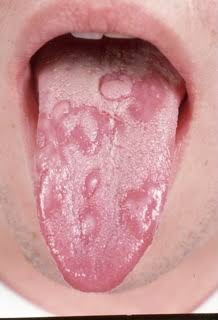
The palatal lesions appear as small, bright red purpuric spots, which darken and coalesce, while the lesions on the tongue closely resemble ‘geographic’ tongue.

Laboratory Findings

The patients usually have a mild leukocytosis, an elevated erythrocyte sedimentation rate, and pyuria.

  • Differential Diagnosis
  • • Geographic tongue and stomatitis—no skin changes, no visceral lesions are seen.
  • • Pustularpsoriasis—Auspitz’ssignpresent.
    • Behcet’ssyndrome—nourethritis,aphthaewithredhalo.
  • • Stevens-Johnson syndrome—acute appearance, moresevere clinical course, no arthritis or urethritis.
    • Benign mucosal pemphigoid—blister formation, nourethritis, found in older patients.
Histologic Features
The microscopic findings are not diagnostic. They consist of parakeratosis, acanthosis, and polymorphonuclear leukocyte infiltration of epithelium, sometimes with mi- croabscess formation similar to psoriasis. The connective tissue shows a lymphocyte and plasma cell infiltrate.
  • Management
  • • Spontaneous remission—many patients undergo spontaneous remission.• Antibiotics—incasesymptomaticpatient,doxycycline or minocycline may be given.
  • • Analgesics—nonsteroidalanti-inflammatorydrugsare given to manage arthritis.
  • • Immunosuppressiveagents—immunosuppressiveagents like azathioprine and methotrexate are given in cases of most resistant cases.

REFERENCE- SHAFER’S TEXTBOOK OF ORAL PATHOLOGY [8TH ED} AND ANIL GHOM TEXTBOOK OF ORAL MEDICINE

WEGNER’S GRANULOMATOSIS

Wegener’s granulomatosis is a disease of unknown aetiology, which basically involves the vascular, renal and respiratory systems. It involves the nose, paranasal air sinuses, lower respiratory tract, gut, joints, nervous system, and kidneys. Involvement of the kidney is the common cause of death.

This disease is caused by an abnormal immune reaction secondary to a nonspecific infection or a hypersensitivity reaction to an unknown antigen.

Clinical Features

>Wegener’s granulomatosis may occur at any age, although the majority of cases are in the fourth and fifth decadesof life.

 >There is a slight predilection for occurrence in males.

 >It is best described as a multisystem disease, which is usually first characterized clinically by the development of rhinitis, sinusitis, and otitis or ocular symptoms.

 >The patient soon develops a cough and hemoptysis as well as fever and joint pain. 

>Hemorrhagic or vesicular skin lesions are also commonly present. 

>Granulomatous lesions of the lungs are found on the chest radiograph, while the glomerulonephritis, which develops ultimately, leads to uraemia and terminal renal failure.

 >In nervous system, sensory neuropathy may be an occasional finding.

>Prognosis—the disease is usually fatal, with mean survival time of 5 months. Death occurs due to involvement of kidney.

Oral Manifestations

Involvement of the gingiva has been the most common and characteristic manifestation, and is termed as strawberry gingivitis.Gingival lesions may manifest as ulcerations, friable granular lesions, or simply enlargements of the gingiva. 

The inflammatory process starts in the interdental papilla and spreads rapidly to the periodontal structure and leads to bone loss and tooth mobility. 

Palate—orallesionstypicallyincludeulcerationofthe palate by extension of nose lesions and destruction of nasal septum. This will lead to perforation of palate.

• Teeth—theremaybelooseningofteethwithinsomecases spontaneous exfoliation. After extraction of teeth patient is usually noticed poor healing.

Laboratory Findings

Laboratory findings include anaemia, leukocytosis, elevated erythrocyte sedimentation rate, and hyperglobulinaemia. Because of kidney involvement, haematuria is common, as well as the finding of albumin, casts, and leukocytes in the urine. Circulating immune complexes have been demonstrated in some patients, but this is not a consistent finding.

Histologic Findings

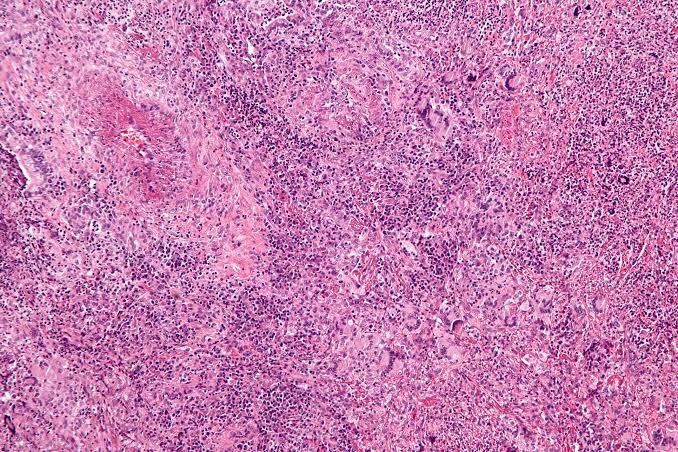
Wegener’s granulomatosis presents a pattern of mixed inflammation centred around the blood vessels. 

The lesions in the upper respiratory tract and lungs consist of giant cell necrotizing granulomatous lesions showing vasculitis. 

Oral biopsy specimens show pseudoepitheliomatous hyperplasia and subepithelial abscesses. The gingival and other lesions show a nonspecific granulomatous process with scattered giant cells.

Diagnosis

  • Clinical diagnosis—typical strawberry gingivitis with necrotic ulceration in the oral cavity.
  • Laboratorydiagnosis—cytoplasmiclocalizationispresent with Wegener’s granulomatosis. Histopathologically chronic inflammatory cells and multinucleated giant cells are found.
  • Differential Diagnosis
  • Agranulocytosis, leukemia, lymphoma—diagnosis by blood picture, possibly histology.
  1. Management
    • Cotrimoxazole—it is combination of trimethoprim and sulfamethoxazole. It has proved to be effective as an adju- vant or sole therapy in both localized and generalized forms.
    • Corticosteroids—regimenofcyclophosphamide12mg/ kg body weight/day with prednisolone 1 mg/kg body weight have been utilized to obtain complete remission.
    • Others—other treatment modalities includes cyclo- sporine, intravenous pooled immunoglobulin, and local irradiation.

REFERENCE- SHAFER’S TEXTBOOK OF ORAL PATHOLOGY {8TH ED} AND ANIL GHOM TEXTBOOK OF ORAL MEDICINE

Systemic lupus erythematosus{SLE}

  • SLE is a multisystem autoimmune inflammatory disorder of unknown etiology.
  • Main feature is the formation of antibodies to DNA, which may initiate immune complex reactions, in particular a vasculitis. 
  • Female to male ratio of 9:1
  • More common in persons of non-European descent.
  • Etiology
  • Geneticpredisposition—relativeofpatientshavehigher incidences of auto-antibodies, immune deficiency and connective tissue disease. This tendency is greatest among identical twins.
    • Immunological abnormality possibly mediated by viral infection—immune complex consisting chiefly of nucleic acid and antibody account for majority of the tissue changes.
    • Autoimmune disease—as these patients develop antibodies to many of their own cells.
    • Endocrine—thereishighincidenceinfemalesinpreg- nancy. This finding suggestive of increased estrogen level.
    • Biochemicalincreaseinexcretionofmetabolicproducts, particularly tyrosine and phenylalanine, in certain SLEpatient.
  • CLINICAL MANIFESTATIONS
  • Lupus is known as “the great mimic.”
  •  Skin lesions of lupus can be classified 
    • lupus-specific (having diagnostic clinical or histopathologic features) 
    • nonspecific lesions.
  • Three subtypes of lupus-specific 
    • Acute
    • subacute 
    • chronic. 
  • Acute cutaneous lupus occurs in 30 to 50% of patients and is classically represented by the butterfly rash-mask-shaped erythematous eruption involving the malar areas and bridge of the nose
  • Chronic cutaneous lupus occurs in 15 to 20% of cases and affects the skin of the face or scalp in about 80% of cases.
  • The least common subtype, subacute cutaneous lupus, occurs in 10 to 15% of patients and includes papulo­squamous (psoriasiform) and annular-polycystic eruptions, usually on the trunk and arms.
  • Nonspecific but suggestive skin manifestations of lupus are common and include 
    • alopecia (both scarring following discoid lesions and non-scarring)
    • Photosensitivity
    • Raynaud’s phenomenon
    • Urticaria
    • Erythema
    • Telangiectases
    • cutaneous vasculitis.

  • ORAL MANIFESTATIONS
  • Two predominant types of oral lesions are
    •  discoid lesions 
    • ulcerations.
  • Oral ulcerations associated with SLE  they occur with increased frequency on the palate and in the oropharynx and are characteristically painless.
  • Histologically, they are characterized by lymphocytic infiltrate at the base of the ulcer and in the perivascular distribution, which is similar to that observed in discoid lesions.
  • Discoid oral lesions, appear as whitish striae frequently radiating from the central erythematous area, giving a so-called “brush border.”
  • Buccal mucosa, gingiva, and labial mucosa are the most commonly affected intraoral sites.
  • Direct immunofluorescent staining for immunoglobulins and complement C3 factor is a useful aid to diagnosis. Granular deposition of IgM, IgG, and C3 along the basement membrane is characteristic

Diagnosis

• Clinical diagnosis—skin lesion with lesion present on oral mucosa which is atrophic and erythematous will suspect lupus erythematous. Oral and nasopharyngeal ulceration is major diagnostic criteria for SLE.

Laboratory diagnosis—L.E. cell inclusion phenomenon with surrounding pale nuclear mass apparently devoid of lymphocytes. Anemia, leukopenia and thrombocyto- penia, with sedimentation rate increased. Serum gamma globulin increased and Coomb’s test is positive.

Positive lupus band test—it shows deposition of IgG,IgM or complement component in skin.

  1. Differential Diagnosis
    • Lichenplanus—homogenouspicture,nodarkerythema and no telangiectasia. Mucosal changes are usually extensive and symmetrical.
    • Lichenoidreaction—historyofdrugisalwaysthere.
    • Ectopic geographic tongue—systemic manifestation present is lupus erythematous, which is absent in ectopicgeographic tongue.
    • Psoriasis—Auspitz’s’signispositive.
    • Electrogalvanic lesion—dissimilar restorations are seenin oral cavity.
    • Leukoplakiaanderythroplakia—lesionstendtomaintainsame appearance and there are no skin changes.
    • Geographic stomatitis—no skin changes, mucosal lesionschange location rapidly.
    • Benign mucous membrane pemphigoid—no systemiccomplain and serology test to be done.
  • TREATMENT
  • Corticosteriods are the cornerstone of therapy
  • A pulse i.v cyclophosphamide regimen for remission induction followed by quarterly infusions
  • Recently, mycophenolate mofetil and azathioprine
  • NSAIDs for arthritis relief
  • Antimalarial like hydroxychloroquinine – effective in cutaneous lupus 
  • DENTAL MANAGEMENT
  • Recommended prophylactic antibiotics if ANC count falls below 500 – 1000 cells/mm3
  • Adrenal supression –
  • Adenocorticotropic hormone supression test is used to evalute
  • Current guidelines – Replacement therapy with hydrocortisone is unnecessary

REFERENCE- ANIL GHOM TEXTBOOK OF ORAL MEDICINE; BURKIT TEXTBOOK OF ORAL MEDICINE AND GOOGLE[SLIDE SHARE]

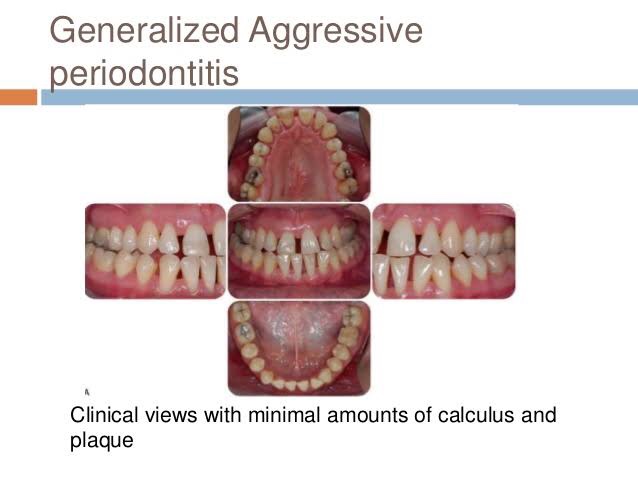
GENERALIZED AGGRESSIVE PERIODONTITIS

The term “juvenile periodontitis” was introduced by Chaput and colleagues in 1967 and by Butler in 1969. In 1971, Baer definedit as “a disease of the periodontium occurring in an otherwise healthy adolescent which is characterized by a rapid loss of alveolar bone about more than one tooth of the permanent dentition.

• Usually affecting persons under 30 years of age (however, may be older).

• Generalized proximal attachment loss affecting at least three teeth other than first molars and incisors.

• Pronounced episodic nature of periodontal destruction. • Poor serum antibody response to infecting agents.

Clinical Characteristics

GAP usually affects individuals under age 30, but older patients also may be affected. In contrast to LAP, evidence suggests that individuals affected with GAP produce a poor antibody response to the pathogens present.

Clinically, GAP is characterized by “gen- eralized interproximal attachment loss affecting at least three per- manent teeth other than first molars and incisors.”The destruction appears to occur episodically, with periods of advanced destruction followed by stages of quiescence of variable length (weeks to months or years). 

P. gingivalis, A. actinomycetemcomitans, and Tannerella forsythia (formerly Bacteroides forsythus) frequently are detected in the plaque that is present.

Two gingival tissue responses can be found in cases of GAP. One is a severe, acutely inflamed tissue, often proliferating, ulcerated, and fiery red. One is a severe, acutely inflamed tissue, often proliferating, ulcerated, and fiery red.

Bleeding may occur spontaneously or with slight stimulation. Suppuration may be an important feature. This tissue response is believed to occur in the destructive stage, in which attachment and bone are actively lost.

Some patients with GAP may have systemic manifestations, such as weight loss, mental depression, and general malaise.

Radiographic Findings

No definite pattern of distribution occurs, The radiographic picture in GAP can range from severe bone loss associated with the minimal number of teeth to advanced bone loss affecting the majority of teeth in the dentition.

Prevalence and Distribution by Age
and Gender

A US national survey of adolescents ages 14 to 17 reported that 0.13% had GAP. In addition, blacks were at much higher risk than whites for all forms of aggressive periodontitis, and male teenagers were more likely to have GAP than female adolescents.

Treatment of aggressive periodontitis 

• Successful treatment of EOP depends on early diagnosis use of antibiotics against the infecting micro organisms and provision of an infection free environment for healing 

• EOP both localized and generalized types includes surgery and use of tetracyclines (Lindhe 1982, Christersson and Zambon 1993) 

T/T of GAP – often less predictable – alternative antibiotics directed to specific pathogenic flora require 

– Multidisplinary approach combines clinical labroartory evaluation with conventional periodontal therapeutic methods for diagnosis and t/t of GAP 

Antibiotic Therapy for Aggressive Periodontitis

Associated MicrofloraAntibiotic of Choice
Gram-positive organismsAmoxicillin–clavulanate potassium (Augmentin)12,72
Gram-negative organismsClindamycin22,23,68,72
Nonoral gram-negative, facultative rodsCiprofloxacin41
Pseudomonads, staphylococci
Black-pigmented bacteria and spirochetesMetronidazole22,65
Prevotella intermedia, Porphyromonas gingivalisTetracycline55
Actinobacillus actinomycetemcomitansMetronidazole-amoxicillin22,65 Metronidazole-ciprofloxacin Tetracycline53
P. gingivalisAzithromycin54

REFERENCE- Caranza textbook of periodontology 11edition and Mc donald 9thed

IMPORTANT SIGNS-II

  • Kocher’s sign-thyrotoxicosis
  • Macewen’s sign- alcohol poisoning
  • Murphy’s sign-acute cholecystitis
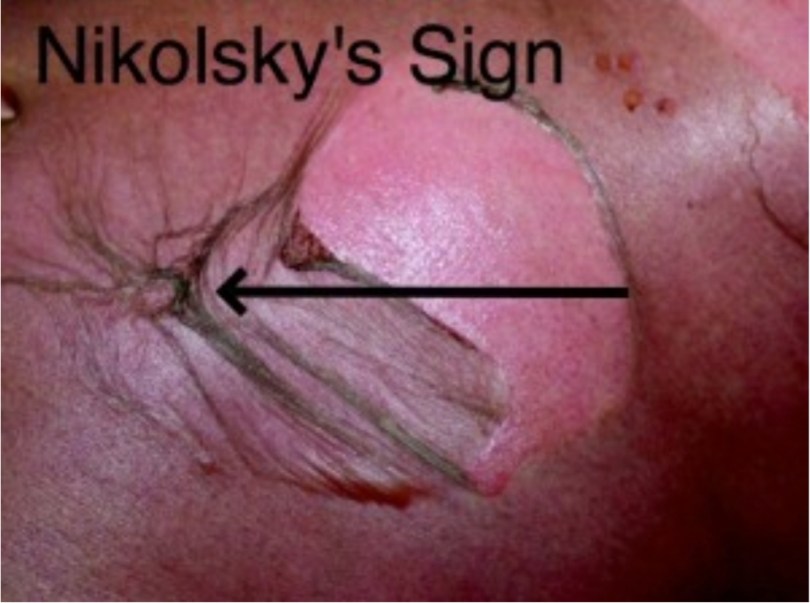
  • Nicolsky’s sign-application of pressure on normal skin produces a new lesion.Seen in pemphigus,TEN,Stevens Johnson syndrome ,Staphylococcla scalded syndrome
  • Osler’s sign- alkaptonuria
  • Pastia sign-scarlet fever
  • Pelken’s sign- scurvy
  • Prayer sign- diabetes
  • Raccoon eye sign-fracture of base of skull
  • Schamroth’s sign-clubbing
  • Signet ring sign-xray of patient with scurvy
  • Spatula sign-tetanus
  • Steinberg sign-Marfan’s syndrome
  • Tear drop sign- orbital blowout fracture
  • Trail sign- tracheal displacement
  • Tram track sign- Struge Weber syndrome
  • Trousseaus sign-seen in tetany
  • Trumbling bullet sign- post traumatic bone cyst
  • Water lily sign-hydatid cyst
  • Wimberger’s sign-congenital syphilis,scurvy
  • Wrist sign-Marfan’s syndrome

Sources:www.slideshare.net.com(signs in medicine),http://www.emdocs.net