Typing in Microbiology

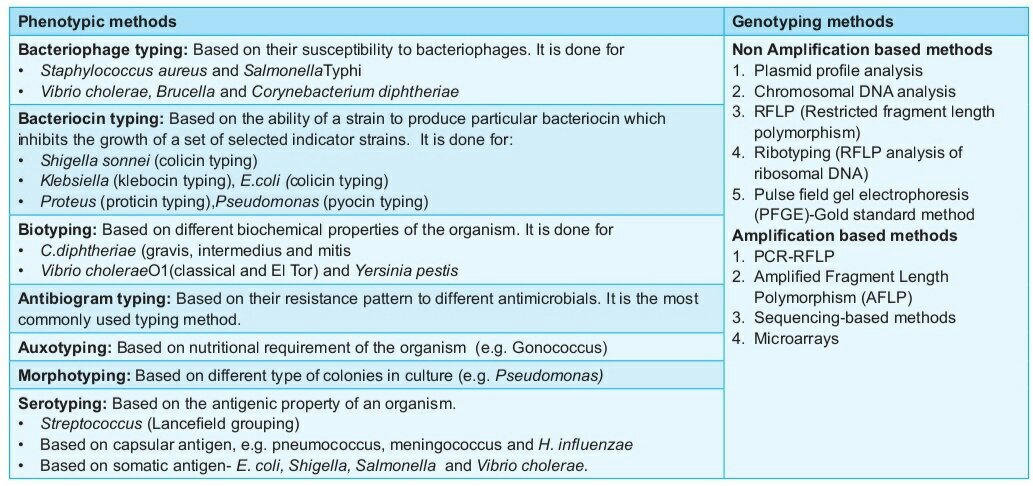
• In microbiology we often come across this word typing in simplest words means classification of microorganisms

• Typing is broadly classified as

– Phenotypic methods

– Genotypic methods

• Genotypic methods are the ones which analyse the kind of genes present on chromosomes and plasmids of microorganisms. They are used to know whether the genes are homologous or heterologous

• And also to know certain specific genes whether they are present or absent and similar other attributes of the genes . They are way more complicated to do and interpret the results as these are expensive methods , hence they are not used in routine diagnostic purpose.

• phenotypic methods are the commonly used methods. These methods are used for diagnostic purpose. These methods are based on observable characters or physical characters of microorganism like shape, size, results from biochemical reaction, susceptibility or resistance to antibiotics or other certain viruses.

• Common type of phenotypic methods is serotyping. Serotyping refers to sero means surface and typing means classification. Serotyping is based on differences in the different structures decorated on the surface of microorganism.

• Serotyping is based on the surface structures such as lipopolysaccharides,membrane proteins, capsular polysaccharide, fimbriae and flagella.

Reference :- Apurba sastry

BONDING AGENTS

Let’s know why was it introduced..

Bonding agents were introduced to improve or to create the bond between the tooth and the Restorative material.

Which was the first bonding agent ??

It’s sevriton cavity seal. It’s based on glycerophosphoric acid dimethacrylate. It had limitations like high polymerization shrinkage and high thermal expansion.

Composition of a dentin bonding agent:-

Primer + Etchants + adhesive , solvents, initiators, fillers particles and others ingredients like polyalkenoic copolymer

Use of primer it’s to wet the surface properly or to reduce the contact angle. They maintain an expanded collagen network to allow filtration of hydrophobic monomer as well. Ex:- HEMA( Hydroxy ethyl methacrylate ) and TEGDMA ( Tri ethanol glycol dimethacrylate ).

Conditioners are also called as Etchants. 10% Malic acid for 1 minute , and 37% phosphoric acid for 15 sec and if the concentration of phosphoric acid exceeds more than 50% then it forms monocalcium phosphate monohydrate which inhibits dissolution. Etching is done for both enamel and dentin.

Mode of action of etchant on enamel :- by selective dissolution of enamel rods at the centre or peripheries or both. They act by increasing the surface energy and increases the surface area which creates microporosities on the surface of enamel.

Mode of action of etchant on dentin :-It involves removal of smear layer and opening of dentinal tubules

Smear layer :- During tooth preparation the cut material along with water forms a thin film on the floor of the cavities known as smear or debris layer

Smear layer is it desirable? ?

In dentin the smear layer becomes burnished into the underlying dentinal tubules and it lowers the dentin permeability which has a protective effect.

Developing a bonding agent for enamel was easier than those of dentin, What would be the reason ?

Dentin contains water and due to inhomogeneous composition and presence smear layer will be a problem, whereas for enamel it contains more inorganic content that is calcium hydroxyapatite crystals.

The purpose of using solvents is in order to increase the diffusion of primers and adhesive into micro retentive tooth surface and most common solvents used are ethanol and acetone.

Adhesives in 1st generation are GPDM, 2nd generation BISGMA, TEGDMA, 3rd generation NPG- GMA,4th generation NPG-GMA, HEMA, 5th generation PENTA , Methacrylated phosphonates, 6th and 7th generation methacrylated phosphonates in water

The etchant generally was 37% phosphoric acid almost for all generations; and primer was HEMA.

Initial generations had all the components primer+ etchant + adhesive separately; as time progressed new generations evolved with all in one bonding agent.

• 2 step method :- 5th and 6th generation; 1 step method :- 7th generation ( all in one system )

• Indications for use of bonding agent:- When composite resin is used as Restorative material; And even when the porcelain veneers are bonded and when the exposed dentin is to be desensitized.

• Conditions that satisfy the true adhesion of Restorative material with tooth structure are sound tooth structure must be conserved; optimal retention must be achieved, microleakage should be prevented.

Hybrid layer :- Structure formed in dental hard tissues by deminerlization of surface followed by infiltration of monomers into collagen mesh and subsequent polymerization is called hybrid layer. It was reported by Nakabayshi in 1982.

Reference :- Philips and Manapalil text book of dental materials
Apoptosis

• It is coordinated and internally programmed cell death it has significance in various physiological processes like involution of thymus in early age , sculpting of tissues during development of embryo and pathological process like diseases of heart like acute MI and CNS diseases like alzehmeirs disease and parkinson’s disease

In apoptosis single cells or small cluster of cells are involved. When compared to the normal cell the apoptotic cell has more eosinophilic cytoplasm and chromatin condensation.

Apoptotic bodies are membrane bound spherical bodies with cell shrinkage ,chromatin condensation and eosinophilic cytoplasm. Apoptotic bodies are also referred to as Mummified bodies.

DNA changes can be seen by gel electrophoresis by H and E stain to see the chromatin condensation and other stains. Flow cytometry for cell shrinkage.

Apoptosis is not accompanied by inflammation unlike necrosis

Mechanism of apoptosis :-

1. Initiators of apoptosis :- Every cell has built mechanism for the cell survival and to activate the signal of cell death. Apoptosis takes place when there is withdrawal of cell survival signals like growth factors , cytokines. And the agents of cell injury like heat and radiation leads to Apoptosis

2. Initial phase of apoptosis :- There are 2 pathways by which apoptosis takes place that is intrinsic and extrinsic pathway by activating the caspases. Intrinsic pathway is the major pathway of cell death. Caspases are nothing but the protein splitting enzymes that will act on nuclear proteins and other protein components.

Intrinsic pathway :-

This pathway of cell death is by release of protein cytochrome C from mitochondria to cytoplasm. This triggers the cell to Apoptosis. Protein C is the life line of intact mitochondria. This is regulated by pro and anti apoptotic genes. Anti apoptotic genes are bcl2 , Mcl 1 and bcl x. Pro apoptotic genes are bid , bad. The proapoptotic genes will trigger apoptosis that will release Bak and Bax that will damage the mitochondrial membrane and releases the cytochrome c from mitochondria to cytoplasm that will activate caspases

Extrinsic pathway :-

This pathway of cell death is by activation of cell death receptors present on the cell surface. Cell death receptor tumour necrosis factor and related transmembrane protein that is fas and it’s ligand fas l this binding is associated with Fas associated death domain. This will activate caspases

3. Final phase of apoptosis :- There is activation of caspases 8 by intrinsic pathway and caspases 9 and 10 by extrinsic pathway that will act on the nuclear proteins and this leads to the changes in the DNA and cell death.

4. Phagocytosis :- The surface of the cell will undergo changes in order to activate the adjacent macrophages for its phagocytosis. Phosphatidyl serine and thrombospondin molecules is present inside, during apoptosis it comes to the exterior that triggers the cell for its phagocytosis. Phagocytosis is rapid and it’s not accompanied by inflammatory cells.

Reference :- Harsh Mohan

STEPS IN COMPLETE DENTURE FABRICATION

Clinical steps in complete denture fabrication :-

Diagnosis and treatment planning

Mouth preparation

Tray selection

Primary impression

Border moulding

Secondary impression

Jaw relations

Teeth selection

Try in

Denture delivery

Laboratory steps in complete denture fabrication :-

Primary cast

Spacer

Special tray

Secondary cast

Denture base

Occlusal rims

Articulation

Teeth arrangement

Dearticulation

Flasking

Packing

Curing

Deflasking

Finishing and polishing

Residual Ridge Resorption

Ridge = Soft tissue + bone

• Residual ridge resorption is a life long process. Residual ridge resorption is maximum upto 3 to 6 months and after that it tappers off.

Alveolar bone :- defined as a bony portion of maxilla and mandible held by the fibres of PDL.

Bone ( Dynamic Process)

Depending on the type of bone the resorption pattern varies like for spongy bone replaced 3-4 yrs and compact bone replaced 10yrs

Which is the process coupled that is bone deposition by osteoblast and bone resorption by osteoclast.

• Residual ridge resorption pattern varies in different individual

According to American college of prosthodontics

Based on bone ht

Type 1 :- residual bone height 21 mm

Type 2 :- residual bone height 16mm

Type 3:- residual bone height 11 – 13mm

Type 4 :- residual bone height 10mm

Type 1 is having good prognosis and type 4 is having poor prognosis that means it’s difficult to gain stability , retention and support

Epidemiology of residual ridge resorption

•It occurs world wide . RRR is accelerated in 1st 6 months with more loss in mandible than maxilla.


• After menopause that is due to harmonal disturbances osteoblastic activity is very less and it’s dominated by osteoclastic activity

” RESORPTION OF MANDIBLE >>>> RESORPTION OF MAXILLA

Direction of bone resorption :-

• Maxilla resorbs upwards and inwards ( centripetal) to become progressively small

• Mandible resorbs outwards and progressively wider

Etiology of residual ridge resorption :-

• Anatomical factors that is quality and quantity of bone of residual ridge RRR is directly proportional to anatomical factors

• Metabolic process :- RRR is directly proportional to bone resorption factors and inversely proportional to formation factors

• Mechanical factors :- If there is excess stimulus or no stimulus resorption takes place

Consequences of residual ridge resorption :-

– loss of sulcus width and depth

– Displacement of muscle attachment to the ridge

– loss of vertical dimension of occlusion. Reduction of lower facial height

– Increase in relative prognathism. Changes in inter alveolar relation. Change in the location of mental foramen.

Treatment :-

– Prevention of loss of natural tooth. Change in the design of denture like impression technique by using minimal pressure impression and selective pressure impression techniques.

• Provide adequate relief on relief are areas. Avoidance of inclined planes. Centralization of occlusal contacts to increase stability and maximise compressive forces

• Adequate interocclusal distance that is by providing enough free way space . Occlusal table should be narrow .

Source :- Deepak nallaswamy and rangarajan.