EROSION

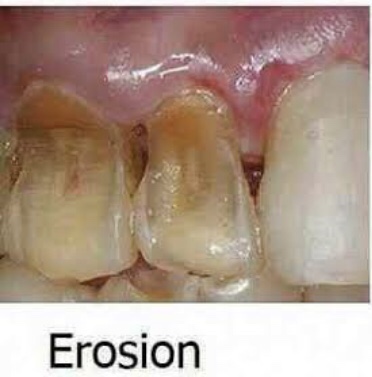
It is the loss of tooth substance by chemical process that does not involve known bacterial action. Dissolution of mineralized tooth structure occurs due to contact with acids. Erosion is a chemical process in which the tooth surface is removed in the absence of plaque.
Types (depending upon etiology)

  • Intrinsic—erosionthatoccurduetointrinsiccausese.g. gastroesophageal reflux, vomiting.
  • Extrinsic—erosionoccurringfromextrinsicsourcese.g. acidic beverages, citrus fruits.Etiology
  • • Local acidosis—it is seen in periodontal tissue from damage due to traumatogenic occlusion.
  • • Chronic vomiting—complete loss of enamel on lingual surfaces of teeth through dissolution by gastric hydrochloric acid. Vomiting can also occur in alcoholics, peptic ulcer, gastritis, pregnancy and drug side effect.
  • • Acidic foods and beverages—Large quantities of highly acidic carbonated beverages or lemon juice can produce erosion. Most of the fruits and fruits juices have a low pH and can cause erosion. Frequent consumption of carbonated drinks, which are acidic in nature, may result in the erosion of teeth.
  • • Anorexia nervosa—it induces chronic vomiting often after bouts of uncontrolled eating that is interspersed between periods of starvation, because of inner rejection of food.
  • • Occupational—workersinvolvinginmanufacturingof lead batteries, sanitary cleaners or soft drinks can develop erosion.
  • • Poorly monitored pH swimming pool—in cases of poorly monitored pH swimming can also cause erosion of the teeth.
  • • Medication—medication like chewable vitamin C and aspirin tablet may lead to erosion of teeth.
  • Clinical features

• Sites—It occurs most frequently on labial and buccal surfaces of teeth; some times, may occur on proximal surfaces of teeth. Usually confined to gingival thirds of labial surface of anterior teeth. Erosion may involve several teeth of dentition. From extrinsic source, it causes erosion on labial and buccal surface and from intrinsic source, it causes erosion on lingual or palatal source.

  • Appearance—it is usually a smooth lesion which exhibits no chalkiness.
  • Symptoms—loss of enamel often causes hypersensitivity in teeth and may also trigger secondary dentin formation.
  • Signs—lossoftoothsubstanceismanifestedbyshallow, broad, smooth, highly polished and scooped out depression on enamel surface adjacent to cementoenamel junction. When erosion affects the palatal surfaces of upper maxillary teeth, there is often a central area of exposed dentine surrounded by a border of unaffected enamel. In most cases, it results in little more than a loss of normal enamel contour, but in severe cases, dentin or pulp may be damaged.
  • Pink spot—there may be pink spot on tooth which is attributable to the reduced thickness of enamel and dentin making the pink hue of pulp visible.
  • Cupping—erosive lesions cause ‘cupping’ in dentin.
  • Radiographic features
  • • It appears as radiolucent defect in the crown margins may be well defined or diffuse.
  • Management
  • Dietcontrol—inapatientwherelossoftoothsurfaceis essentially caused by erosive fluids, advise regarding diet and use of sugar free chewing gum.
  • Fluoride mouthwash—prescription of a fluoride mouthwash is certainly indicated here.
  • Brushinghabits—brushinghabitsshouldbemodified.
  • Restoration—restoration of the defect, usually by glassinomer cement.
  • Systemic management—for systemic management ofvomiting, patient should be referred to the physician.

REFERENCE- ANIL GHOM TEXTBOOK OF ORAL MEDICINE [2nd ed]

ABRASION

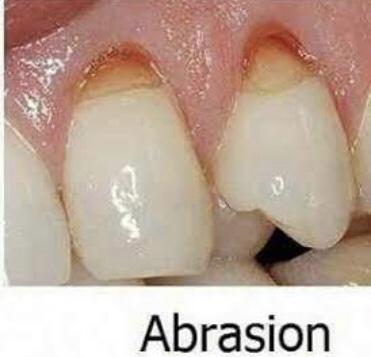
Abrasion is the pathological wearing away of tooth substance through some abnormal mechanical process. Abrasion usually occurs on the facial surface of the crown and the exposed root surfaces of teeth, but under certain circumstances it may be seen elsewhere such as on incisal or on proximal surfaces.

  1. Etiology
    • Abrasivedentifrices—useofabrasivedentifricescanleadto abrasion of the incisal surface.
    • Habitual—Habitualpipesmokermaydevelopabrasion on the incisal edges of lower and upper anterior teeth. In some cases habitual opening of bobby pins may lead to abrasion.
    • Horizontal tooth brushing—horizontal tooth brushing may lead to abrasion of the cervical area of teeth.
    • Occupational—itoccurswhenobjectsandinstrumentare habitually held between the teeth by people during working. Holding nails or pins between teeth e.g. in carpenters, shoemakers or tailors.
    • Dentalflossortoothpicksinjury—improperuseofdental floss and tooth picks.
    • Ritual abrasion—it is mainly seen in Africa.Clinical featuresTooth brush injury
      • Sites—itusuallyoccursonexposedsurfacesofrootsofteeth. It is more commonly seen on left side of right handed persons and vice versa.

• Mechanism—it occurs due to back and forth movement of brush with heavy pressure causing bristles to assume wedge shaped arrangement between crown and root.

• Appearance—in horizontal brushing there is usually a ‘V’ shaped or ‘wedge’ shaped ditch on the root at cementoenamel junction . It is limited coronally by enamel.

• Symptoms—patient develops sensitivity as dentin becomes exposed.

• Signs—the angle formed in the depth of the lesion as well as that of enamel edge is a sharp one. Cervical lesions caused purely by abrasion have sharply defined margins and a smooth, hard surface. The lesion may become more rounded and shallow, if there is an element of erosion present.

• Dentinal features—exposed dentin appears highly polished  Exposure of dentinal tubules and consequent irritation of the odontoblastic processes stimulates secondary dentin formation which is sufficient to protect the pulp from clinical exposure.

Dental floss or tooth pick injury
• Site—Cervical portion of proximal surfaces ,just above the gingival margin, is affected. Grooves on distal surface are deeper than on mesial surface

Radiographic features

Tooth brush injury

  • Location—radiolucent defect at the cervical level of teeth.
  • Shape—well defined semilunar shape ,with borders of increasing density.
  • Pulp—pulp chamber may be partially or fully sclerosed in severely affected teeth.Dental floss injury
    • Appearance—narrow semilunar grooves in theinterproximal surfaces of teeth near cervical area.
  • Management

• Modified teeth cleaning habits—modification of teeth cleaning habits will be indicated.

• Removal of cause—elimination of causative agent should be carried out.

• Restoration—restoration should be done for esthetics purpose and to prevent further tooth wear.

REFERENCE- ANIL GHOM TEXTBOOK OF ORAL MEDICINE [2nd ed]
ATTRITION

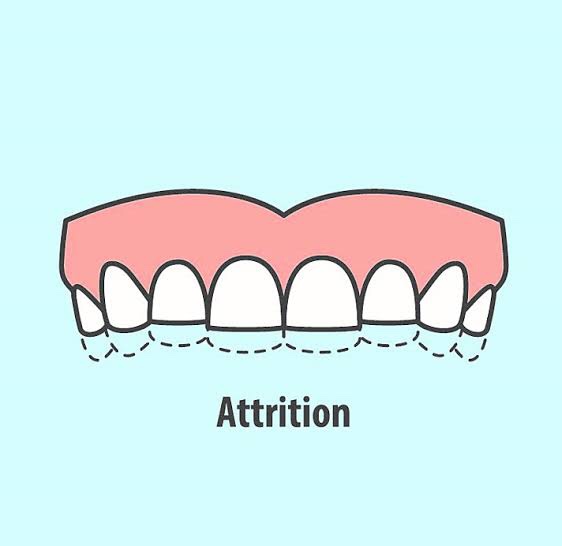
  1. It is the physiologic wearing away of teeth because of tooth- to-tooth contact, as in mastication. It plays an important physiological role as it helps to maintain an advantageous crown-root ratio and gains intercoronal space of 1 cm, which facilitates third molar eruption. Attrition can be considered pathological when it cause functional, esthetics and dental sensitivity problems.

Types

• Physiological attrition—attrition which occurs due to normal aging process, due to mastication.

• Pathological attrition—it occurs due to certain abnor- malities in occlusion, chewing pattern or due to some structural defects in teeth.

Etiological factors for pathological attrition

• Abnormal occlusion
• Developmental—malocclusion and crowning of teeth, may lead to traumatic contact during chewing, which may lead to more tooth wear.
• Acquired—due to extraction of teeth. Extraction causes increased occlusal load on the remaining teeth, as the chewing force for the individual remains constant.

• Premature contact in case of edge-to-edge contact,pathological attrition can also occur.
• Abnormal chewing habits parafunctional chewing habit like bruxism and chronic persistent chewing of coarse and abrasive food or other substances like tobacco.
• Occupation in certain occupations, workers are exposed to an atmosphere of abrasive dust and cannot avoid it getting into mouth.
• Structural defect in defects like amelogenesis imperfecta and dentinogenesis imperfecta, hardness of enamel and dentin is reduced and such teeth become more prone to attrition.

Clinical features

• Sex—men usually exhibit more severe attrition than women due to greater masticatory forces.

• Sites—it may be seen in deciduous as well as permanent dentition. It occurs only on occlusal, incisal and proximal surfaces of teeth. Severe attrition is seldomly seen in primary teeth, as they are not retained for any great period. Palabal cusps of maxillary teeth and buccal cusps of mandibular posterior teeth show most wear.

• Appearance – the first clinical manifestation of attrition is the appearance of small polished facet on a cusp tip or ridge and slight flattening of an incisal edge.

Physiologic attrition

  • Physiological tooth surface loss results in a reduction, in both vertical tooth height and horizontal tooth width .Physiological attrition showing wearing of the occlusal surface of the molar teeth.
  • Contact points—due to slight mobility of teeth in their socket (which is a manifestation of resiliency of periodontal ligament) similar facets occur at contact points.
  • Color of teeth when the dentin gets exposed, it generally becomes discolored i.e. brown in color.
  • Signs—there is gradual reduction in cusp height and consequent flattening of occlusal inclined plane. There is shortening of the length of dental arch, due to reduction in the mesiodistal diameter of teeth. Secondary dentin deposition occurs.

• Pathologicalattrition

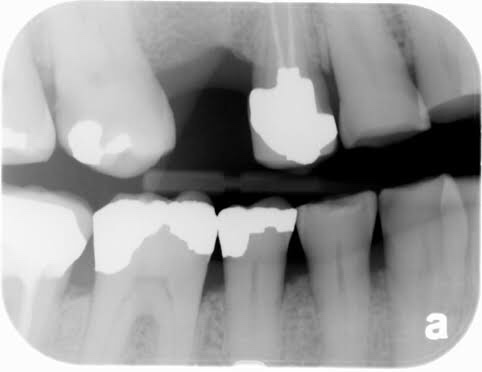
Severe tooth loss—in pathological attrition severe tooth loss is seen .

Dentoalveolar compensation—if attrition affecting the occlusal surfaces of teeth has occurred, then reduction in occlusal face height (vertical dimension of occlusion) and increase in the freeway space could be anticipated. This may be further complicated by forward posturing of mandible. It is often observed, however, that despite overall tooth surface loss, the freeway space and the resting facial height appear to remain unaltered primarily because of dentoalveolar compensation. This is important with respect to patient assessment. If restoration of worn teeth is being planned then the extent of dentoalveolar compen- sation would appear to determine the dentist’s strategy; defining the need to carry out measures such as crown lengthening, to ensure the same vertical dimension of occlusion and freeway space.

Radiographic features

• Crown—smoothwearingofincisalandocclusalsurfaces of involved teeth is evident by shortened crown image

• Pulp—sclerosisofpulpchamberandcanalsisseendue to deposition of secondary dentin which narrows the pulp canals.

• Periodontal ligament—widening of periodontal ligament space and hypercementosis.

• Alveolar bone—some loss of alveolar bone.

Management

  • Modifying factors—treatment of patient depends upon degree of wear relative to the age of patient, etiology, symptoms and patient’s desire.
  • Habit breaking appliance—the provision of one of three different sorts of splints could be considered. A soft bite guard can help in breaking a bruxist habit or simply will protect the teeth during the bruxist habit. A localized occlusal interference splint is designed to break the bruxist habit and can be worn easily during the day. A stabilization splint reduces bruxism by providing an ideal occlusion: it also enables the clinician to locate and record centric relation. In case of bruxism, use of night guards may be effective in reducing attrition.
  • Correctivemethod—correctionofmalocclusion,stoppage of tobacco chewing habit and restriction of diet to non coarse food are useful in avoiding attrition.
  • Managementofsensitivityandesthetics—non-cariousloss of tooth tissue may require treatment for sensitivity, esthetics, function and space loss in the vertical dimension.

REFERENCE- ANIL GHOM TEXTBOOK OF ORAL MEDICINE [2nd ed]
GINGIVAL INFLAMMATION

Pathologic changes in gingivitis are associated with the presence of oral microorganisms attached to the tooth and perhaps in or near the gingival sulcus.

STAGE I GINGIVITIS: THE INITIAL LESION

The first manifestations of gingival inflammation are vascular changes consisting of dilated capillaries and increased blood flow. These initial inflammatory changes occur in response to microbial activation of resident leukocytes and the subsequent stimulation of endothelial cells. Clinically, this initial response of the gingiva to bacterial plaque is not apparent.

Changes can also be detected in the junctional epithelium and perivascular connective tissue at this early stage. For example, the perivascular connective tissue matrix becomes altered, and there is exudation and deposition of fibrin in the affected area. Also, lymphocytes soon begin to accumulate. The increase in the migration of leukocytes and their accumulation within the gingival sulcus may be correlated with an increase in the flow of gingival fluid into the sulcus.

The character and intensity of the host response determine whether this initial lesion resolves rapidly, with the restoration of the tissue to a normal state, or evolves into a chronic inflammatory lesion. If the latter occurs, an infiltrate of macrophages and lymphoid cells appears within a few days.

STAGE II GINGIVITIS: THE EARLY LESION

The early lesion evolves from the initial lesion within about 1 week after the beginning of plaque accumulation.Clinically, the early lesion may appear as early gingivitis, and it overlaps with and evolves from the initial lesion with no clear-cut dividing line. As time goes on, clinical signs of erythema may appear, mainly because of the proliferation of capillaries and increased formation of capillary loops between rete pegs or ridges . Bleeding on probing may also be evident.1 Gingival fluid flow and the numbers of transmigrating leukocytes reach their maximum between 6 and 12 days after the onset of clinical gingivitis.

The amount of collagen destruction increases 70% of the collagen is destroyed around the cellular infiltrate. The main fiber groups affected appear to be the circular and dentogingival fiber assemblies. Alterations in blood vessel morphologic features and vascular bed patterns have also been described.

PMNs that have left the blood vessels in response to chemo- tactic stimuli from plaque components travel to the epithelium,

cross the basement lamina, and are found in the epithelium, emerg- ing in the pocket area. PMNs are attracted to bacteria and engulf them in the process of phagocytosis . PMNs release their lysosomes in association with the ingetion of bacteria.Fibroblasts show cytotoxic alterations, with a decreased capacity for collagen.

Meanwhile, on the opposite side of molecular events, collagen degradation is related to matrix metalloproteins (MMPs). Different MMPs are responsible for extracellular matrix remodeling within 7 days of inflammation, which is directly related to MMP-2 and MMP-9 production and activation.

STAGE III GINGIVITIS: THE ESTABLISHED LESION

Over time, the established lesion evolves, characterized by a predominance of plasma cells and B lymphocytes and probably in conjuncation with the creation of a small gingival pocket lined with a pocket epithelium.The B cells found in the established lesion are pre- dominantly of the immunoglobulin G1 (IgG1) and G3 (IgG3) subclasses.

In chronic gingivitis, which occurs 2 to 3 weeks after the beginning of plaque accumulation, the blood vessels become engorged and congested, venous return is impaired, and the blood flow becomes sluggish .The result is localized gingival anoxemia, which superimposes a somewhat bluish hue on the reddenedgingiva.18 Extravasation of erythrocytes into the connective tissue and breakdown of hemoglobin into its component pigments can also deepen the color of the chronically inflamed gingiva. The established lesion can be described as moderately to severely inflamed gingiva.

An inverse relationship appears to exist between the number of intact collagen bundles and the number of inflammatory cells.Collagenolytic activity is increased in inflamed gingival tissue17 by the enzyme collagenase. Collagenase is normally present in gingival tissues5 and is produced by some oral bacteria and by PMNs.

Enzyme histochemistry studies have shown that chronically inflamed gingivae have elevated levels of acid and alkaline phos- phatase, β-glucuronidase, β-glucosidase, β-galactosidase, esterases, aminopeptidase, and cytochrome oxidase. Neutral mucopolysaccharide levels are decreased, presumably as a result of degradation of the ground substance.

Established lesions of two types appear to exist; some remain stable and do not progress for months or years and others seem to become more active and to convert to progressively destructive lesions. Also, the established lesions appear to be reversible in that the sequence of events occurring in the tissues as a result of successful periodontal therapy seems to be essentially the reverse of the sequence of events observed as gingivitis develops. As the flora reverts from that characteristically associated with destructive lesions to that associated with periodontal health, the percentage of plasma cells decreases greatly, and the lymphocyte population increases proportionately.

STAGE IV GINGIVITIS: THE ADVANCED LESION

Extension of the lesion into alveolar bone characterizes a fourth stage known as the advanced lesion or phase of periodontal break- down.

Gingivitis will progress to periodontitis only in individuals who are susceptible. Patients who had sites with consistent bleeding had 70% more attachment loss than at sites that were not inflamed consistently (GI = 0). Teeth with noninflamed sites consistently had a 50-year survival rate of 99.5%, whereas teeth with consistently inflamed gingiva had a 63.4% survival rate over 50 years. Based on this longitudinal study on the natural history of periodontitis in a well-maintained male population, per- sistent gingivitis represents a risk factor for periodontal attachment loss and for tooth loss.

Reference- Caranza textbook of periodontology 11th edition