PRINCIPLES OF ENDODONTIC TREATMENT

ASEPSIS : By rubber dam placement or isolation or by sterilization of instruments.

  1. APPLICATION OF RUBBER DAM :
  • To maintain a safe and aseptic operating field .
  • Only safeguard against the bacterial contamination from saliva and swallowing of root canal instruments.

2. STERILIZATION :

  • Cold sterilization
  • Hot salt sterilization
  • Glass bead sterilization
  • Direct flaming
  • Autoclaving
  • Dry heat oven

a) DEBRIDEMENT OF ROOT CANAL :

  • Infected root canal must be cleaned of debris .
  • All the necrotic tissue should be removed from the root canal as it encourages bacterial growth.
  • Instrumentation and irrigation is required for complete debridement .
  • Sodium hypochlorite or any other irrigant should be used for irrigation.

b)DRAINAGE :

  • Drainage should be done when gross infection or swelling is present.
  • In case of acute alveolar abscess drainage should be done either through root canal or by incision or both .
  • Drainage is established by preparing a cavity lingually on anterior teeth and occlusally on posterior teeth.

c) IMMOBILIZATION :

  • Done to allay pain and promote healing .
  • It reduces the potential for spreading of microorganisms.
  • Also reduces trauma to PDL.

d)ATRAUMATIC PROCEDURES :

  • All traumas should be avoided.
  • Soft tissues should be handled carefully and gently.
  • Instrument should not be passed beyond apical foramen.
  • Radiograph should be carefully studied.

e)TERPHINATION:

  • Means relieving pain.
  • Biterphination means creating of a surgical passage in the region of the root apex for escape of pus or blood to relieve the pressure of accumulated pus or gas in jaw bone.
  • Done in case of acute alveolar abscess .

f)CHEMO PROPHYLAXIS:

  • If the patient has history of rheumatic fever or valvular heart disease , an antibiotic such as phenoxy -methyl penicillin 2 g 1 hour before and 1 g 6 hour after the operation should be given.

References: GROSSMANS TEXBOOK
TEETHING


Teething is a term limited by common usage to eruption
of primary dentition. Since the time of Hippocrates (460-
377 BC) teething is blamed for ailments such as fever, convulsions, bronchitis, otitis media and diarrhea, for
causing 12% of the deaths in children under four years.
Complete opposite views are also available. It is seen
that these local and systemic factors are associated with
the disease somewhere else also and just as a coinci-
dence appear with teething.

Eruption of primary dentition usually begins in the 4-6th month of a child’s life. The appearance of normal teeth is eagerly awaited by the parents since it represents an important early milestone in development. In most cases eruption of teeth causes no distress to the child or parents, but sometimes the process causes local
irritation, which is usually minor but which may be severe enough to interfere with the child’s sleep.

CLINICAL FEATURES OF TEETHING

LOCAL SIGNS

1. Hyperemia or swelling of the mucosa overlying theerupting teeth.
2. Patches of erythema on the cheeks.
3. Flushing may also occur in the skin of the adjacen cheek.

SYSTEMIC SIGNS

1.General irritability and crying
2.Loss of appetit.

3.Sleeplessness

4.Increased salivation and drooling

5.Insanity
6.Meningitis

7.Increased thirst
8.Circumoral rash
9.Cough

Associated Problems
Systemic

Fever,convsions, diarrhea,vomiting, bronchitis, cholera, tetanus

Local

Eruption hematoma, eruption sequestrum, ectopic eruption, transmigration , transposition

MANAGEMENT

PREVENTIVE MEASURES

1. Maintain child’s oral and general body health.

2.Gums should be wiped after each meal with cotton soaked in a weak antiseptic.

3. Adequate quantities of vitamins, minerals , proteins, are given to the child for increasing body’s resistance .

GENERAL MANAGEMENT

1. Hard , non sweetened rusks

2. Use of toasted bread helps in providing gingival stimulation.

3. Use of hard fruits such as appleor guava .

MEDICAL MANAGEMENT

demulcent and mild antiseptic.

1. Topical application of glycerin: It acts as a protective demulcent and mild antiseptic.
2. Topical application of lignocaine hydrochloride which provide relief in the interval before the analgesic is effective .
3. Topical application of benzyl alcohol can also be effective.

SURGICAL MANAGEMENT

Surgical treatment is sometimes recommended for the relief of pain from an eruption cyst or a hematoma. The technique advocates is to make 2 semilinar incisions over the crowns of the tooth , which meet at their extremities. The intervening portion of the tissue , which lies over the occlusal surface of unerupted tooth is then removed with a pair of tissue foreceps.

REFERENCES:TEXTBOOK OF PEDODONTICS SHOBHA TANDON 2ND EDITION

STAGES OF GINGIVITIS

Gingivitis is defined as an inflammation which is confined to the tissues of the marginal gingiva . It is an observable alteration in tissues associated with changes in vascular permeability and dilation often accompanied with the infiltration of leukocytes into the affected tissues .

The sequence of events cumulating in the clinically apparent gingivitis is categorized into

  • STAGE 1: Initial lesion
  • STAGE 2 : Early lesion
  • STAGE 3 : Established lesion
  • STAGE 4 : Advanced lesion

STAGE 1 : THE INITIAL LESION ( 2- 4days ):

  1. VASCULAR CHANGES : Classic vasculitis sub adjacent to junctional epithelium, dilated capillaries , increased blood flow
  2. MICROSCOPIC CHANGES : Presence of leukocytes, loss of perivascular collagen and presence of serum proteins changes in the coronal most position of junctional epithelium .
  3. CLINICAL CHANGES : Exudation of fluids from the gingival sulcus , sub clinical gingivitis .

STAGE 2 : EARLY LESION (4-7 DAYS ):

  1. VASCULAR CHANGES : Vascular proliferation
  2. MICROSCOPIC CHANGES : Rete pegs formation in junctional epithelium , presence of lymphocytes , loss of collagen is increased , fibroblasts show cytoplasmic alterations .
  3. CLINICAL CHANGES : Bleeding on probing, erythematous gingiva.

STAGE 3 : ESTABLISHES LESION ( 14-21 DAYS ) :

  1. VASCULAR CHANGES : Same as early lesion with blood stasis.
  2. MICROSCOPIC CHANGES: Proliferation , apical migration and lateral extension of junctional epithelium, atrophic areas , plasma cells are predominant , further loss of collagen, increased enzyme levels of acid and alkaline phosphatase.
  3. CLINICAL CHANGES : Changes are seen in color, surface texture and consistency , bluish hue around the reddened gingiva , gingiva appears to be moderately to severely inflamed .

STAGE 4 : THE ADVANCED LESION :

  1. VASCULAR CHANGES: Same as early and established lesions. characterized by the invasion of the lesion to the underlying alveolar bone .
  2. MICROSCOPIC CHANGES: Persistence of features seen in established lesion, extension of inflammation into deeper structures including alveolar bone and periodontal ligament , presence of all types of inflammatory cells , conversion of bone marrow into fibrous tissues.
  3. CLINICAL CHANGES :Formation of periodontal pocket and its associated changes.

REFERENCES: ESSENTIALS OF PERIODONTOLGY SHANTIPRIYA REDDY 5TH EDITION

ORAL MALODOR

INTRODUCTION:

Halitosis – or chronic bad breath – is something that mints, mouthwash or a good brushing can’t solve. Unlike “morning breath” or a strong smell that lingers after a tuna sandwich, halitosis remains for an extended amount of time and may be a sign of something more serious. 

CLASSIFICATION :

  1. BASED ON ETIOLOGY :
  • Local factors of pathological origin : poor oral hygiene , extensive caries, periodontal disease , cysts , tumors .
  • Local factors of non pathological origin : stagnation of saliva associated with food debris , dentures, excessive smoking .
  • Systemic factors of pathological origin : diabetes mellitus, liver failure, lung abscess , tuberculosis .
  • Systemic factors of non pathological origin : diet like garlic , onion , meat , excessive alcohol consumption.
  • Xerostomia :conditions like sjogren’s syndrome, radiation therapy.

2. BASED ON PATIENT’S CRITERIA :

  • Genuine halitosis
  • Pseudo halitosis
  • Halitophobia

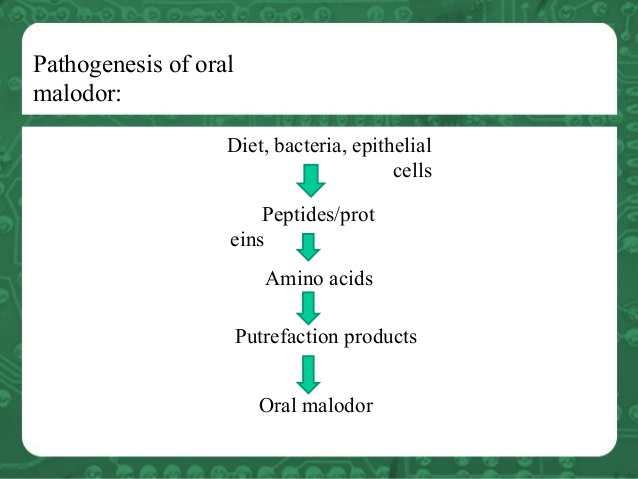
PATHOGENSIS OF MALODOR :

ETIOLOGY :

  1. Physiological halitosis
  • mouth breathing
  • medications
  • aging and poor dental hygiene
  • fasting / starvation
  • tobacco
  • foods like onion , garlic and alcohol

2. Pathological halitosis:

  • periodontal infection
  • stomatitis
  • xerostomia
  • faulty restorations
  • unclean dentures
  • oral cancers
  • candidiasis
  • nasal infections
  • GERD
  • bronchitis, pneumonia
  • diabetes mellitus
  • renal failure
  • fever

DIAGNOSIS :

  1. Review of medical , dental , personal history
  2. Clinical examination : tongue coating, mouth breathing , xerostomia
  3. Complete periodontal examination
  4. Measurement of malodor : gas chromatography . halimeters, BANA test , chemiluminescence , diamond probe

TREATMENT :

  • Brush your teeth after you eat.
  • Floss at least once a day.
  • Brush your tongue.
  • Clean dentures or dental appliances. .
  • Avoid dry mouth.
  • Adjust your diet. .
  • Regularly get a new toothbrush.
  • Schedule regular dental checkups.
  • Regular use of halita solution which reduces the levels of volatile sulfur compounds .

References: Essentials of clinical periodontology . Shantipirya reddy 5th edition