For decades, functional appliances like the Twin Block and Herbst have been mainstays in the treatment of Class II malocclusions due to mandibular retrognathism. As orthodontic students, we are often taught what these appliances do—but not always how or why their effects change over time.
This is where the concept of Growth Relativity becomes essential.
The Traditional Question: Do Functional Appliances Really Grow the Mandible?
A common question in orthodontics is whether functional appliances can truly stimulate mandibular growth beyond genetic potential. Short-term studies often show promising results—forward positioning of the mandible, improved facial profile, and apparent condylar changes. However, long-term studies consistently demonstrate that many of these effects reduce or relapse after appliance removal.
This discrepancy highlights an important principle:
👉 Not all growth observed during treatment is permanent growth.
Growth Relativity: A More Realistic Biological Explanation
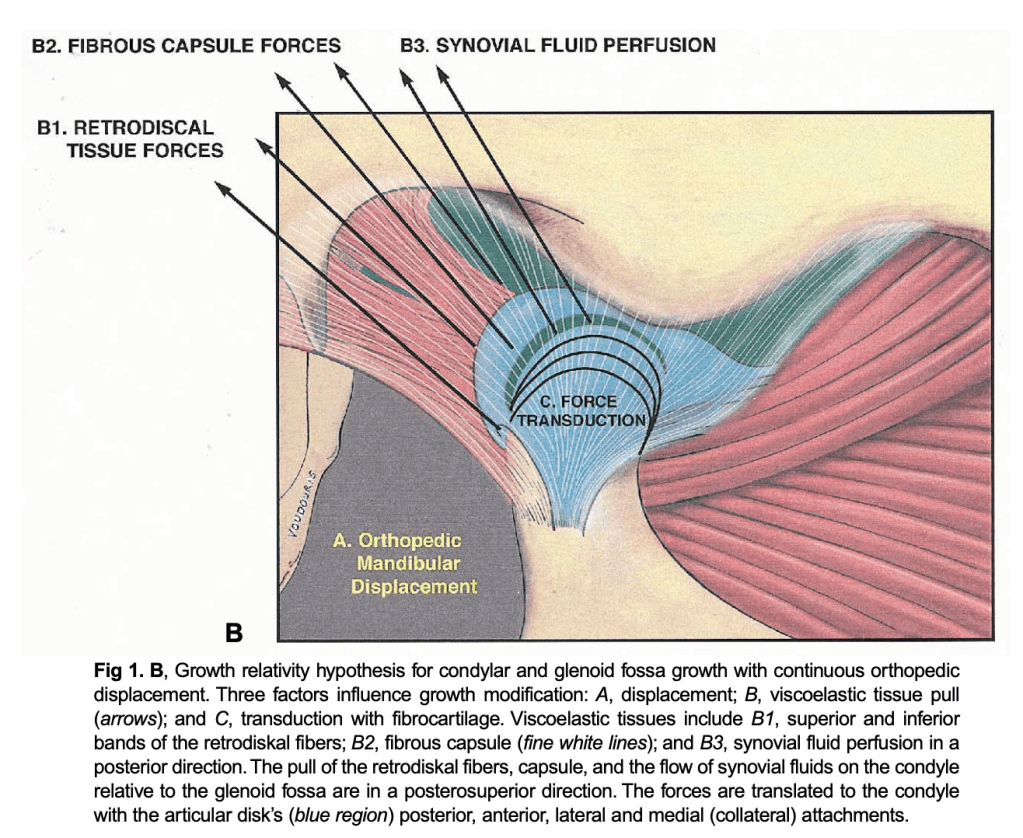
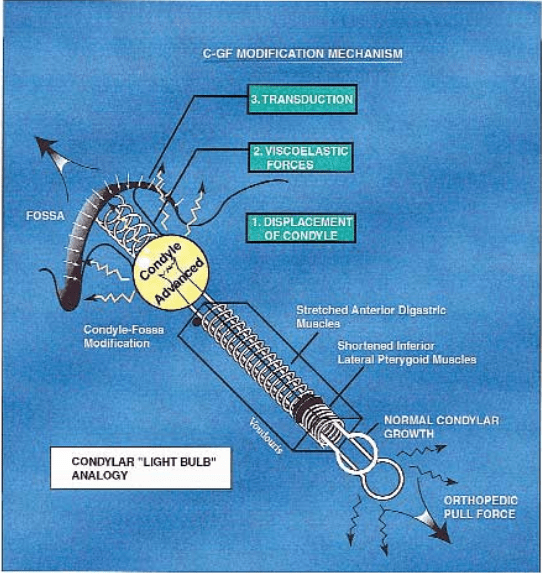
The Growth Relativity hypothesis proposes that condylar and glenoid fossa changes during functional appliance therapy are relative, adaptive, and time-dependent, rather than permanent growth stimulation.
According to this concept, three major factors influence condyle–fossa modification during mandibular advancement:
- Mandibular Displacement
Forward positioning of the mandible alters the spatial relationship between the condyle and the glenoid fossa. - Viscoelastic Tissue Stretch
Non-muscular tissues—such as the retrodiskal tissues, fibrous capsule, ligaments, and synovial fluid—are stretched during advancement. These tissues exert biologically significant forces on the condyle and fossa. - Force Transduction via Fibrocartilage
The unique fibrocartilaginous cap of the condyle acts as a conduit, allowing forces to be transmitted and “radiate” to areas where new bone formation may occur—even at a distance from the original soft tissue attachment.
Why the Condyle Is Not an Epiphysis
Unlike long bone epiphyses, the mandibular condyle:
- Is covered by fibrocartilage, not hyaline cartilage
- Lacks a strong intrinsic growth-driving mechanism
- Responds more to functional and environmental influences
As a result, condylar changes during functional therapy are adaptive responses, not genetically programmed growth spurts.
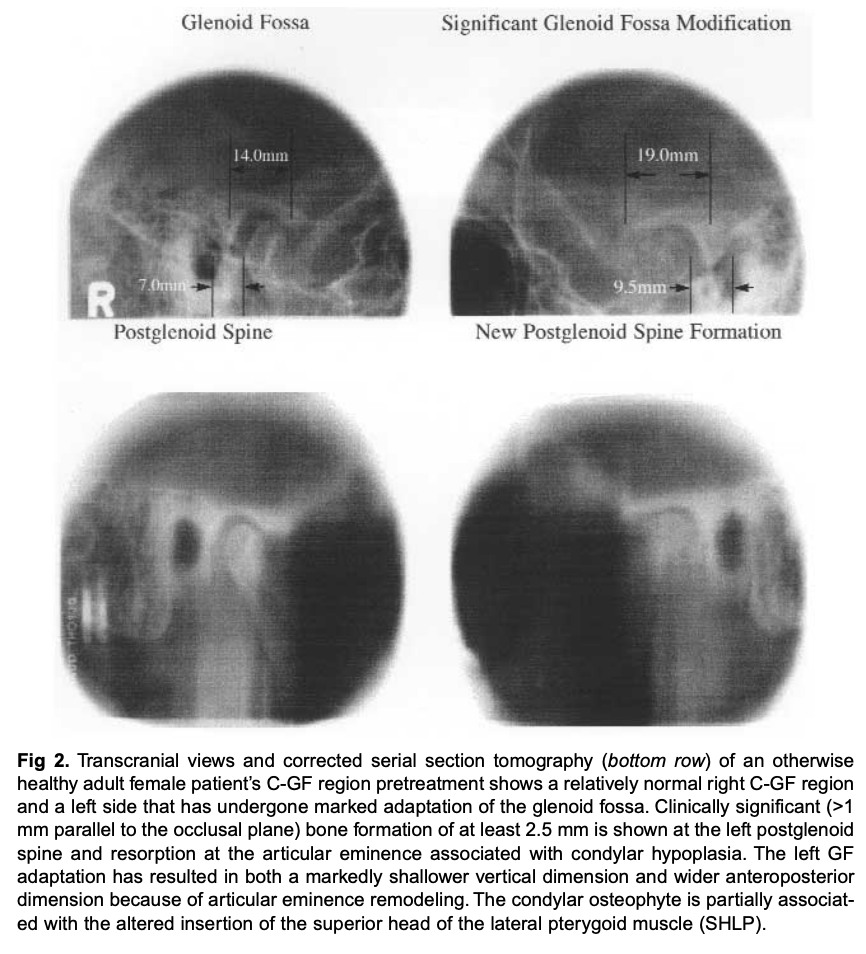
The Light Bulb Analogy
A helpful way to visualize Growth Relativity is the light bulb on a dimmer switch:
- 🔆 During active treatment:
Mandibular advancement “turns up the light.” Condylar and glenoid fossa remodeling becomes more active. - 🔅 During retention:
Once the appliance is removed, muscle activity returns, the condyle reseats, and the “light dims.” - 💡 Long-term:
Growth activity returns close to baseline levels.
This explains why short-term gains may not be fully maintained unless carefully managed.
Clinical Implications for Twin Block and Herbst Appliances
Understanding Growth Relativity changes how we use these appliances in practice.
Twin Block
- Intermittent force
- Requires good patient compliance
- Allows vertical control
- Stepwise mandibular advancement is preferred to avoid tissue overload
Herbst Appliance
- Continuous force
- Compliance-free
- Higher risk of condylar compression if poorly designed
- Best used with:
- Thin posterior bite blocks
- Rapid maxillary expansion (to reduce occlusal interference)
⚠️ Condylar compression should be avoided, as it may reduce adaptive remodeling and increase the risk of TMJ problems.
Why Relapse Happens
Relapse occurs due to:
- Release of stretched viscoelastic tissues
- Reseating of the condyle into the fossa
- Reactivation of masticatory muscle forces
This reinforces the idea that functional appliances reposition structures—they do not permanently override biology.
Key Takeaway for Orthodontic Students
Functional appliances are powerful tools—but only when used with biological realism.
✔ They produce relative, adaptive skeletal changes
✔ They rely heavily on soft tissue biomechanics
✔ Long-term stability depends more on growth timing, appliance design, and retention, not just advancement
Understanding Growth Relativity helps us move beyond appliance mechanics and toward biologically intelligent orthodontics.

 Dentowesome