

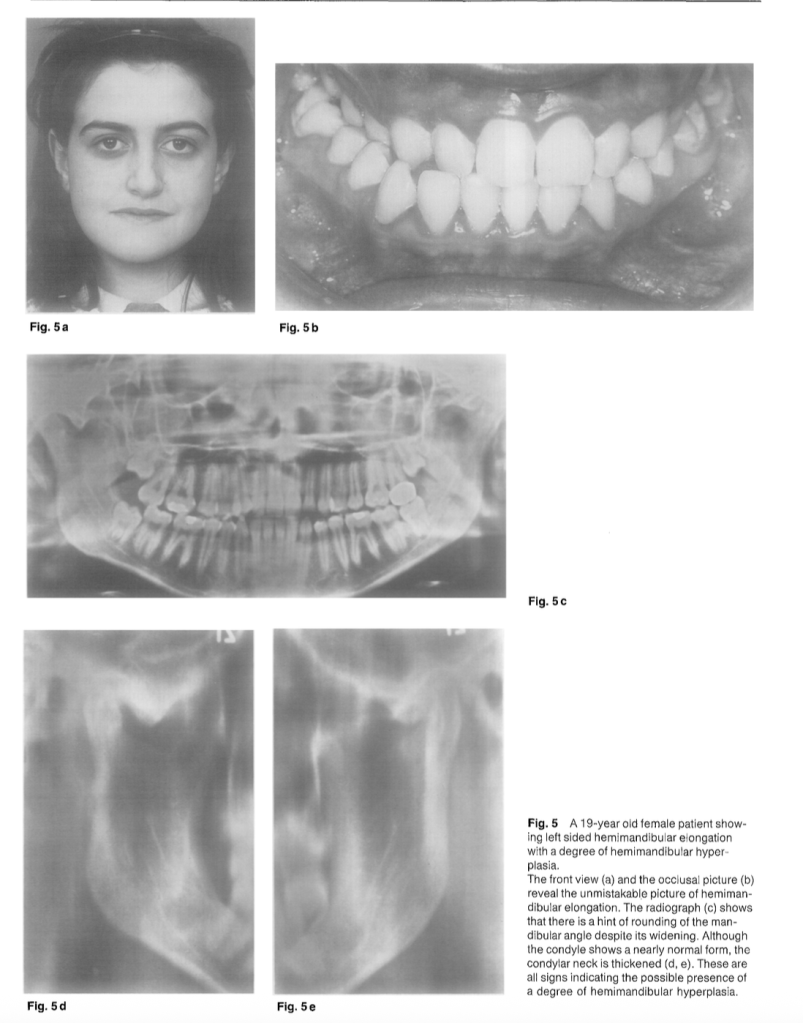
🔍 1. Distinguishing H.H. vs H.E. — Clinical & Radiographic
| Feature | Hemimandibular Hyperplasia (H.H.) | Hemimandibular Elongation (H.E.) |
|---|---|---|
| Growth Direction | Vertical | Horizontal |
| Chin Position | Not significantly displaced | Displaced to unaffected side |
| Facial Asymmetry | Vertical facial height increased on one side | Horizontal deviation of mandible and chin |
| Occlusion | Tilted occlusal plane, possible open bite on affected side | Crossbite on unaffected side, straight occlusal plane |
| Radiographic Findings | Enlarged condyle + condylar neck, thick trabeculae, mandibular canal displaced downward | Condyle often normal, elongated mandibular body, obtuse angle |
| Symphysis Involvement | Ends exactly at midline | Also terminates at midline |
| Maxilla | May follow mandibular downward growth | Maxilla usually normal |
| Midline Deviation | May show mild dental midline deviation | Midline shifted to unaffected side |
⚙️ 2. Pathophysiological Mechanism of Unilateral Mandibular Overgrowth
- Growth originates in the fibrocartilaginous layer of the condyle.
- Two distinct growth regulators hypothesized:
- One stimulates vertical (bulk) growth → H.H.
- One stimulates horizontal (length) growth → H.E.
- Stimulus could be focal or diffuse, explaining pure vs hybrid presentations.
- Growth usually begins between ages 5–8, often progressing through puberty.
🧬 3. Histological Distinctions & Diagnostic Relevance
| Hemimandibular Hyperplasia | Hemimandibular Elongation | |
|---|---|---|
| Cartilage Layer | Diffuse thickened fibrocartilage across condyle | Localized (cuneiform) hyperplasia centrally |
| Osteoblast Activity | Widespread bone formation and remodeling | Focal ossification within center of condyle |
| Vascularity | High, with active osteoclastic/osteoblastic zones | Less prominent, but active centrally |
| Interpretation | Suggests global condylar overactivity | Suggests directional mandibular displacement |
Implication:
Early recognition of histological subtype can guide timing of high condylectomy and prevent secondary maxillary changes.
⚠️ 4. Hybrid & Combined Forms: Diagnostic & Treatment Challenges
- Hybrid Form: H.H. + H.E. on one side → grotesque asymmetry, both height and length changes, often tilted occlusal plane + midline shift.
- Combined Form: H.H. on one side + H.E. on the other → complex occlusion, facial rotation, and treatment planning.
- Diagnostic Pitfall: Unilateral hypoplasia of the opposite side can simulate elongation on the normal side (pseudo-H.E.)
Why It Matters: Treatment plans require asymmetric surgical corrections (e.g., unilateral sagittal split, condylectomy, leveling osteotomies).
⛽ 5. Condyle as a Growth Center — The “Pacemaker” Hypothesis
- The fibrocartilaginous layer of the condyle has intrinsic growth potential.
- Condylar resection (high condylectomy) halts H.H. and H.E. — proof of condyle-driven growth.
- Functional stimuli (mandibular movements) and condylar growth factors complement each other.
- Growth control can persist even after condylar resection if function is restored (e.g., post-TMJ ankylosis surgery).
- Thus, condyle = “growth regulator”, influencing not only normal but abnormal skeletal morphology.
📇 Laminated Reference Card: H.H. vs H.E.
Chairside Quick Reference
| Clinical Criteria | H.H. | H.E. |
|---|---|---|
| Growth | Vertical | Horizontal |
| Condyle | Enlarged, irregular | Normal or slightly enlarged |
| Condylar Neck | Thickened, elongated | Slender or normal |
| Mandibular Canal | Displaced downward | Normal position |
| Occlusal Plane | Tilted, open bite possible | Crossbite on opposite side |
| Chin Deviation | Minimal | To unaffected side |
| Maxillary Compensation | Downward growth on affected side | None |
| Radiograph Tip | Look for vertical ramus elongation, bowed inferior border | Look for extended horizontal body, obtuse angle |
🧬 Histology Tip:
- H.H. = Diffuse hyperplasia
- H.E. = Cuneiform central hyperactivity
🩻 Radiographic Sign:
- H.H. = Rounded angle, mandibular canal displacement, thick trabeculae
- H.E. = Oblique angle, elongated body, normal trabeculae
SPOTIFY PODCAST LINK: https://open.spotify.com/episode/5DYWP1mioPvtgt2NQ6ccl3?si=ojHcZmrgSCKGLFvK734ffg
PDF link: Check the link below!

 Dentowesome