🌪️ What is Dilaceration?
Let’s start with a word that sounds like it belongs in a Harry Potter spellbook: DILACERATION.
Imagine this: a developing tooth is growing peacefully like a tiny plant underground, and then BAM 💥—a trauma happens (like your toddler faceplanting on a coffee table), and the tooth takes a detour.
That detour results in the tooth bending its root like it’s doing a deep downward dog. 🧘♂️ This abnormal bend or curve in the root or crown is what we call dilaceration.
👶 How Does Trauma Cause Dilaceration?
📌 Let’s break it down like a dance move:
| Age of Injury | Where’s the Permanent Tooth Germ? | Result of Trauma |
|---|---|---|
| 2–3 years | Palatal & superior to primary root | Crown gets pushed up; root curves later |
| 4–5 years | Shifts labially, closer to resorbing primary root | Oblique force causes root to start forming in a new angle |
💡 Key Point:
The force direction matters more than how strong the trauma was. Even a little bump from a sippy cup can cause drama for that developing tooth. 😵💫
🔬 Dr. Walia et al. (2016) explain that trauma gets transmitted via the primary incisor’s apex to the Hertwig’s Epithelial Root Sheath of the developing permanent tooth. This damages its root-forming potential and leads to—you guessed it—root yoga (aka dilaceration). 🧘♀️
🚫 When Central Incisors Don’t Erupt: Why?
An unerupted maxillary central incisor is rare, but when it happens—it’s a BIG deal for the child and the parents (cue the panic: “My baby’s smile is ruined! 😱”).
🎯 Two Main Causes:
- Obstructive: Something’s blocking the path (like:
- Supernumerary teeth 🧅
- Odontomes 🔩
- Traumatic: Trauma = twisted root = confused eruption path 🌀
😕 Why is it a Problem?
Besides the obvious aesthetic issues (no front tooth = vampire vibes 🧛♂️), there are real functional and developmental concerns:
- 😵 Adjacent teeth tip & reduce space
- 🗣️ Speech & phonetics get affected
- 🦷 Canines may erupt all wonky due to delayed central incisor eruption
🛠️ Treatment Options (A Game of Patience vs. Prosthetics)
| Option | Pros | Cons |
|---|---|---|
| 1. Extraction + Prosthodontics | Quick fix | Multiple revisions until age 18; bone loss risk |
| 2. Extraction + Mesialization (convert lateral → central) | Creative | Involves extensive reshaping & esthetic challenges |
| 3. Orthodontic-surgical modality | Natural alignment, preserves bone 🦴 | Requires time, patience, skill, and ✨hope✨ |
👶 Since most patients are young, long-term prosthetics aren’t ideal. And orthodontists love keeping natural teeth (like Pokémon—you gotta catch ’em all! 😄).
🎯 Does Spontaneous Eruption Happen?
Short answer: sometimes… 🤷♀️
Studies say after removing the blockage (like a supernumerary), autonomous eruption happens in only 54–78% of cases. But even then, you might have to wait 3 years ⏳—and the alignment still might not be great.
So… often you still need Phase I ortho treatment.
🤯 But What If the Tooth is Dilacerated?
Now that’s where the real challenge begins.
Root bends = eruption confusion = 🧩 difficult alignment.
Traditionally, many opted for surgical repositioning or extraction. But now, thanks to the brave hearts of ortho pioneers (👩🔬🧑🔬), more case reports show orthodontic-surgical approaches are possible—even successful!
🧪 Yet, data is limited. Some studies report 100% success, but… the samples are not always clear if they were cherry-picked.
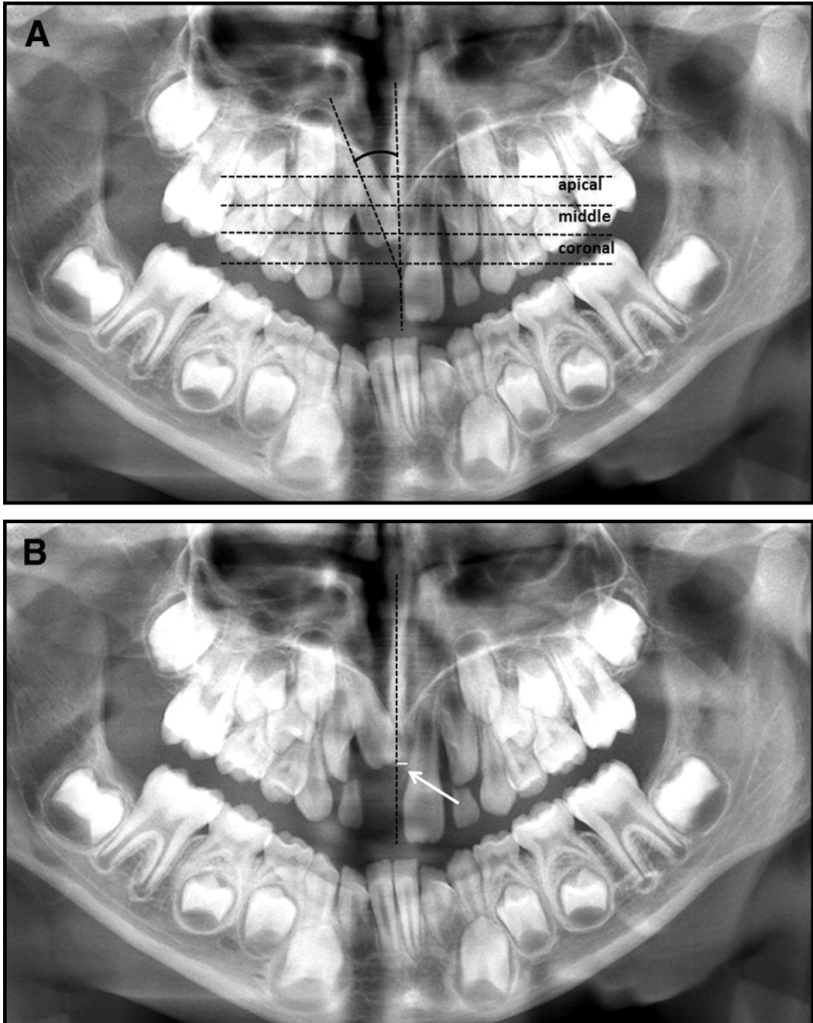
| Stage | Name | Duration | Notes |
|---|
| T1 | Leveling + Space Opening | ~5 months | Brackets + wires party begins 🎉 |
| T2 | Traction | ~9 months | Pull that bad boy down! ⛓️ |
| T3 | Finishing | ~8 months | Align, torque, upright — orthodontic polish time ✨ |
🎯Factors That Really Mattered
1️⃣ Etiology
- Biggest game-changer! Dilacerated incisors = longer treatment, more chance of failure. 🚩
- Obstructive impactions fared much better (P = 0.02)
2️⃣ Initial Height
- Higher up the tooth, longer the rescue mission (especially T2 stage). ⏳
3️⃣ Age
- Older = longer finishing time (T3). Teen angst, but in tooth form.

 Dentowesome