What Even Is Biomechanics?
“It’s physics, but with ✨life✨!”
- Science: Biomechanics = Bio (living stuff) + Mechanics (forces, motion, and “why things break”).
- Ortho Version: How to bully teeth into moving using braces, wires, and your ✨sheer willpower✨.
- Translation: Imagine teeth are stubborn goats. Biomechanics is the GPS 🗺️ and carrot 🥕 combo that herds them into place.
Force: The OG Tooth Mover 🏋️♂️
“Push, pull, or yeet—force gets the job done.”
- Force 101: A vector (fancy for “GPS direction + muscle”). Needs:
- Magnitude: How hard you push (e.g., 50g = gentle nudge 👆, 500g = “I WILL MOVE THIS TOOTH TO NARNIA” 🦁).
- Direction: Where you push (up, down, sideways, or “let’s rotate this incisor like a DJ” 🎧).
- Point of Application: Where you attach the force (bracket = bullseye 🎯).
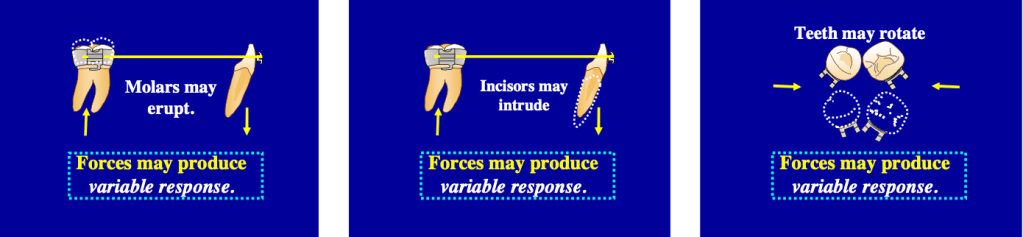

Active Elements: The Tools of Chaos 🔧🌀
“Archwires, springs, elastics—oh my!”
- Archwires: The “bossy big sibling” of braces. Bend them, and they’ll fight back to straighten out (like a grumpy slinky 🌀).
- Springs: The undercover agents 🕵️♂️. Coiled, sneaky, and ready to boing teeth into position.
- Elastics: Rubber bands of doom. Stretch them between teeth like a tiny WWE ring 🥊.
Force Types:
- Tension: Stretching elastics = “COME HERE, TOOTH!” 🙌
- Compression: Squishing springs = “MOVE, TOOTH!” 👊
- Bending/Torsion: Twisted wires = “I’ll make you rotate in style!” 💃
Combining Forces: Teamwork or Chaos? 🤝💥
“Two forces walk into a bar…”
- Parallel Forces: Besties holding hands 👯. Example: Twin headgear straps pulling molars back.
- Non-Parallel Forces: Frenemies fighting 😤. Example: One spring pushing up, another pulling down = tooth confusion 🤯.
Golden Rule:
If forces don’t cancel out, anchorage saves the day (aka, anchor teeth = the gym buddy spotting you 🏋️♀️).
No anchorage? Congrats, you just moved ALL the teeth… and maybe the patient’s face. 😱
Why Grams > Newtons 📏🍔
“Orthos don’t do rocket science… unless it’s molar rockets.”
- Science: Force = mass × acceleration (F=ma). But teeth move slowly, so acceleration ≈ Netflix binge speed 🐌.
- Ortho Hack: Ignore physics class. Use grams (mass) instead. 1 Newton ≈ 100g (or “the weight of a hamster” 🐹).

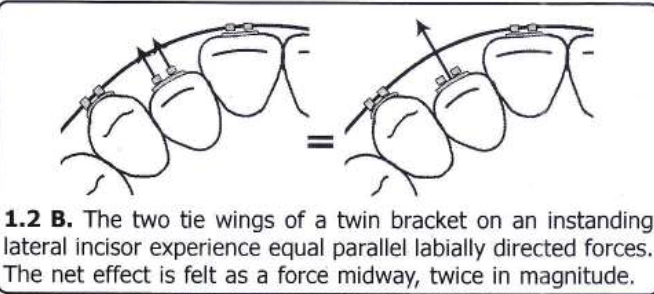
Parallel Forces: The “Double Trouble” Technique
“Two pushes > one push. Basic math.”
Scenario: Twin edgewise brackets on a tooth (like a twin-engine plane ✈️).
Science: Two equal, parallel forces in the same direction = combined force acting at the midpoint.
Example: Pushing a tooth labially from both tie wings = net force at the center (💥).
Why Care? Twin brackets = double the power without drama.
Force Couples: The Tooth Rotator 9000 🔄
“Push one side, pull the other. Chaos ensues.”
- Force Couple: Two equal, parallel, but opposite forces (non-colinear).
- Example: Rotating a tooth → one tie wing gets pushed, the other pulled (like twisting a jar lid 🍯).
- Pro Tip: If forces are colinear (same line), they cancel out. Boring. Non-colinear = tooth spins like a Beyblade.

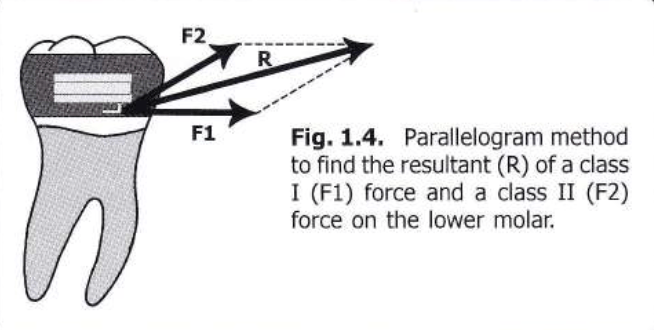
Non-Parallel Forces: The Parallelogram Party 📐🎉
“Forces going wild? Draw a parallelogram!”
- Resultant Force: The diagonal of the parallelogram tells you where the tooth will move.
- Example: Class I + Class II forces on a molar → diagonal = tooth’s escape route 🏃♂️.
- Law of Transmissibility: Slide forces along their line of action to make them meet (like sliding DMs to your crush 💌).

Breaking Down Forces: The “What’s the Damage?” Move 🔍
“One force, two effects. Ortho magic!”
- Resolving Forces: Split a single force into horizontal (retraction) and vertical (extrusion) components.
- Example: Class II elastic → 70% retraction 😬, 30% extrusion 🦷.
- Pro Hack: Use right angles for easy math (thanks, rectangles! 📏).
Multiple Forces: The Ortho Jenga Game 🧩
“Combine forces like a DJ mixes beats.”
- Combine two forces → find the resultant.
- Combine that resultant with the third force.
- Repeat until you’ve tamed all forces.
- Real Life: Headgear + distalizing spring = controlled chaos 🤯.
What’s the Big Deal with C.Res?
“It’s the GPS for moving teeth. Miss it, and you’re lost.”
- C.Res = Tooth’s Boss: Imagine it’s the puppet master 🧙♂️ pulling strings. Where you apply force relative to C.Res decides if the tooth tips, intrudes, or does a cha-cha slide 💃.
- Not the Center of Mass!
- Center of Mass: For free bodies (like a tooth flying through space 🚀).
- C.Res: For teeth stuck in bone (thanks, PDL! 🦴). Think of it as the tooth’s “democratic leader” swayed by bone, gums, and angry collagen fibers.
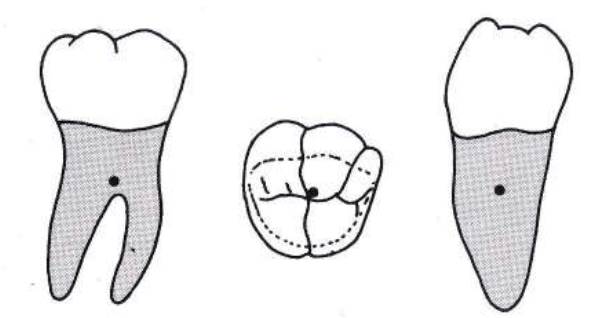
Where is C.Res Hiding? 🕵️♂️
Depends on the tooth’s roots and drama level:
- Single-rooted teeth (incisors/canines):
- Location: Between alveolar crest & root apex.
- Debate Alert: Some say 50% root length 🎯, others 25-33%
- Multi-rooted teeth (molars):
- Location: Near the furcation (where roots split).

Pro Tip:
- Healthy PDL = C.Res stays put.
- Loose PDL/root resorption = C.Res shifts (like a politician changing sides 🏃♂️).
Force vs. C.Res: The Tooth Movement Rules
How you push/pull determines the tooth’s dance moves:
- Force THROUGH C.Res (direct hit 🎯):
- Result: Pure translation (tooth moves straight, no tilt).
- Example: Intruding incisors with force at C.Res (like pressing an elevator button 🛎️).
- Force AWAY from C.Res (off-target 💥):
- Result: Tipping (crown moves one way, root the other).→ crown flares, root digs in 😬.
- Force Couple (Two Opposing Forces) 🔄:
- Result: Pure rotation (tooth spins like a Beyblade).
Why C.Res Changes Over Time ⏳
Teeth age like milk, not wine:
- Root Resorption: Short roots → C.Res moves apically (closer to the tip).
- Bone Loss: Weak PDL → C.Res shifts unpredictably (like a GPS glitch 🗺️).
- Connected Teeth: Splint teeth? Their C.Res merges into a mega-C.Res (Avengers assemble! 🦸♂️)
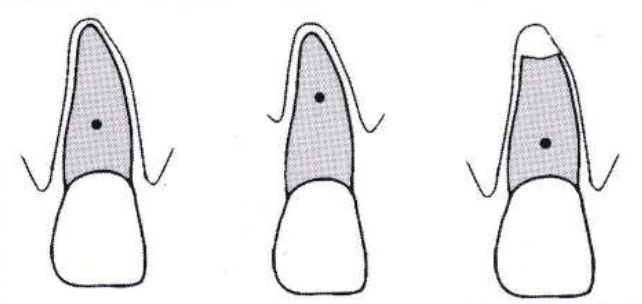
3D C.Res: Don’t Be a Flat-Earther 🌍
Teeth exist in 3D. Plan forces accordingly!
- Occlusal View: C.Res = Along the long axis.
- Facial/Lingual View: Between alveolar crest & apex (single-root) or furcation (molars).
- Proximal View: Same as facial/lingual.

 Dentowesome