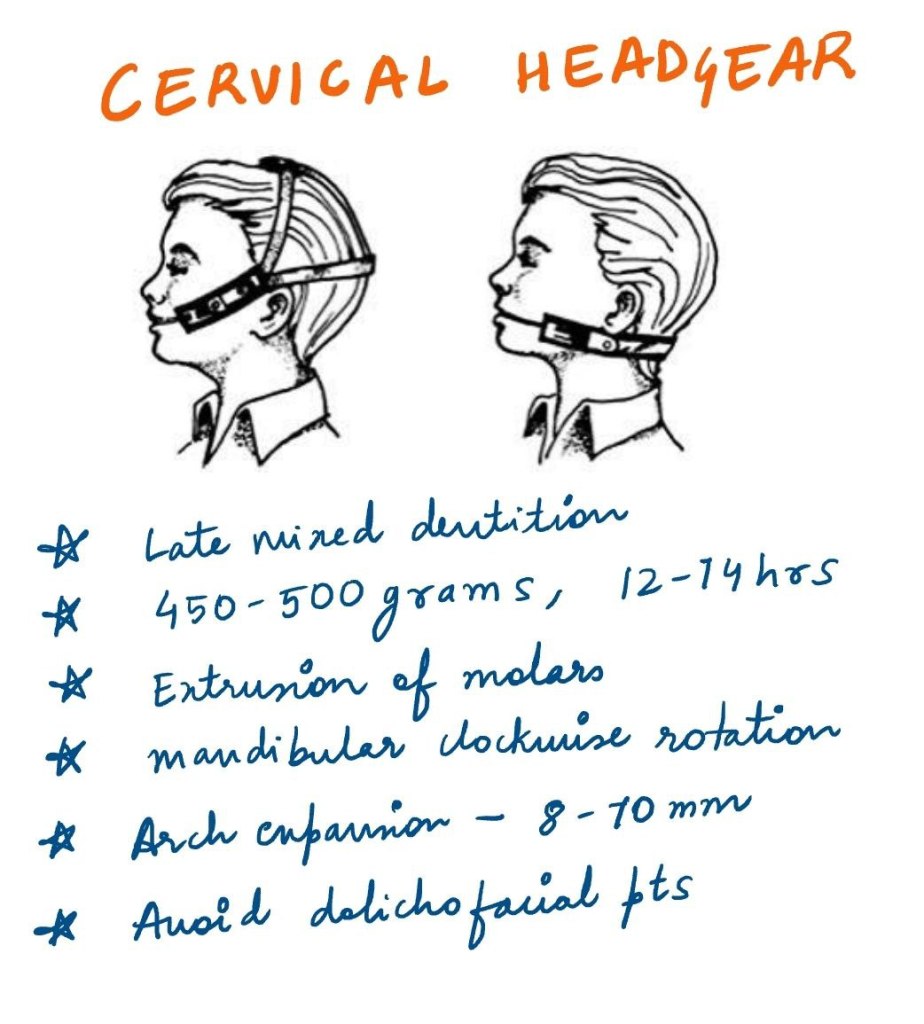
Treating Class II malocclusion can be a challenging endeavor due to the diverse range of appliances available and the complexity of dental and skeletal relationships between the maxilla and mandible. To simplify the analysis and ensure consistent outcomes, studies focusing exclusively on cervical headgear have provided valuable insights.
Why Cervical Headgear?
Cervical headgear is like the Swiss Army knife of Class II malocclusion treatment. Its efficacy, however, depends significantly on when you start using it. Research suggests that the late mixed dentition or the onset of permanent dentition is the orthodontic equivalent of “prime time.” With a force of 450 to 500 grams on each side—basically the weight of a small apple—the appliance works best when worn for 12 to 14 hours daily. Yes, that’s half a day, so patients need to be as committed as a coffee addict to their morning brew.
Effects of Cervical Headgear on Molar Position and Bite
One notable effect observed in studies is the extrusion of maxillary first molars, a phenomenon first described in the 1970s. Think of it as the molars getting a little too excited and rising up—like bread dough, but less tasty. This leads to bite opening and an increase in vertical parameters, which can be a problem for dolichofacial patients with long faces. Adding height to an already tall face is like putting a top hat on a giraffe—probably not the best idea. However, with careful management, even vertical growers can benefit from this appliance.
Mandibular Rotation and Vertical Changes
Molar extrusion also causes mandibular clockwise rotation, leading to an increase in the mandibular plane angle. This backward rotation is well-documented, and while it’s not ideal, it’s not the end of the world either. After all, even the best orthodontic plans can sometimes feel like trying to herd cats—challenging but ultimately rewarding.
Arch Expansion and Alignment
Cervical headgear also moonlights as a gentle expander of the upper arch, introducing an 8 to 10 mm expansion in the inner bow. This expansion helps align maxillary teeth and the mandibular arch to follow suit. It’s like getting a BOGO deal on alignment—who doesn’t love that? These changes create excellent conditions for the mandible to grow to its full potential, making Class II correction a reality.
Maxillary Repositioning and Overjet Correction
Another party trick of cervical headgear is improving the maxillomandibular relationship. By restricting forward and downward maxillary displacement, it lets the mandible grow normally, compensating for the initial overjet. It’s like giving the mandible a chance to shine on the orthodontic stage—finally, the underdog gets its moment.
Key Takeaways for Orthodontic Students
- Timing Matters: Initiate treatment during late mixed dentition or early permanent dentition for optimal results.
- Patient Selection: Avoid using cervical headgear in dolichofacial patients with extreme vertical growth patterns.
- Appliance Effects: Understand the implications of molar extrusion, mandibular rotation, and vertical parameter changes.
- Comprehensive Benefits: Leverage the appliance’s ability to expand arches, improve alignment, and enhance the maxillomandibular relationship.
Cervical headgear remains a cornerstone in the treatment of Class II malocclusion. By mastering its application and understanding its effects, orthodontic students can achieve predictable and effective outcomes in their clinical practice.
Ortho Pan India Whatsapp Group 🙂

 Dentowesome