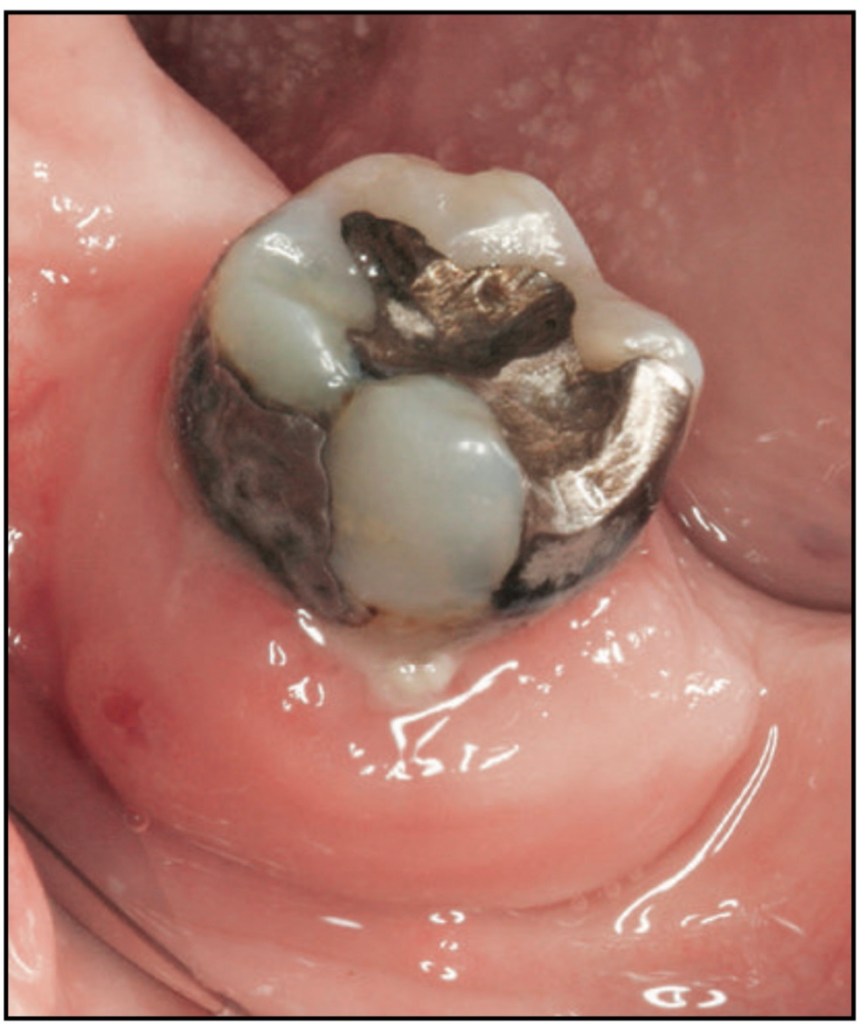
When Bad Breath Signals Trouble: A Case of Mandibular Molar Abscess
The patient is a 65-year-old man complaining of oral malodor. His dentist referred him to you to access the mandibular right second molar because of swelling, pus, and soreness. When he sits in your chair, he seems disoriented and irritable.When you look in his mouth, you find generalized inflammation of the gingiva and an abscess on the buccal aspect of the mandibular right second molar with suppuration. Charting demonstrates an 8-mm facial pocket and 6-mm palatal and interproximal pockets.
Q: What is your diagnosis of the patient?
Medical:
There are a number of reasons for the patient to appear dazed and irritable:
- Hypoglycemia or hyperglycemia
- Alcohol or drug overdose
- Hyperthyroidism or hypothyroidism
- Cerebrovascular incident
Dental:
- The patient may have diabetes mellitus–associated gingivitis related to the endocrine system, under the heading of gingival diseases modified by systemic diseases, which is a subcategory of dental plaque–induced gingival diseases.
- The patient has a periodontal abscess, which is a subclassification of abscesses of the periodontium.
Q: What could have led to the abscess formation?
- Diabetes: According to Bjelland et al,18 multiple periodontal abscesses may result from uncontrolled hyperglycemia. Rees19 listed multiple or recurrent periodontal abscesses among the possible indications of undiagnosed or poorly controlled diabetes mellitus.
- The abscess may also be caused by a preexisting periodontal pocket in association with bacteria at the depth of the pocket.
- A foreign body can also cause a periodontal abscess.
Q: How will you treat the periodontal abscess?
- I would ask the patient if he has seen his physician recently and whether he knows his hemoglobin A1c levels to determine if the abscess may be associated with diabetes (only his medical doctor can make that diagnosis).
- An incision at a 90-degree angle to the long axis of the tooth will drain the exudate.Without removal of the cause (foreign body, bacteria, or calculus), the abscess will recur. If this is not possible, extraction might be necessary.
- Antibiotics and analgesics should be prescribed. A follow-up with a dentist is also needed.
- Saline Rinse: Advise warm saline rinses to reduce discomfort and promote healing.
Dentowesome | @dr.mehnaz

 Dentowesome