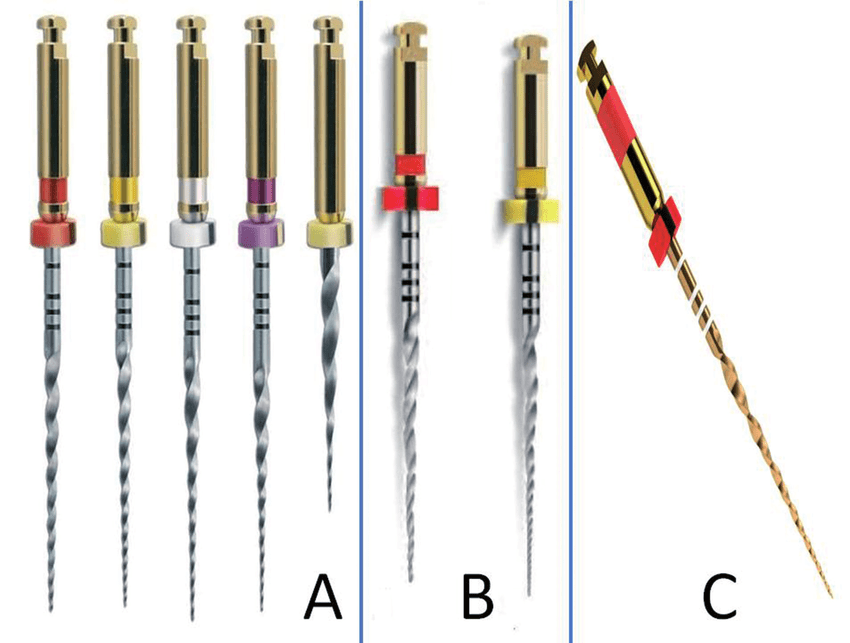
Fracture strength of roots instrumented with ProTaper Universal, ProTaper Next, and ProTaper Gold systems has been the subject of several studies. These studies have evaluated the influence of different factors on the quality of root canal preparation and the incidence of instrument fractures.
Duque et al. (2017) took a deep dive into the influence of NiTi wire in these systems on root canal preparation quality. Spoiler alert: it matters! 🧐
One study by Duque et al. (2017) aimed to evaluate the influence of the NiTi wire in ProTaper Universal (PTU) and ProTaper Gold (PTG) instrument systems on the quality of root canal preparation. The study used high-definition microcomputed tomography to scan twelve mandibular molars with separate mesial canals. The PTU and PTG instruments were used to shape twelve mesial canals each. The canals were scanned after preparation with F2 and F3 instruments of the PTU and PTG systems. The study found that the NiTi wire in both systems had an influence on the quality of root canal preparation.
Machado et al. (2018) did some detective work, analyzing when and where instrument fractures occurred. Surprise, surprise – operator experience played a role! 👨⚕️🔍
Another study by Machado et al. (2018) retrospectively analyzed the incidence of ProTaper Universal System instrument fractures. The study analyzed charts, clinical record cards, and radiographs of endodontic treatments performed using the ProTaper Universal System. The study found a low incidence of instrument fractures and identified the arch, group of teeth, and root thirds in which these fractures occurred.
In a similar study by (Machado et al., 2018), the incidence of ProTaper Universal System instrument fractures was evaluated in relation to the arch, group of teeth, and root thirds. The study aimed to evaluate the null hypothesis that complexity results in greater rotary flexure of the instrument, thereby concentrating the forces of stress that may cause premature failure of the NiTi alloy.
Analyzing the incidence of fracture of ProTaper Universal System instruments, Machado et al. (2018)found that the experience of the operators was one of the main reasons associated with higher instrument fracture rates. The study compared the fracture rates with previous studies and identified the operators’ experience as a contributing factor.
Siddique et al. (2020) went into battle against bacteria, testing these systems for their antibacterial prowess. XPendo Shaper emerged as the hero! 🦠💪
Siddique et al. (2020) conducted a clinical trial to compare the antibacterial effectiveness of three rotary file systems, including ProTaper Next, ProTaper Gold, and XPendo Shaper. The study used real-time polymerase chain reaction to evaluate the antibacterial effectiveness in root canals of teeth with asymptomatic apical periodontitis. The study found that XPendo Shaper showed better intracanal bacterial reduction than ProTaper Gold.
In another study by (Siddique et al., 2020), the effectiveness of ProTaper Next in bacterial reduction was affirmed by various in vitro studies. The study compared ProTaper Next with other file systems and found that ProTaper Next had higher bacterial reduction than Twisted file, ProTaper Universal, and manual techniques.
Milani et al. (2022) tested the resilience of teeth prepared with these systems and found that they didn’t all hold up the same. Different strokes for different folks, or in this case, teeth! 😬💥
The fracture resistance of roots prepared with ProTaper Universal, ProTaper Next, and ProTaper Gold rotary files was compared in a study by (Milani et al., 2022). The study evaluated the fracture resistance of fifty-six single-canal premolar teeth prepared with the three file systems. The study found differences in the fracture resistance of the teeth prepared with the different file systems.
Devi et al. (2021) looked for cracks induced by these systems during root canal prep. ProTaper got caught red-handed causing cracks in 25% of cases! 😱
Devi et al. (2021) conducted an in vitro study to assess dentinal defects induced by ProTaper Universal, ProTaper Gold, and Hyflex electric discharge machining (EDM) rotary file systems during root canal preparation. The study observed cracks in 25% of the roots instrumented with ProTaper at the apical root surface. The study compared the incidence of dentinal microcracks resulting from the use of different file systems.
Miguéns-Vila et al. (2017) inspected micro-cracks caused by ProTaper NEXT and ProTaper Universal and found that the control group had squeaky-clean roots! 😁🔍
The incidence of dentinal micro-cracks resulting from the use of ProTaper NEXT and ProTaper Universal systems was evaluated in a study by (Miguéns-Vila et al., 2017). The study used LED transillumination to analyze dentinal micro-crack formation at different points in the root canal. The study found no root defects in the control group.
Yusufoğlu et al. (2019) compared fracture resistance after using ProTaper and One Shape systems, showing that round cross-sectioned root canals are less likely to break a sweat! 💪🦷
The fracture resistance of roots enlarged with ProTaper and One Shape rotary systems was compared in an in vitro study by (Yusufoğlu et al., 2019). The study evaluated the fracture resistance of roots filled with different sealers. The study found that a round cross-sectioned root canal resulted in more homogeneous stress distribution and increased fracture resistance.
Agrawal et al. (2022) put these systems to the fatigue test, with Hyflex EDM emerging as the Iron Man of files! 🦾💥
Agrawal et al. (2022) conducted a study to compare the fracture resistance of Hyflex EDM, Neolix Neo NiTi, ProTaper Next, and ProTaper Gold files. The study evaluated the cyclic fatigue resistance of the different file systems and found that Hyflex EDM OneFile instruments showed greater cyclic fatigue resistance than ProTaper Gold Primary instruments, as well as ProTaper Next and Neolix NiTi.
In conclusion, several studies have evaluated the fracture strength of roots instrumented with ProTaper Universal, ProTaper Next, and ProTaper Gold systems. These studies have examined factors such as the influence of the NiTi wire, incidence of instrument fractures, antibacterial effectiveness, dentinal defects, and fracture resistance. The results of these studies provide valuable insights into the performance and characteristics of these rotary file systems.

 Dentowesome