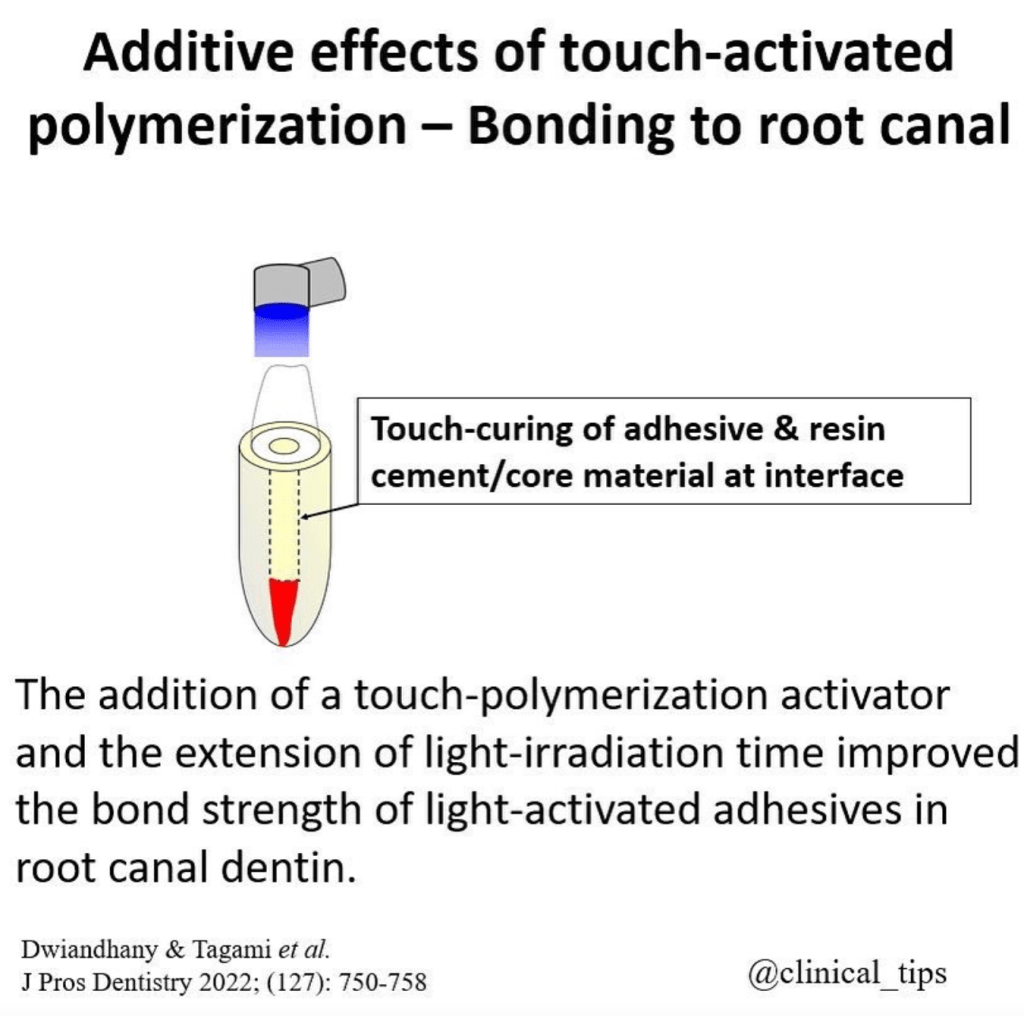
Additive effects of touch activated polymerization have been studied in the context of bonding to root canal dentin. Studies have shown that stresses from polymerization shrinkage and problems with adequate access to the root canal complicate the formation of high-strength bonds when cementing endodontic posts with resin cements [1].
The effects of different bonding systems with various polymerization modes and root canal regions on the bond strength of core build-up resin composite to dentin have also been investigated [2][4].
The interaction of geometrically related factors predicts that bonding of adhesive root-filling materials to root canals is highly unfavorable when compared with indirect intracoronal restorations with a similar resin film thickness [3].
Resin cement polymerization results in shrinkage, creating micro gaps between the fiber-reinforced composite (FRC) posts and the root canal wall [7].
The BS of fiber posts to root canals can be improved by soft-started polymerization [6].
The effect of composite post placement and/or light-irradiation of dual-cure resin composite on adhesion to root canal dentin using the chemical activation mode of a 1-step self-etch dual-cure adhesive has also been evaluated [8].
The activity of matrix metalloproteinases (MMPs) following endodontic irrigation protocols and correlation to the push-out bond strength (PBS) and nanoleakage expression (NL) in the root dentin have been studied [9].
Finally, the mechanical properties of the bonding agent, which could be enhanced by adequate polymerization, have been shown to affect the bond strength to root canal dentin [10].
[1] (2003). Microtensile bond strength between adhesive cements and root canal dentin. Dental Materials, 3(19), 199-205. https://doi.org/10.1016/s0109-5641(02)00030-1
[2] (2021). Effects of different bonding systems with various polymerization modes and root canal region on the bond strength of core build-up resin composite. J Prosthodont Res, 4(65), 521-527. https://doi.org/10.2186/jpr.jpr_d_20_00251
[3] (2005). Geometric Factors Affecting Dentin Bonding in Root Canals: A Theoretical Modeling Approach. Journal of Endodontics, 8(31), 584-589. https://doi.org/10.1097/01.don.0000168891.23486.de
[4] (2021). Effects of different bonding systems with various polymerization modes and root canal region on the bond strength of core build-up resin composite. J Prosthodont Res, 4(65), 521-527. https://doi.org/10.2186/jpr.jpr-d-20-00251
[5] (2020). Novel Bioactive and Therapeutic Root Canal Sealers with Antibacterial and Remineralization Properties. Materials, 5(13), 1096. https://doi.org/10.3390/ma13051096
[6] (2017). Is the bonding of self-adhesive cement sensitive to root region and curing mode?. J. Appl. Oral Sci., 1(25), 2-9. https://doi.org/10.1590/1678-77572015-0430
[7] (2020). The Effects of Differences in Post Canal Widths on Microleakage in Prefabricated Fiber Reinforced Composites. sod, 2(5), 1-8. https://doi.org/10.28932/sod.v5i2.2432
[8] (2010). Effect of composite post placement on bonding to root canal dentin using 1-step self-etch dual-cure adhesive with chemical activation mode. Dent. Mater. J., 6(29), 642-648. https://doi.org/10.4012/dmj.2010-006
[9] (2022). In Situ Zymography Analysis of Matrix Metalloproteinases Activity Following Endodontic Irrigation Protocols and Correlation to Root Dentine Bond Strength. Polymers, 17(14), 3567. https://doi.org/10.3390/polym14173567
[10] (2005). Regional Bond Strength of Four Self-etching Primer/Adhesive Systems to Root Canal Dentin. Dental Materials Journal, 2(24), 261-267. https://doi.org/10.4012/dmj.24.261

 Dentowesome