

TYPES OF RME APPLIANCES:

• The first premolars and the first molars are banded.
• Wire tags are soldered onto the palatal aspect of the bands.
• These wire tags get inserted into a split palatal acrylic plate incorporating a screw at its centre.
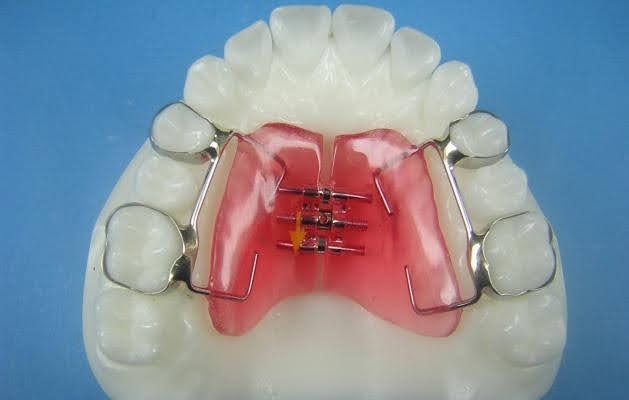
• The first premolar and molar of either side are banded.
• A thick stainless steel wire of 1.2 mm diameter is soldered on the buccal and lingual aspects connecting the premolar and molar bands.
• The lingual wire is kept longer so as to extend past the bands both anteriorly and posteriorly. These extensions are bent palatally to get embedded in the palatal acrylic.
• The split palatal acrylic has a midline screw.
• The plural does not extend over the rugae area.

• This is a tooth borne appliance without any acryl palatal covering.
• This design makes use of a spring loaded screw called a MINNE expander (developed at the University of Minnesota, Dental School).
• The first premolars and molars are banded.
• Metal flanges are soldered onto the bands on the buccal and lingual sides.
• The expander consists of a coil spring having a nut that can compress the spring.
• This coil spring is made to extend between the lingual metal flanges that have been soldered.
• The expander eactivated by closing the nut so that the spring gets compressed.

• This type of appliance makes use of a special type of screw called HYRAX (Hygienic Rapid Expander).
• The screws have heavy gauge wire extensions that are adapted to follow the palatal contour and are soldered to bands on premolars and molars.


REFERENCES:
- Orthodontics: The Art & Science, SI Bhalajhi (7th Edition)
- ResearchGate
- Slideshare
- accutechortho.com

 Dentowesome