Written by – Dr.Urusa I Inamdar
In 1864, S.C. Barnum, introduced the rubber dam into dentistry. It is used to define the operating field by isolating one or more teeth from the oral environment. The dam eliminates saliva from the operating site and retracts the soft tissue.
Advantages
- A dry and clean operating field
- Improved access and visibility
- Potentially improved properties of dental materials
- protection of the patient and operator
- Operating efficiency
Disadvantages
Time consumption and patient objection are the most frequently quoted disadvantages of the rubber dam.
Certain oral conditions may preclude the use of the rubber dam , these include :
- Teeth that have not erupted sufficiently to support a retainer
- Some third molars
- Extremely malpositioned teeth
In addition, patients suffering from asthma may not tolerate the rubber dam if breathing through the nose is difficult. Latex allergy.
However, latex free rubber dam material is currently available.
Materials
- Holder
- Retainer
- Punch
- Retainer forceps
- Napkin
- Lubricant
- Modeling compound
- Anchors
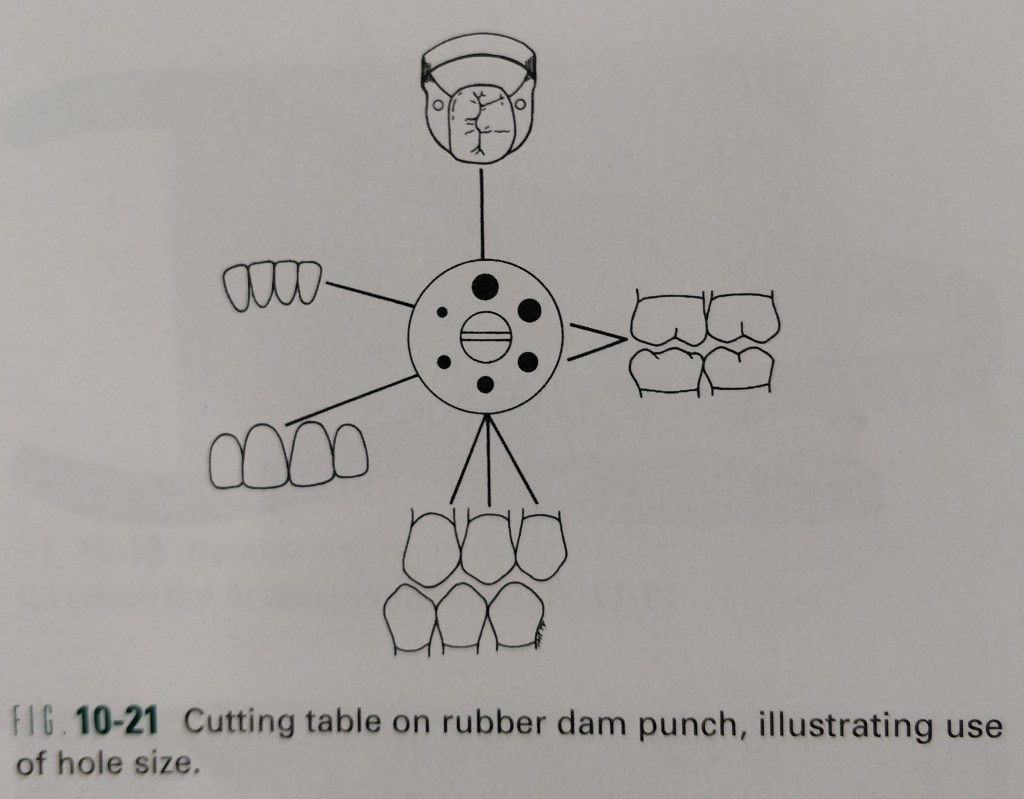
Hole size and position
Placement
- Testing and lubricating the proximal contacts.
- Punching the holes.
- Lubricating the dam.
- Selecting the retainer.
- Testing the retainers stability and retention.
- Positioning the dam over the retainer.
- Applying the Napkin.
- Positioning the Napkin.
- Attaching the frame.
- Attaching the neck strap ( optional )
- Passing the dam through posterior contact.
- Applying low fusing modelling compound ( optional )
- Applying the anterior anchor ( if needed)
- Passing the septa through the contacts without tape.
- Passing the septa through the contacts with tape.
- Inverting the dam interproximally.
- Inverting the dam faciolingually.
- Using a Saliva ejector ( optional )
- Confirming a properly applied rubber dam .
- Checking for access and visibility.
- Inserting the wedges.
Removal
- Cutting the septa.
- Removing the retainer.
- Removing the dam.
- Wiping the lips.
- Rinsing the mouth and massaging the tissue.
- Examining the dam.
Alternate / additional methods and factors
The procedure just detailed describes the method of sequentially placing the retainer and rubber dam on the anchor tooth.
- Applying the dam and retainer simultaneously.
- Applying the dam before the retainer.
- Cervical retainer placement.
- Fixed bridge isolation.
- Substitution of a retainer with a matrix.
Errors in application and removal
- Off center arch form
- Inappropriate distance between the holes
- Incorrect arch form of holes
- Inappropriate retainer
- Retainer pinched tissue
- Shredded or torn dam
- Incorrect location of hole for class v lesions
- Sharp tips on no. 212 retainer
- Incorrect technique for cutting septa
Reference:
Sturdevant’s – Art and science of Operative Dentistry (4th edition)

 Dentowesome