🔹 Aims:
- Limiting pathogen growth & metabolism.
- ⬆️ resistance of tooth surface.
- Caries control methods.
🔹 Levels of Prevention:

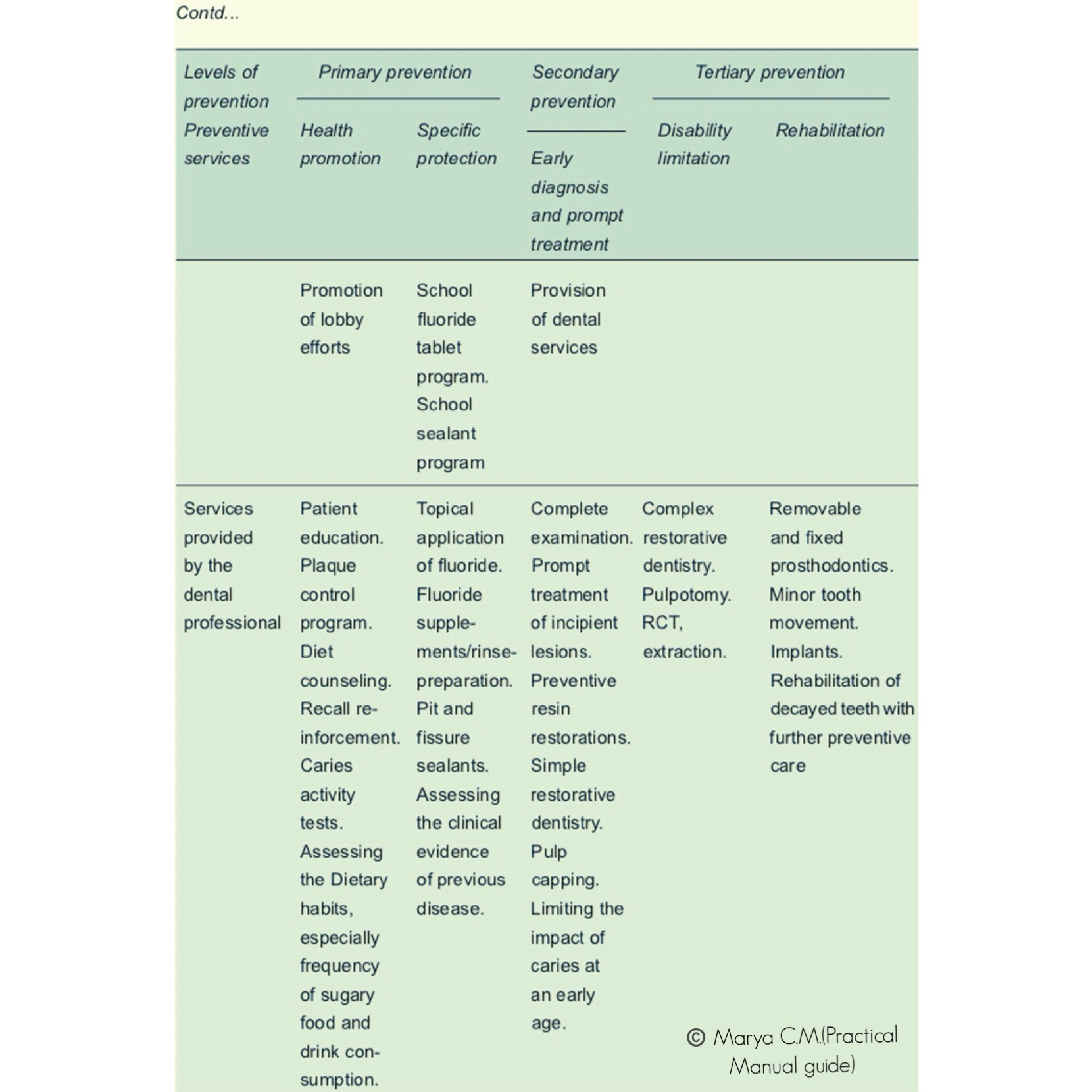
🔹 Prevention Include:-
- Improving Oral Hygiene
- Diet Modification
- Salivary Stimulants
- Flouride application
- Pit & Fissure sealants
- Antibiotics
- Laser
Key’s Triangle
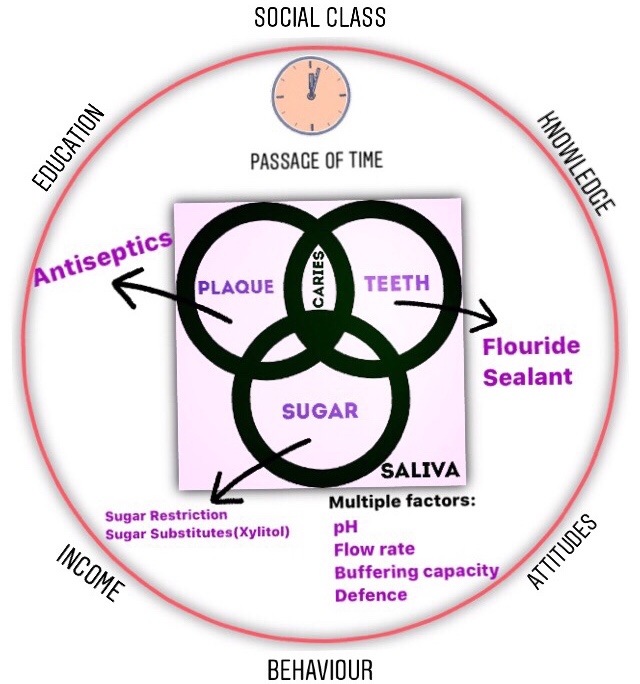
1. BY IMPROVING ORAL HYGIENE:
🔹 Oral hygiene procedures:
- Tooth Brushing
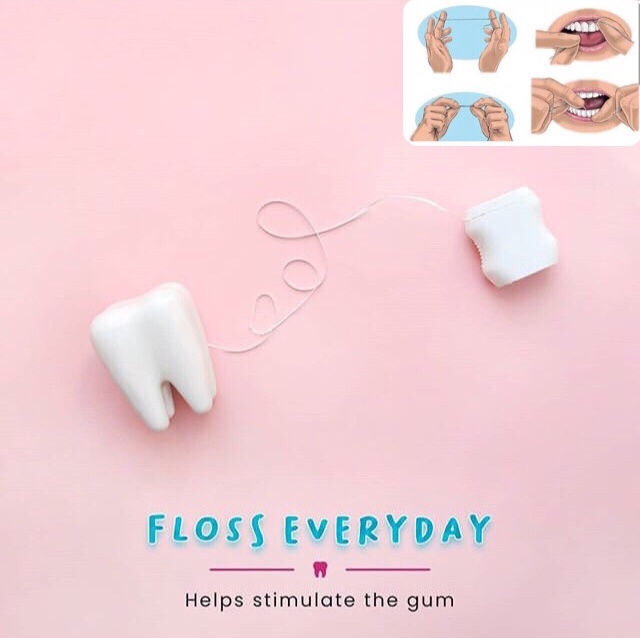
- Flossing
- Oral prophylaxis

Lubricate your brush with a small amount of water. Put a small amount of toothpaste about the size of a pea on the head of the toothbrush.
Learn Correct Brushing Technique:

1. Insert the toothbrush into your mouth an about 45-degree angle to your gums. Gentle circular motions clean better & avoid wear on teeth and gums!
2. Brush the outside surface of the teeth, making sure to get the back molars & upper area of your chewing surfaces.
3. Flip the toothbrush upside down to get the inside surface of your top front teeth. Flip it back around to get the inside surface of your bottom front teeth.


Q & A (Common questions)
Q.1 How often should I get my teeth cleaned?
Some people are at higher risk of getting dental cavities or gum disease – and this group should get their teeth cleaned more often once every 6 months or a year!
Q.2 Which Toothbrush?
Soft-bristle toothbrush, small heads are preferable as they can reach all areas of the mouth easily.
Q.3 Which toothpaste?
Always use a flouridated toothpaste.
Q.4 How much time to brush?
Brush altleast 2-3 min.,twice daily(In the morning & at bedtime)
Toothbrush dimensions (ADA specification for acceptable toothbrushes are as follow)
- Length: 1-1.25 inches.
- Width: 5/16-3/8 inches.
- Surface area: 2.54-3.2 cm
- 2 – 4 rows of bristles
- 5 to 12 tufts per row
- 80-85 bristle per tuft
Diameter of bristles are:
- Soft: 0.007 inch (0.2mm)
- Medium: 0.012 inch (0.3 mm)
- Hard: 0.014 inch (0.4mm)
🔹 Toothbrush Selection:
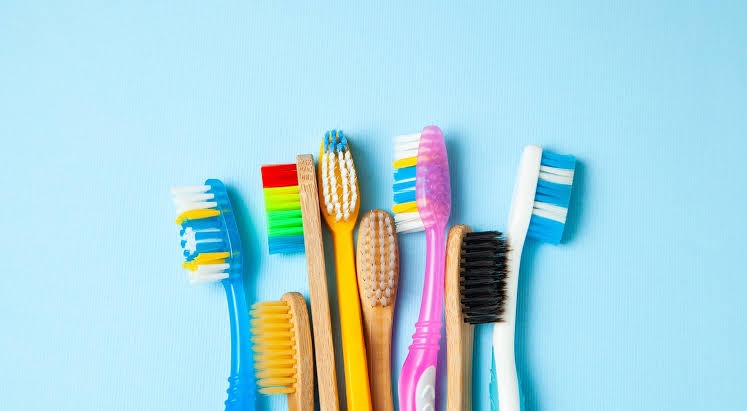
- Ability of the patient
- Manual dexterity of the patient (Power Vs. Manual)
- Age of the patient
- Size & shape
- Professional Personnel
- Soft nylon brush preferrable (Tooth abrasion or gingival recession can be prevented)
🔹 Care of toothbrushes
WE ALL USE TOOTHBRUSHES to take care of our teeth, but what are we doing to take care of our toothbrushes? It’s critical that our toothbrushes remain in good condition so they can do their jobs of keeping our teeth healthy. Here are few checklists👇🏻
1) Cleaning Your Toothbrush
➡️ Running your toothbrush under water and giving it a good shake won’t do much to get rid of all the germs you just brushed off your teeth, especially if you’ve recently battled the flu or a cold. Luckily, there are a few ways to deep-clean your toothbrush. Boiling the bristles for a few minutes will kill any germs on them, as will soaking the toothbrush in mouthwash.
2) Toothbrush Storage Dos and Don’ts
Do you store your toothbrush with the bristles on the counter or shelf, in a toothbrush cover, or near your toilet? Don’t!
The best way to keep bacteria from growing on your toothbrush is to store it upright somewhere it can air out. It’s also a good idea to keep it well away from your toilet, and always put the lid down before flushing.
3) When To Replace Your Toothbrush
Replace once every 3 months
➡️ If the bristles on your brush are getting bent, worn, or frayed, it’s definitely time for a new one — particularly if they’re sticking out the wrong way, because that won’t do your teeth any good! Bristles need to be straight in order to reach all the places they should. Just as important: have they become discolored? You don’t want to brush your teeth with stained, dirty bristles!
🔹 Brushing Techniques
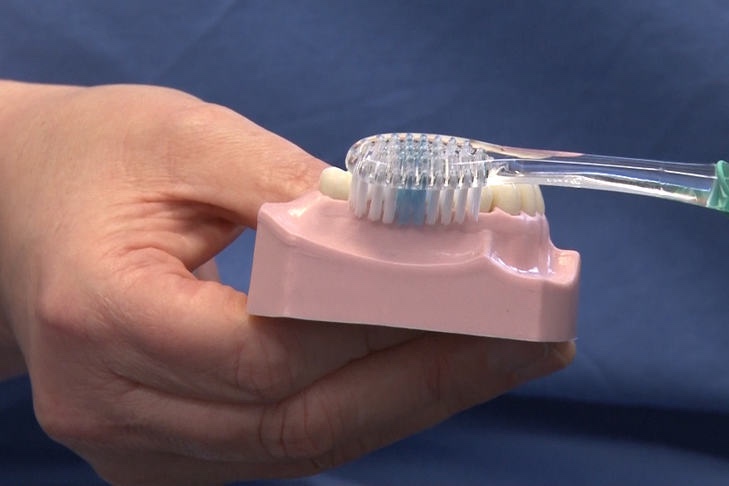
Tooth brushing techniques – this image shows the correct hold and toothbrush angle for the recommended BASS technique. © University of Sheffield
🔹 The best method is the one that is working for you, so don’t change your method (or your brush type) unless you are experiencing problems.
The ‘BASS’ Method (Sulcular)
➡️ Holding the toothbrush between fingers and thumb, place the bristles at a 45° angle to the teeth so that they point towards the junction of the tooth crown and gingiva (gum). By doing this the bristles can penetrate up to 3mm subgingivally (below the gum) in a healthy mouth, and even deeper into the pocket where periodontal disease is present. Once in the correct position, the head of the brush is vibrated in a small circular action. In order to clean the lingual surface of the anterior teeth, the toothbrush should be placed in a vertical position. The occlusal surface is brushed using the scrub technique.
The ‘SCRUB’
➡️ This technique is usually adopted by children or by adults who have not received any advice on tooth brushing, but should only be used by children or those with poor manual dexterity. The toothbrush is simply swept along the teeth backwards and forwards, often in long strokes, covering all the surfaces including the occlusal. The problem with this method is that abrasion cavities may be caused by over brushing certain areas and by being too heavy handed. To overcome this, change the grip from a palm grip to a finger grip, and use short movements covering one tooth at a time. The advantage of this method is that it is easy to follow.
The ‘CIRCULAR’ (Fones Method)
➡️ A technique recommended for young children, as it is easy to learn. Always use a soft toothbrush to avoid gingival damage. The teeth are closed together and with the toothbrush at 90° to the teeth, a small circular action is used covering the maxillary and mandibular posterior teeth. For the anterior teeth the incisors are placed edge to edge and the mouth is opened to clean the remaining surfaces. The occlusal surfaces are cleaned using the scrub technique.
The ‘ROLL’
➡️ With this technique the bristles are placed at the junction of the crown of the tooth and the gingiva (gums) pointing apically (towards the tooth roots). The head of the brush is then rotated upwards on the lower teeth and downwards on the upper teeth towards the occlusal surface. The occlusal surfaces are cleaned using the scrub technique. The advantage of this method is that pressure can be applied to the gingiva without causing gingival recession; however the disadvantage is that it does not clean subgingivally. This method is often shown to patients with recession, often combined with the BASS technique.
And there is also the ‘MODIFIED BASS’
➡️ Carried out exactly the same as the bass technique but at the end the operator uses the roll technique. This method can be used by someone who needs to clean subgingivally, but who also has some areas of gum recession.
How to brush babies’ and children’s teeth
This is not an easy task but it needs to be done on a regular basis! Parents need to clean the baby’s mouth after feeding, initially with something like a wet cotton bud and then when the first teeth erupt, with a soft baby’s brush and a smear of toothpaste containing no less than 1000ppm fluoride.
To clean children’s teeth, stand behind them or sit them on your knee. Tilt the child’s head back so you can see into their mouth. Gently but thoroughly clean all the surfaces of the teeth. When you have finished, let the child have a go with the toothbrush. If the child won’t open their mouth, place your fingers in the child’s mouth and very gently apply pressure at the back of the mouth behind the molars using your thumb and first finger, this should open the jaw with no discomfort to them. Children need to be helped or supervised by an adult when cleaning their teeth until the age of at least 7 and encouraged to spit out excess toothpaste and not rinse.
Interdental cleansing aids:
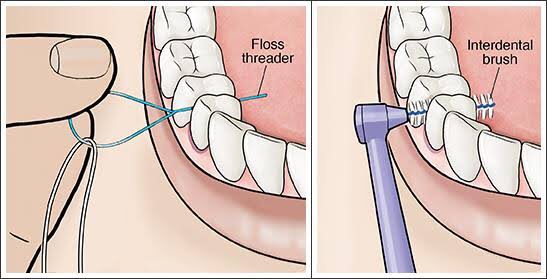
- Dental floss
- Wooden sticks
- Interdental brushes
- Single tufted brushes
🔹 Enameloplasty
- Fissure depth < 1/3 or 1/4 thickness of enamel
- Removal of shallow, developmental fissure/pit with flame shaped bur, smooth saucer shaped surface – self cleansing.
🔹 Dentifrices: Paste form, polishing agents, Desensitizing agents
🔹 Disclosing Agents
- Areas of plaque retention
- Used after toothbrushing
- Tablet/solution form
- Red dye most commonly used
- Two-tone dye: stains blue(mature plaque) & stains red (newly formed)
🔹 Chemical Methods
1) Substance which alter the surface of tooth structure:
- Flouride
- Iodide
- Bis-quanides
- Silver nitrate
- ZnCl
2) Substance which interfere with carbohydrate degradation viz. Vitamin K
3) Substance which interfere with bacterial growth & metabolism viz. Urea & Caries Vaccine
🔹 Chemical Agents for plaque control:
Chlorhexidine
- Helps in remineralization of incipient caries
- Mouth rinse at bed time for 2 weeks
- Prevents bacterial adhesion
🔹 Caries Vaccine
• First developed by Williams(1944) using a Lactobacillus vaccine
• Vaccine: A vaccine is a biological preparation that provides active acquired immunity to a particular infectious disease. A vaccine typically contains an agent that resembles a disease-causing microorganism and is often made from weakened or killed forms of the microbe, its toxins, or one of its surface proteins.
• Effective molecular targets for Vaccine development:
- GTF
- Wall associated proteins
- Adhesins
- Glucan binding protein
• Types of Vaccines:
- Recombinant Vaccines (Attenuated mutant vectors viz Salmonella)
- Conjugate (conjugation of protein with polysaccharide)
• Concerns:
- HCRA in S.Mutans which when injected to animals damage the heart.
- Precise timings & no. of injections not yet determined
- Longetivity of immune response – not yet known
• Nasal Vaccine – Newer approach (As Ab-producing factory that resides in body’s mucosal surfaces.
2) By diet modification:
Thinking About Another Sweet Gulp? Think Again!
-In addition to the sugar, there are acids in sweetened drinks that are also harmful to the teeth. These acids lead to dental erosion, or tooth wear.
Contd…Page 2👇🏻

 Dentowesome